Where customer emotion meets business reality
Empathy is practically a prerequisite for working in CX. You care about the customer, you want to understand what has gone wrong, help them feel heard and, ideally, find a resolution that leaves them feeling better than when they arrived.
But spend just a day working in CX and you realise there is another side to it.
The people who care the most are often the ones absorbing the most customer frustration. And when your instinct is to help, it can be hard to know where empathy should end and business reality should begin. Do you issue the refund? Send the replacement? Make an exception? CX agents are expected to make those judgement calls in emotionally charged moments, while still navigating policy, protecting margin and hitting their metrics.
That is where empathy gets messy.
In this episode of CX After Hours, Caroline ON Wilson, Director of CX at Carpe, joined hosts Anya Kelly and Guillaume Luccisano to talk about what happens when customer emotion meets business reality. The conversation moved through frontline burnout, refund boundaries, over-apologising, and one unexpected use of AI: helping agents create a little distance from emotionally charged conversations.
The bigger question running through it all was simple. How do you build a CX function that genuinely cares without asking your team, or your business, to absorb the cost of that care indefinitely?

Watch or listen to the full episode:
Apple Podcasts
Spotify
YouTube
Great CX is not 'maximum generosity'
The harder conversation starts when empathy influences the actual resolution.
CX people tend to be wired to make things right. A customer is upset, so you send the replacement. An order went badly, so you offer a refund. Our host Anya even admitted that when a particularly nice customer reaches out, her immediate reaction can be: what can I send you for free?
There is nothing inherently wrong with that instinct. Some of the best customer experiences happen when an agent is given enough freedom to do something unexpectedly generous.
The problem is when generosity becomes the default operating model.
Caroline describes the challenge as finding a 'Goldilocks zone' between protecting the human and protecting the business. There needs to be enough flexibility to make customers whole and save relationships, but enough friction that the team is not simply refunding left and right.
That is not the CX leader abandoning the customer. But a business that ignores its margins in the name of customer happiness eventually has a much bigger customer problem.
The interesting question is not whether a brand should be generous. It is where generosity actually changes the outcome. Take a high-LTV customer who contacts a brand because they have lost the lid to a water bottle. The company cannot ship an individual lid, so you send them a completely new bottle. That takes knowing what the product costs and what that customer has already spent with you. With that knowledge correctly applied, a relatively small commercial decision has a very good chance of creating an outsized moment of loyalty.
That is very different from a CX agent automatically refunding $1,600 on someone's second order because they feel uncomfortable saying no.
The context matters. What has this customer spent? What actually went wrong? Is this a moment where an exception could save the relationship? What happens after the replacement or refund?
Caroline's advice is to start tracking it. Look at why products are being replaced and refunds are being issued, the value of the customer involved, and what that customer does afterwards. Applied well, that context is what separates a considered resolution from a guess, the same discipline that lets an agent respond with accurate, context-rich answers rather than reacting on instinct.
CX has spent years arguing for the right to be more commercially involved in the business, and this is part of it. It is not enough to say that a generous resolution felt like the right thing to do. The strongest CX teams are learning where going above and beyond actually works.
Stop making every agent reinvent the decision
So how do you give agents room to make the water-bottle decision without creating a refund free-for-all?
This was where one of Caroline's strongest ideas came through: clarity is kindness.
In a badly designed CX operation, the policy technically exists, but the grey areas are everywhere. The agent reads the ticket and starts negotiating with themselves. Should I make an exception? Is this customer important enough? Will my manager back me if I refund this? Am I about to get questioned in QA?
Multiply that across hundreds of tickets and it becomes its own form of fatigue.
"When you set those guidelines out and you have those SOPs in place and you're very clear on when those exceptions should happen, there is not that emotional and mental fatigue of figuring out: should I make an exception? Should I not? Obviously in CX we're always trying to hire people who have that high EQ and can think on the fly and figure out those moments. But they shouldn't have to. That's your job."
Caroline goes on to talk about creating a 'container of safety'. The boundaries are clear enough that, inside them, agents can act with confidence.
Maybe there are customer tiers where a replacement is an immediate yes. Maybe an agent can refund up to a certain amount without approval. Maybe specific combinations of order value, customer history and issue type require escalation. Less experienced agents might spend more time on the predictable, binary questions that AI can resolve instantly, while experienced agents take the cases where there is more context to interpret.
None of this removes agency. It gives people the business context required to use it properly.
You can't put a human into an SOP
Of course, there is an obvious problem with all this talk about guidelines and SOPs: customers refuse to behave like neatly documented ticket categories.
You can map every scenario you have seen before and a customer will still find a new way to surprise you by Friday.
"The reality is we are in the work of dealing with humans. And a human cannot be put into an SOP."
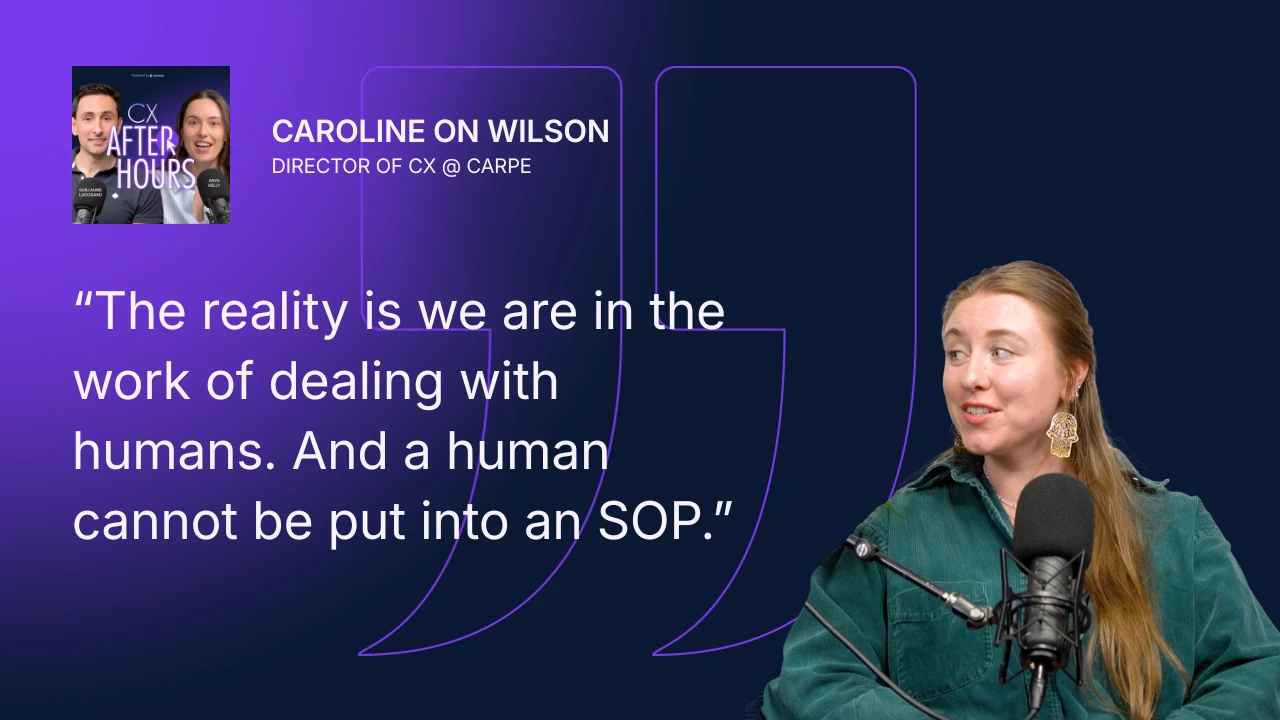
That is why Caroline's background in photojournalism and documentary storytelling feels surprisingly relevant to her approach to CX. She is interested in the subtext. What is someone actually saying underneath the words they have typed?
Sentiment is much harder to read than a red angry-face icon makes it look. An all-caps message might be an angry customer. It might also be someone who is not digitally native and simply types that way. And a beautifully polite email might contain an absolutely outrageous request.
Even empathy itself can be misapplied. One example discussed in the episode was over-apologising: a customer arrives confused rather than angry. The agent misreads the emotional temperature and sends back an enormous apology that makes the situation sound catastrophic. Suddenly the customer is wondering whether they should be angry.
This is where scripts start to reach their limit. The answer is not documenting the exact level of apology required for every conceivable ticket, but helping agents recognise patterns and respond with support that feels human and helpful rather than robotic.
AI can create something CX teams desperately need: distance
For all the talk about AI making customer service more human, Caroline raised a different possibility. Maybe one of AI's useful qualities is that it is not human at all.
A person can open an all-caps message and immediately react to it. Before they have properly read the ticket, they have already decided the customer is angry. If the agent has dealt with ten difficult conversations that morning, that emotional reaction does not happen in isolation.
AI does not carry the previous ten tickets into the eleventh.
That creates an interesting role for copilots and other agent-facing AI tools. A human agent can receive a brutal customer message and have no idea where to begin. Rather than staring at the reply box while the emotion of the interaction builds, AI can analyse the situation, help identify what the customer is actually asking for, and give the agent a starting point.
The value is not necessarily the final response it writes. The value might simply be the distance it creates between the customer hitting send and the agent deciding how to respond.
That fits with a wider point Caroline makes about sentiment. Humans are good at reading nuance, but we also bring our own emotions and assumptions to every interaction. AI is very good at recognising patterns across large volumes of conversation and does not personally care that someone has typed an entire paragraph in capital letters.
Check out the full episode here:
Apple Podcasts
Spotify
YouTube


