Getting the AI foundations right in CX - before you try to scale
Most brands want AI to make CX faster, cheaper, and easier to scale. But AI will not fix a messy CX operation. In fact, it will expose it.
If your systems are unclear, your documentation is outdated, your playbooks are thin, or your escalation paths are messy, AI does not magically solve those problems. It takes what already exists and pushes it out at scale.
That is the core message from Leeor Cohen in this episode of CX After Hours.
Leeor is the founder and CEO of Create CX and Scale Your Team. His work sits across fractional CX leadership, process, playbooks, AI implementations, and BPO support. He has also been on the brand side, starting on the CX front lines at Bonobos and later leading ecommerce operations and CX at Coterie Baby.
His view on AI is practical. Before brands rush to automate more customer interactions, they need to ask a harder question: are the foundations strong enough for AI to work in the first place?
In this episode, hosts Guillaume Luccisano and Anya Kelly sit down with Leeor to talk about why CX teams need to stop chasing shiny tools, how to build better inputs for AI, why playbooks still matter, and how automation can actually make the human side of CX more valuable.

Watch or listen to the full episode:
Apple Podcasts
Spotify
YouTube
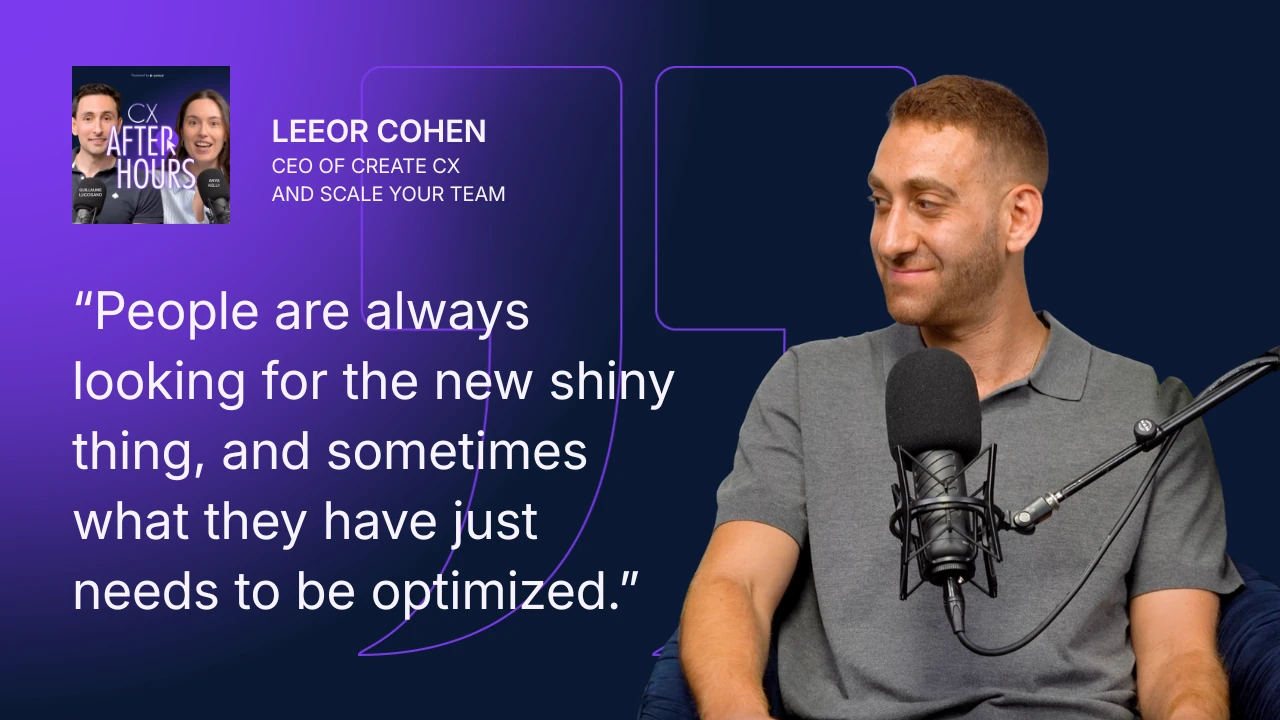
"People are always looking for the new shiny thing, and sometimes what they have just needs to be optimized."
One of Leeor's biggest frustrations is how quickly brands assume the tool is the problem.
The helpdesk is not working, the AI platform is not delivering, or the BPO is not good enough. So the team starts looking for something new.
But in many cases the problem is not the platform. It is how the platform has been set up, maintained, and used.
Leeor sees this especially often with ecommerce and DTC brands, where many teams are operating on similar Shopify-based tech stacks.
As he puts it:
"People think that this is rocket science. It's not rocket science. It's making one right decision after the other."
That does not mean tools do not matter. Some platforms will be better suited to certain teams, budgets, and workflows. But switching tools can also become a way to avoid doing the harder work, like cleaning up processes, fixing macros, and documenting policies.
Leeor calls this "help desk hygiene" or "CX hygiene."
"The hygiene is important because it's not necessarily the tool, it's what you're doing with it."
That point matters even more in the AI era, because if your CX operation is already messy, adding AI does not automatically make it better. It may just make the mess move faster.
Here is one of the simplest ways to understand AI in CX: the quality of the answer depends on the quality of the information behind it.
Many brands want to skip straight to automation before doing the foundational work of mapping what customers actually need. Leeor's team approaches this by helping brands think through the questions and bottlenecks customers are likely to encounter across the whole journey.
"We are not the experts on your business. You know your business better than we ever will. But what we can do, and do very thoughtfully, is predict all the questions or bottlenecks that customers are gonna encounter."
One practical way to do that is to ghost shop your own brand:
- Click through the homepage.
- Read the product page.
- Go through checkout.
- Look at the confirmation email.
- Ask what a first-time customer would be confused by.
Leeor says that process can help brands predict a huge percentage of customer questions.
"You can put yourself in the customer's shoes and really predict what 90 to 95% of those questions are gonna be."
That is where playbooks become important. Not as rigid scripts or generic consulting documents, but as the shared source of truth for how the business handles customer moments. The same clarity is what lets an AI agent answer common questions accurately and in context rather than guessing.
Leeor knows some people dislike the word playbook. But he sees it differently:
"It's really a guideline. Like, it's just a guide to the answer. It's not the 100% answer to the test."
That is a useful distinction. A good playbook does not remove judgement. It gives both humans and AI a stronger foundation to work from.
The same foundations support humans and AI
"The irony of agent and AI is that the first two steps have to be done the same. There's no difference."
One of the strongest points in the episode is that AI does not remove the need for good CX operations. If anything, it makes them more important.
The same foundational work that helps human agents succeed is also what helps AI agents work properly.
- You need clear policies.
- You need current documentation.
- You need escalation paths.
- You need examples of good answers.
- You need to know when to automate and when to hand off.
Leeor describes the right approach as crawl, walk, run. Start with one use case. Prove it works. Build confidence. Then expand.
The key is that AI should match the brand's actual needs, not the vendor's hype cycle.
In Leeor's experience, some ecommerce and retail brands still do not want much AI. Some are nervous about brand risk. Some are not sure the cost of automation outweighs the strength of their existing team.
Leeor's view is that those decisions should be brand-led. AI should not be forced into CX just because everyone else is talking about it. It should be implemented where it genuinely improves the operation, and where the handoff to a human still feels seamless for the customer.
AI can make CX more human
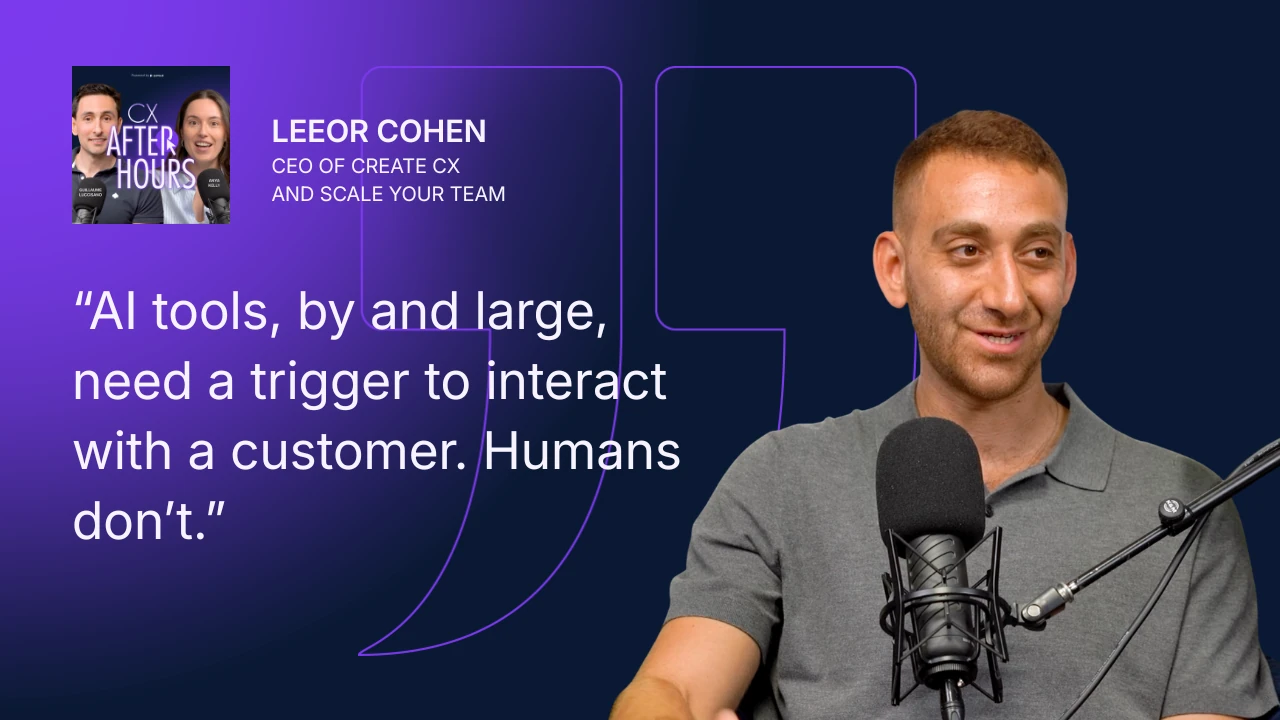
"AI tools, by and large, need a trigger to interact with a customer. Humans don't."
A lot of the conversation around AI in CX is framed as human versus machine. Leeor takes a more useful view: AI can take on the repetitive work. That does not make humans less important. It can make their work more valuable.
If AI handles the easier tickets, human agents can spend more time on the moments that require judgement, empathy, and context.
- The sensitive shipping issue.
- The high-LTV customer.
- The retention save.
- The personalized outreach.
- The unusual fulfillment problem.
- The situation where the customer needs someone to actually think.
Leeor says many brands are not necessarily shrinking their teams because of AI. Instead, they are finding better ways to use the human agents who already know the business.
For example, instead of hiring a huge temporary team during the holidays, brands can use AI to absorb some of the repetitive volume while keeping trained agents focused on higher-value work.
That might include responding to Trustpilot reviews, doing proactive outreach, handling operational fulfilment issues, or spending time working on customer segments that need special care.
As Leeor puts it:
"You have your trained human agents that could handle the easy stuff, but can also handle the hard stuff, and that unlocks so much for the business."
That is the real opportunity. Not replacing humans with AI, but using AI to clear space for humans to do the work that actually builds loyalty.
Check out the full episode here:
Apple Podcasts
Spotify
YouTube


