Why CX is a goldmine of data - and how AI can finally help you use it
Most brands say they want to understand their customers. But they often miss one of the richest sources of customer insight - CX data.
Every support ticket, product review, social DM, NPS comment, complaint, and customer conversation is telling you something about your product, your operations, your marketing, your brand, and your growth.
Most companies just are not using it properly.
Instead, CX is still too often treated as a support function. In many businesses it's a cost center - a team that answers emails, clears the queue, and handles the messy stuff after something has already gone wrong.
Cati Brunell-Brutman sees it differently.
In this episode of CX After Hours, Cati, formerly CX Lead at Glossier, makes the case that customer experience is one of the clearest windows into what customers actually think, feel, need, love, and hate.
And with AI, CX teams now have a much better way to turn all of that raw customer feedback into insight the rest of the business can actually use.
In this episode, hosts Guillaume Luccisano and Anya Kelly sit down with Cati to talk about how high-performing CX teams turn customer conversations into business impact.

Watch or listen to the full episode:
Apple Podcasts
Spotify
YouTube
CX is not a cost center. It's customer intelligence.
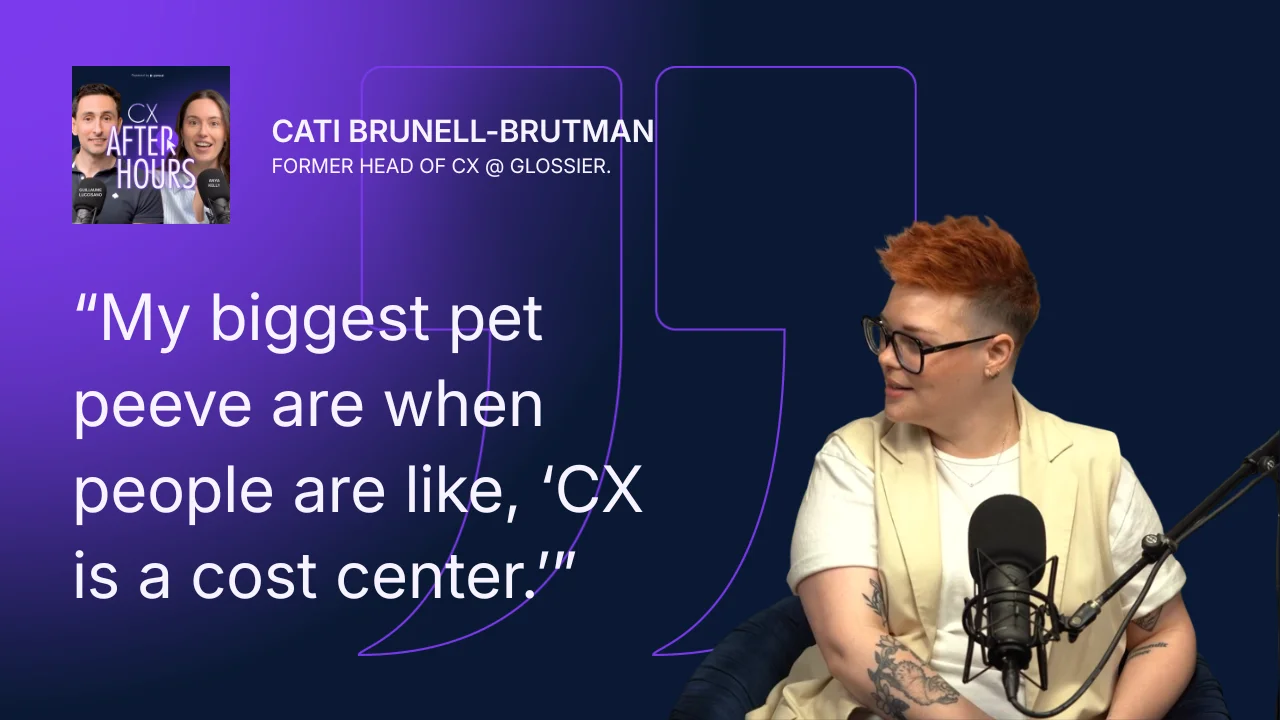
"My biggest pet peeve are when people are like, 'CX is a cost center.'"
Cati has spent more than a decade working across CX and community roles at brands including Birchbox, Daily Harvest, The Wing, Headway, and Glossier.
Her route into CX was not traditional. Before customer experience, she worked in theater production and management. But when she started on the front lines at Birchbox, helping customers with makeup recommendations over chat and phone, she realized the job was not that different.
She was still talking to multiple departments, coaching people, solving problems, and thinking creatively. In short, it was still all about keeping the show moving.
That eventually led her to Glossier, where she spent five and a half years and ultimately led global digital CX across internal teams, external BPOs, ecommerce, wholesale, and retail. It is also where she worked directly with Yuma - the Glossier case study covers how her team automated its most time-sensitive support workflows.
Across all of that work, one thing became clear: CX has far more strategic value than most companies realize.
CX teams hear what customers love. They hear what customers hate. They hear where the product is confusing, where the website is unclear, where marketing has overpromised, where operations are creating friction, and where policies are making things harder than they need to be.
If marketing, product, or ops has a question about what customers will think, Cati argues that a good CX agent can probably answer it.
Because they are already hearing it every day.
That is the part many companies miss. CX is not just where problems go to be solved. It is where customer reality shows up first.
CX needs to get into the rooms where decisions are made
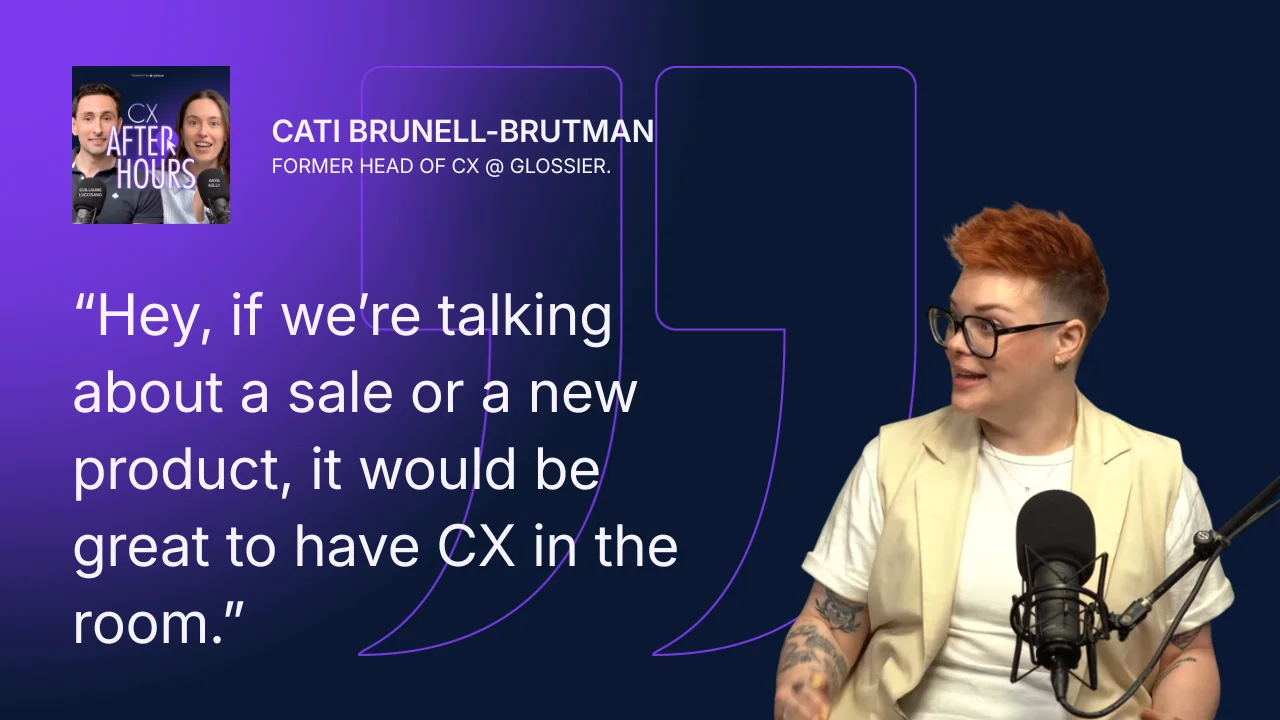
"Hey, if we're talking about a sale or a new product, it would be great to have CX in the room."
Having customer insight is one thing. But getting the rest of the business to listen is another.
Cati says she has been lucky that when she has asked for CX to be included in meetings, people have usually understood why. But she has still had to ask.
If the business is planning a sale, CX should be there. If product is preparing a launch, CX should be there. If operations is making decisions that affect delivery, fulfillment, or customer expectations, CX should be there.
Because CX touches everything.
But Cati also makes an important point: CX leaders cannot just show up with complaints.
They need to speak the language of the stakeholder they are trying to influence.
For the VP of Operations, that might mean data about fulfillment delays or delivery confusion. For the CMO, it might mean campaign feedback or customer language. For product, it might mean repeated customer questions, product reviews, or recurring complaints.
Cati's approach is to understand what each team cares about first. What are they working on? What do they want to fix? What would help them do their job better?
Then, when CX has useful data, it can be framed in a way that helps.
Not: "CX is complaining again."
But: "Here is information that will help you solve the thing you already care about."
That is a very different conversation.
It turns CX from the team bringing problems into the team helping other people make better decisions.
The best CX data still needs a story
Data alone does not create change. That is one of the strongest themes in this episode.
CX teams can have the tickets, the reviews, the DMs, the NPS comments, and the survey results. But if they cannot explain what it means, why it matters, and what the business should do next, the insight often goes nowhere.
Cati's point is that CX leaders need to bring the story with the data.
- What is the pattern?
- Which customers are affected?
- How often is it happening?
- What is the business risk?
- What could the team change?
- Why should anyone outside CX care?
One example Cati discussed from her time at Glossier was the packaging for their Ultralip product.
Customers were sharing feedback. CX was seeing the pattern. The data helped make the issue clear enough for the business to act. Eventually, Glossier changed the packaging and could go back to customers with a simple but powerful message: we heard you.
That feedback loop matters.
A customer says something. CX captures it. The business acts on it. The brand shows customers their feedback made a difference.
That actually becomes so much more than a product fix - and builds long-term trust with the customer.
It tells customers their voice is not disappearing into a void. And it tells the business that CX is not just handling complaints. It is identifying the friction that affects product experience, brand perception, and future purchase behavior.
Retail teams are an underrated source of customer insight
"It was as simple as a Google Form that anybody on the floor could just fill out and put feedback."
One of the most practical parts of the episode is Cati's point about retail teams. In ecommerce, it is easy to focus on digital feedback. Email, chat, reviews, DMs, NPS comments, social posts.
But for brands with retail locations, the people on the shop floor are hearing customer feedback in real time.
They see how people interact with the product. They hear what confuses them. They know what questions keep coming up. They can spot when a campaign message is not landing or when a product detail is creating hesitation.
At Glossier, the team created a simple way to capture that feedback: a Google Form that retail employees could fill out from their phones.
It did not need to be complicated. The key was making it easy and showing people that the feedback went somewhere.
Cati says the team shared how the data was being used, including how store directors could bring it into conversations with regional leaders and ecommerce.
That matters because people are more likely to share feedback when they know it is being heard.
It also motivates the teams closest to customers.
If someone on the floor flags an issue and later sees that feedback shape a decision, that changes how they see their role. They are not just selling product. They are helping the business understand the customer.
That is a lesson for any CX leader.
Your best insight may not only come from dashboards. It may come from the people having the most human conversations with customers every day.
"Create your community."
Cati's final takeaway is simple: CX leaders need community.
That means finding other CX leaders outside the company. Building the group chat. Asking questions. Comparing notes. Sharing problems. Learning how other people are solving the same issues in different contexts.
But it also means building community inside the business.
Find the people in product, marketing, operations, CRM, retail, and ecommerce who care about making things better. Understand what they are working on. Bring them useful customer insight. Help them solve problems.
That is how CX earns influence - not by demanding a seat at the table, but by becoming useful to the people already sitting there.
That is the through-line of the whole episode.
CX is full of insight, but insight only matters if it moves through the business. AI can help find the patterns, but humans still need to understand the story. Customer feedback can shape better products, but only if teams listen. Surprise and delight can build loyalty, but only if people are empowered to act. Metrics can help, but only if they reflect the real customer journey.
The best CX teams are not just answering customers.
They are helping the business understand them.
That is the real opportunity.
Use AI to find the patterns. Use data to make the case. Use stories to make people care. Use community to get better faster. And keep bringing the customer's voice into the rooms where decisions get made.
Because CX is not just a support function. It's one of the clearest windows into what customers actually think.
Check out the full episode here:
Apple Podcasts
Spotify
YouTube


