Why customer experience is never "fixed" - and how to hire and scale CX anyway
Most brands want customer experience to become a clean, efficient, fully solved function. Hire the team, set the policies, add the help desk, bring in AI, reduce the backlog and keep customers happy.
Simple, right? Not quite.
In this episode of CX After Hours, Michael Bair (Founder of Bair Consulting and former SVP of Customer Experience at FIGS) makes the case that CX is never really "fixed." It keeps changing because the business keeps changing. You launch new products and suddenly customers have new questions. You update a policy and create friction somewhere else. New channels get added. Teams grow. Tools break. Expectations rise. And just when you think you have the system under control, something else shifts. That is the reality of CX.
The job of a CX leader is not to prevent every issue from happening. It is to build the team, operating rhythm, and decision-making muscle to keep improving when things inevitably break.
In this episode, hosts Guillaume Luccisano and Anya Kelly sit down with Michael to talk about hiring, scaling, AI, BPOs, metrics, shipping anxiety, and why the best CX leaders are often the ones who still genuinely like customers.
Watch or listen to the full episode:
Apple Podcasts
Spotify
YouTube
Great CX starts with people who actually like customers
A lot of people work in customer experience. But not all of them like customers.
That might sound obvious, but Michael argues it is one of the most underappreciated differences between average CX teams and great ones.
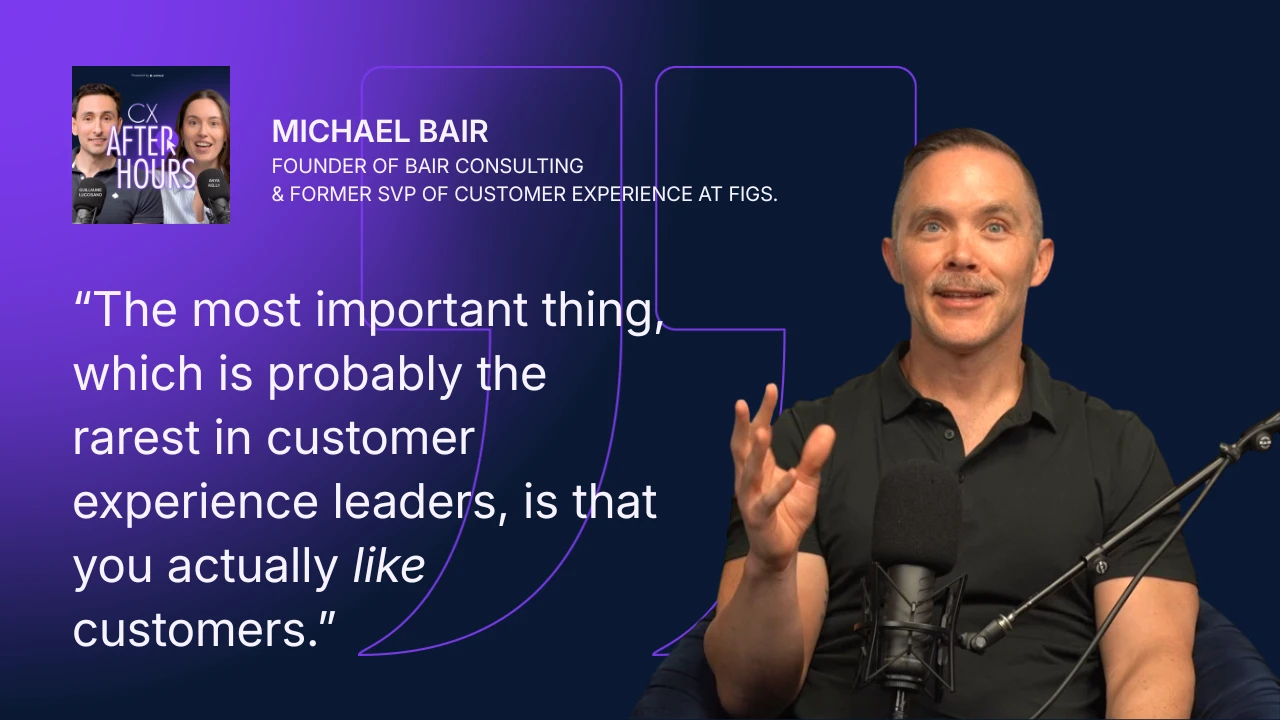
"The most important thing, which is probably the thing that I think is actually the rarest in customer experience leaders is you actually like customers."
That matters because CX is not just about managing tickets. It's about dealing with people when something has gone wrong, when they're confused, impatient, disappointed, or looking for help.
Sure, you can teach someone a policy, train them on a tool and improve their writing. But if they don't actually like people, the work is always going to feel like a burden. And customers can usually feel that.
As Michael says, "It's really hard to do customer experience well if you don't actually like people and you actually don't like customers."
Hire for PhDs: passionate, hungry, and driven
Michael has hired more than 1,000 people in his career. His hiring philosophy is simple, memorable, and slightly unconventional. "We only hire people that have PhDs."
Not actual PhDs.
"Passionate, hungry, and driven."
For Michael, those three traits matter because very few people come into CX with a perfect resume or a customer experience degree. They come from retail, sales, hospitality, call centers, operations, college jobs, or completely different industries.
So the question is not always, "Have they done this exact job before?" It's more often: do they care about the brand? Do they want to grow? Do they want to take on more? Do they want to do more than answer emails, calls, and chats forever?
Michael is clear that experience can help. He talks about hiring people from companies known for great customer service, like Nordstrom, because they had already learned what exceptional client service looked like.
But he is also careful not to reduce hiring to credentials. Some of the best people he has managed did not have college degrees. Some people with polished resumes are not good fits. Some people interview well and then underperform.
That is why Michael is less interested in someone's ability to perform in an interview and more interested in the decisions they have made.
"People's interview skills rarely, if ever, translate to them being like a good employee."
Instead, he wants to understand motivation. Why did they leave a role? Why did they take the next one? How did they get promoted? What kind of environment helps them do their best work?
When you scale, don't lower the bar
Scaling CX comes with pressure. As volume goes up backlogs grow, the team inevitably gets stretched and leaders need people yesterday. The temptation is to hire quickly, lower the bar, and deal with the consequences later.
Michael's view is direct: "If they're not a hell yes, they're a no."
That might sound harsh, but it is the kind of standard that protects a CX function as it grows. Because in CX, a weak hire is going to affect customers directly.
The bigger the team gets, the more important the hiring standard becomes.
AI is a staffing strategy
A lot of CX teams still talk about AI like it sits outside the operating model.
Michael sees it differently: "I think of AI as a staffing strategy."
That's a useful reframing.
Ten years ago, a CX leader might have looked at volume and calculated how many people were needed to cover it. Today, AI becomes another part of that equation. If AI can handle work equivalent to 20 people, that changes your BPO strategy. If AI can resolve repetitive, text-based, low-risk questions instantly, that changes what your internal team should focus on.
But it does not remove the need for judgment.
Michael compares AI to BPOs. A BPO can be good. AI can be good. But if you have a complex, high-value, brand-sensitive issue, and you can send it to an internal person who has worked with you for three years, lives the brand, and has learned directly from leadership, that is probably the better decision.
The question is not "Can AI answer this?" but "What is the best resource for this customer, in this moment?"
That's a much better way to think about automation. Not as a blanket push to reduce human involvement, but as a routing and resourcing decision.
"Where's my order?" is not always impatience
Every e-commerce CX team knows the pain of WISMO tickets.
Where is my order? Why has the tracking not updated? Why is my package still at the distribution hub? Why did someone else get theirs first?
In the episode Michael jokes that carrier tracking statuses may be "the worst thing to ever exist" because they often create more anxiety than clarity.
But the more interesting part of the conversation comes when Michael reframes what those tickets might mean:
"If you are getting a bunch of Where's My Order tickets, that is customers not subtly communicating to you that your shipping is too slow."
That does not mean every customer is being reasonable. But it does mean the business should listen to the pattern.
If WISMO is your number one contact reason, customers are telling you something. Your shipping promise, actual delivery speed, tracking experience, communication, or fulfillment model is not meeting expectations.
And for Michael, the customer experience does not end when the package leaves the warehouse.
"The full customer experience includes the time from when they check out to when the package is in their hand."
That is a critical point for e-commerce brands. Operations might think the job is done when the order ships. CX knows the customer does not see it that way. The experience ends when the product arrives.
Defining what great looks like
When asked what simple fixes most CX teams are leaving on the table, Michael talks about measurement.
"CX teams need clear measures of success."
That means everyone needs to know what good looks like. From frontline associates to team leads, VPs, BPO partners and AI agents. The team cannot improve if success is vague.
And Michael is a big believer in the daily dashboard. Instead of a buried spreadsheet no one opens, he has always put in place daily visibility the whole team can track.
He wants teams seeing the scoreboard all the time because, as he puts it, "Humans love scoreboards."
That might include customer satisfaction, first response time, total tickets, LTV increases, retention rate, and other metrics. But there's one true North Star for e-commerce: repeat purchase rate.
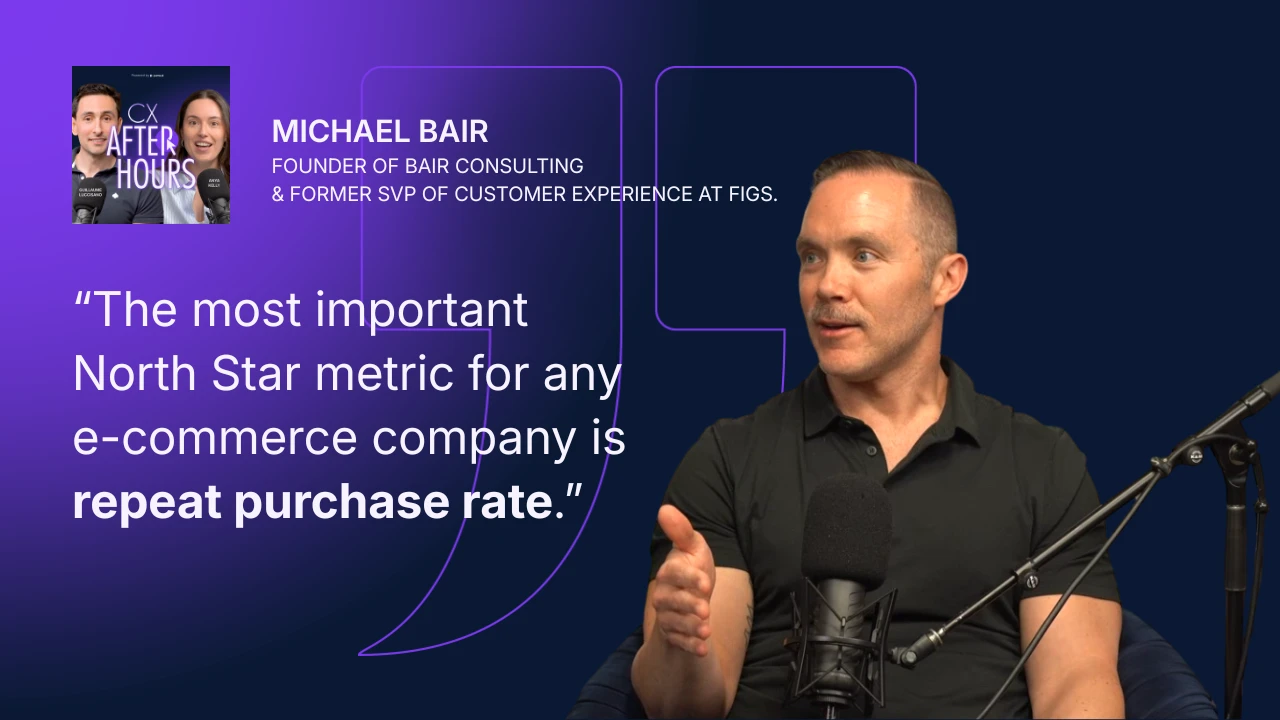
"The most important North Star metric for any e-commerce company is repeat purchase rate."
Why?
Because if you have to acquire a new customer every time you want to sell something, the business does not work. E-commerce growth depends on customers coming back.
Above all the activity, the bigger question in CX is whether the experience makes customers more likely to buy again.
"If your experience is actually accretive to the business, the repeat purchase rate and probably the LTV of that customer should be higher."
That is where CX becomes much more than support.
It becomes a measurable part of the revenue engine.
CX leaders need to stay close to customers
The episode ends with a plea from Michael to CX leaders: "You have to fall in love with customers."
That is not soft advice. It is practical.
If CX leaders want more influence, more trust, and more of a seat at the table, they need to be the people inside the company who understand customers better than anyone else.
That means getting close to the work.
Hop on calls. Read chats. Review emails. Look at the tickets. Understand what customers love. Understand what they hate. See the patterns. Bring those patterns back to the business.
Michael says one of the best ways to earn influence is to be "the one person in the company who really cares about customers."
That is the through-line of the whole episode. CX will always be messy because customers are messy. Operations are messy. Growth is messy. Hiring is messy. Channels are messy. AI is messy. Scaling is messy.
But the answer is not to give up on fixing it. The answer is to build the kind of CX function that can keep adapting.
Hire people who care. Do not lower the bar. Use AI as part of the staffing model. Route high-value work to your best resources. Build the knowledge base. Create the scoreboard. Measure repeat purchase. Stay close to customers.
Because CX is not a function you finish. It is a function you keep building.
Check out the full episode here:
Apple Podcasts
Spotify
YouTube


