Using AI tools for ecommerce and DTC is a relief, especially during peak seasons when orders surge, queues overflow, and support teams are spread thin.
But is your AI stack actually resolving tickets? Or are customers walking away frustrated by an interaction that felt automated but never helpful?
The numbers suggest the latter. Quickfire Digital found that 77% of retailers say their AI initiatives need work. A Liveops survey also found that only 29% of holiday shoppers said AI improved their support experience.
So there is a gap, and it traces back to finding the right AI tool that matches your specific CX and operations needs, not just one that looks good in a demo.
This guide handpicks seven AI tools for DTC, with helpdesk fit, real pricing, honest automation benchmarks, and limitations vendors rarely disclose.
Our guide to ecommerce customer service is worth reading alongside it. It shows you what good looks like before you evaluate anything.
| Tool | Type | Best for | Helpdesk fit | Suitable pricing model |
|---|
| Yuma 2.0 | AI customer service platform | Ecommerce teams that want full resolutions, not just replies | Gorgias, Zendesk, Kustomer, Gladly, Re:amaze | Book a demo |
| Gorgias AI Agent | AI Agent | Shopify stores already on Gorgias | Gorgias (native only) | $300 per month for 2,000 tickets |
| Intercom Fin | AI Agent | SaaS-style or subscription ecommerce | Intercom (native) | From $0.99 per outcome |
| Zowie | AI Agent | Mid-market DTC, multi-channel ops | Gorgias, Zendesk, custom | Book a demo |
| Tidio Lyro | AI Chatbot | Small stores under 3K tickets/month | Re:amaze, Gorgias (limited) | $349 per month for 2,000 tickets |
| Richpanel | Self-Service + AI | Mid-size DTC, self-service portal priority | Gorgias (1-click import), Shopify | $500 per month for 2,000 tickets |
| Zendesk AI | AI Agent | Enterprise ecommerce, multi-brand ops | Zendesk (native) | $55 agent/month paid yearly |
Research note: This article was researched and created using publicly available information from vendor websites, pricing pages, product documentation, industry reports, and third-party review platforms in June 2026. Because AI and SaaS products change quickly, always confirm pricing, features, and integration details on the vendor's website listed here before making a buying decision.
1. Yuma AI
Yuma is an AI customer service platform for ecommerce brands. With Yuma 2.0, one written Handbook, managed in plain language, runs every customer conversation across email, chat, SMS, WhatsApp, social DMs, outbound outreach and phone calls.
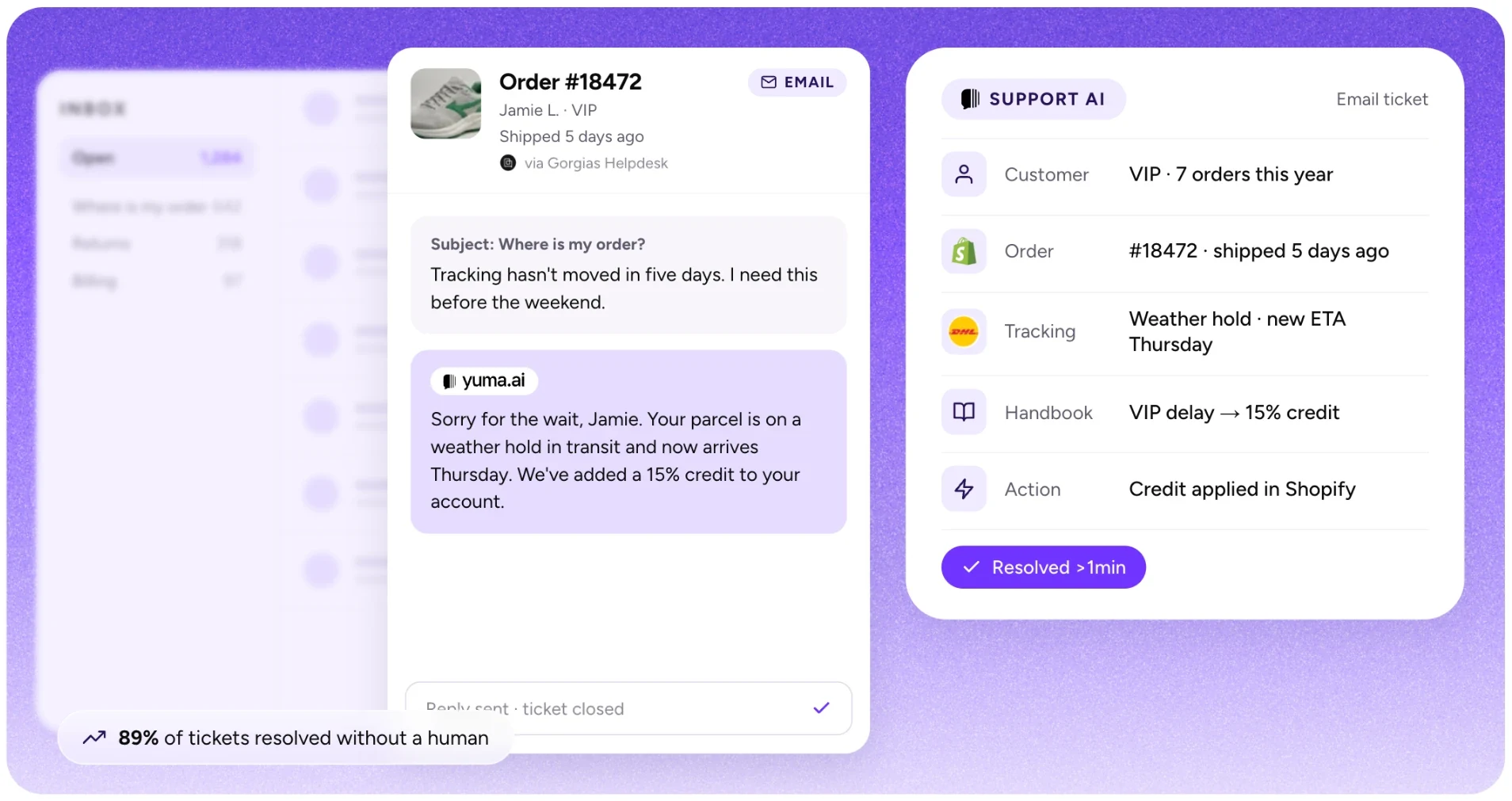
Ask Yuma writes the Handbook from your SOPs or real tickets, every playbook carries its own tests, and changes roll out gradually. Yuma works inside your existing helpdesk, takes actions in your backend, and with Web Actions can complete tasks in tools that have no API.
Here's what that covers in practice:
- Support: end-to-end ticket resolution, including WISMO, returns, exchanges, refunds, and subscription changes.
- Phone calls: Yuma Voice answers your support line 24/7 and takes backend actions mid-call, reading the same Handbook as email and chat.
- Outbound: event playbooks start conversations from business events, like an order placed or a parcel delivered, by email or SMS.
- Sales AI: a pre-purchase add-on that answers product questions on your storefront, running on the same Handbook.
Web Actions extend where Yuma can act. Yuma drives a real Chrome browser to complete tasks in tools that have no API. So if a carrier portal requires logging in to file a claim, Yuma can open it, file the claim, and write the reference back to the ticket. Setup is recording a video of yourself doing the task once.
Yuma also allows integrations with core systems that run ecommerce operations, including Shopify, Zendesk, Klaviyo, DHL, Stripe, WooCommerce, Re:amaze, and 37+ other platforms.
So an integration, for example, with Shopify may allow Yuma to read live order data and instantly process actions such as refunds, order edits, and delivery updates within a support ticket.
Verified proof points, why brands choose Yuma
Below are selected case studies highlighting measurable, real-world impact from brands using Yuma AI.
- EvryJewels was handling big seasonal spikes in ticket volume. With Yuma, 89% of its tickets are automated and its support cost is 63% lower, all without scaling the support team to match the high order pace.
- MFI Medical is a medical equipment supplier with a very large product catalog. Through Yuma, it automated 64% of its total support volume, with 87% faster first responses.
- Petlibro reached 79% automation and 20% annual savings.
- Clove, with Yuma, reached 70% automation and a 3x ROI within 3 months.
Yuma is SOC 2 Type II certified and is trusted by 110+ ecommerce brands.
Where it fits
Yuma is used in post-purchase support operations, for customers asking questions like "Where is my order?", "Can I change my address?", or "I want to return this item." Instead of routing these to agents, Yuma resolves them directly inside Shopify and the helpdesk, following the playbooks in your Handbook.
When a request isn't covered by the Handbook, Yuma doesn't improvise. It hands the conversation to your team and logs the gap as an open question, so you only answer it once.
Sales AI removes buying friction at pivotal moments by acting as a shopping assistant that answers product questions, compares options, and helps customers complete checkout.
For brands that get a lot of chat, phone and social traffic, the same Handbook runs every channel, so a policy change applies everywhere at once, and complex cases still escalate to your CX agents.
In simple terms, Yuma fits wherever a customer interaction becomes an operational task; this is beyond a conversation.
Yuma AI pricing
Our pricing is now published as illustrative annual tiers (Starter, Growth, and Scale), each with a per-resolution rate, with every bundle sized to your forecast during a demo. The first 30 days are free and there's a $0 implementation fee on any plan. See Yuma's pricing.
And we only bill for a full resolution, which is a ticket Yuma handles start to finish with no human involved. The moment your agent steps in to resolve a ticket, it becomes free.
Start with a free CX audit.
Review
Yuma is rated 4.8/5 on G2 and was named a G2 Fall 2026 High Performer.
Limitations
- Plans run on an annual (12-month) commitment, so Yuma suits teams ready to commit rather than those wanting month-to-month billing.
- No native integration with Freshdesk, HubSpot, or Intercom.
Implementation
- Yuma is quick to deploy: most brands are live within a week. It allows one-click integration with Shopify and major help desks like Gorgias and Zendesk.
- The setup doesn't require engineering. Ask Yuma drafts your Handbook from the SOPs and tickets you already have, and a dedicated onboarding team reviews it with you.
- Most brands start with a single playbook, such as WISMO or returns, roll it out on a small share of conversations once its tests pass, and expand as accuracy is validated.
Read our guide to learn why ecommerce CX teams choose Yuma over a generic helpdesk.
Best for
- Ecommerce teams that want full resolutions, not just replies.
- Shopify-native and DTC brands processing 5,000 to 150,000+ tickets per month.
- Teams on Gorgias or Zendesk that want to add an AI layer without migrating.
- Ecommerce brands in fashion, beauty, jewellery, and subscriptions, where Yuma's use cases are most proven.
Find out where AI fits in your support operation, at no cost. Yuma's CX specialists review your real ticket history and return a personalised report on your automation gaps and highest-ROI workflows. No generic recommendations. No sales pitch required to receive it.
Get your free CX audit | Book a Demo
2. Gorgias AI Agent
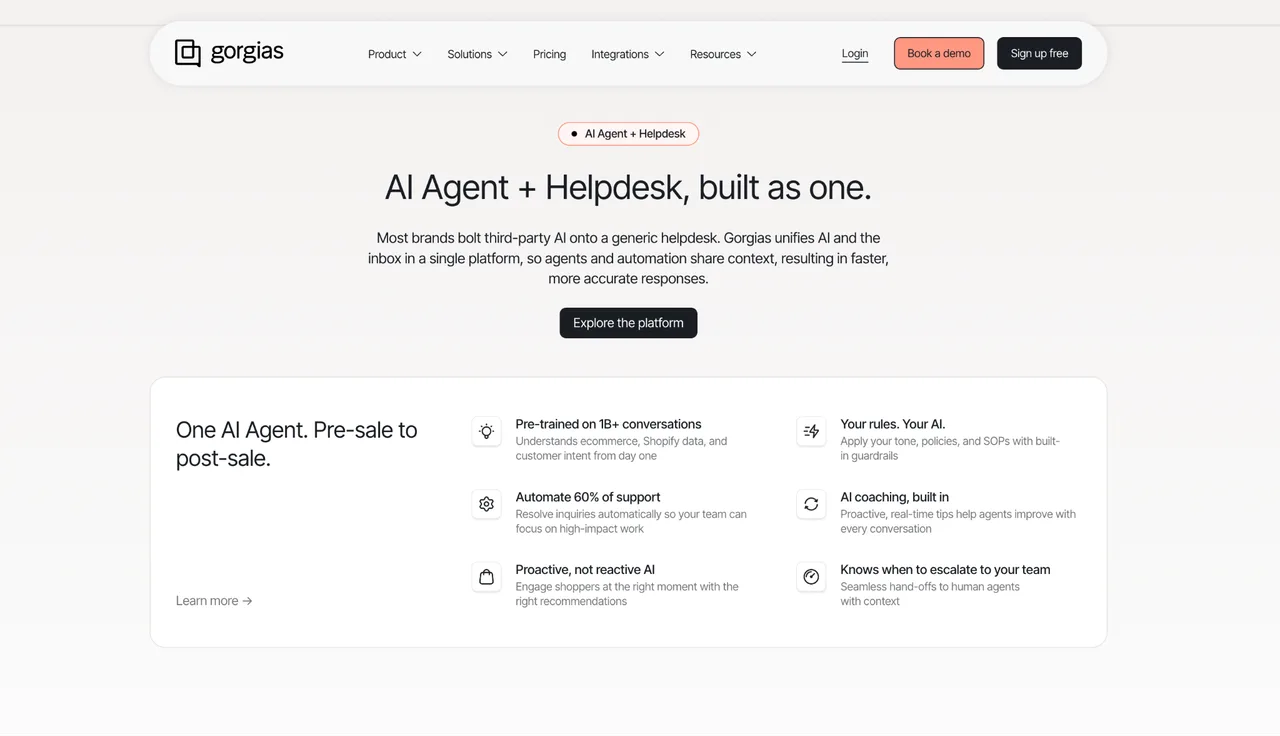
Gorgias is an AI agent plus helpdesk for managing your everyday ecommerce support. Its AI Agent pulls order and customer data, enabling agents to issue refunds, process cancellations, and make edits without switching tools.
Where it fits
Shopify, WooCommerce, BigCommerce, and Magento brands already using Gorgias that want AI automation without migrating to a new helpdesk.
Pricing overview
| Plan | Monthly Price | Ticket Volume | What's Included |
|---|
| Starter | $10/mo | 50 tickets | Basic helpdesk features |
| Basic | $50/mo | 300 tickets | Helpdesk + support tools |
| Pro | $300/mo | 2,000 tickets | Full helpdesk + automation features |
| Advanced | $750/mo | 5,000 tickets | Higher volume + advanced support features |
| Enterprise | Custom | Custom volume | Tailored setup for large teams |
Note: The AI Agent is billed at roughly $0.90 per resolved conversation on annual plans (about $1.00 on monthly), and each automated resolution also counts as a billable helpdesk ticket, so both fees can apply to the same ticket.
Reviews
Gorgias is rated 4.6/5 on G2 based on 561 reviews.
Limitations
- Double-billing: Gorgias charges per manual ticket AND per AI interaction. An AI-assisted ticket is billed twice. At 10,000 tickets/month with 65% automation, this amounts to a significant cost line item.
- Cost structure: AI usage is billed on top of helpdesk usage, which can increase total spend at high volumes.
- Automation range: Real-world case studies show automation rates may range from 26 to 56%, depending on setup and ticket mix.
Best for
- Stores with straightforward post-purchase features, such as order tracking, returns, and basic support queries.
- Teams that want support for automation and revenue attribution within a single helpdesk system.
Compare Yuma AI vs Gorgias AI to understand which support automation tool best fits your ecommerce stack.
Fin is an AI agent for Intercom built to handle customer conversations with strong conversational quality and deep knowledge-base understanding. It excels at answering questions directly from documentation and structured business knowledge.

Where it fits
Subscription ecommerce or DTC brands already using Intercom for customer messaging, onboarding, or product communication.
Pricing overview
| Component | Pricing | What it includes |
|---|
| Fin AI Agent (standalone) | From $0.99 per resolution | Pay per resolved conversation. Works with any helpdesk. |
| Fin with Intercom | From $0.99 per resolution + $29 per helpdesk seat/month | Full Intercom suite + Fin AI Agent for support + sales use cases |
| Helpdesk Plan | From $29/month per seat | Core Intercom helpdesk, inbox, workflows, reporting |
| Copilot (add-on) | $35 per user/month | Agent assistance, suggestions, and workflow support |
| Pro Add-on | $99/month (1,000 conversations analysis) | CX insights, reporting, trends, and AI analysis tools |
Reviews
Intercom Fin holds a 4.5/5 rating on G2 (3,800+ reviews) and a 3.1/5 rating on Trustpilot (515 reviews).
Reviews typically highlight strong conversational performance, while lower ratings are often linked to billing experience, long delays, and cost expectations.
Limitations
- Not built around Shopify-native order workflows (refunds, exchanges, and order edits often require custom procedures or integrations).
- Advanced workflows may require setup through Intercom's procedures or external systems.
- Total cost can vary depending on usage and team configuration.
Best for
- DTC and subscription brands already using Intercom for messaging or customer communication.
- Teams with mostly knowledge-base-driven tickets (policy questions, product specs, subscription FAQs).
- Brands prioritizing conversational quality and documentation-driven support over deep ecommerce order automation.
4. Zowie
Zowie is an AI agent platform built for mid-market and enterprise brands that need consistent, rule-based automation across customer support workflows. It focuses on executing predefined business logic for high-stakes actions like refunds, claims, and identity checks.
Where it fits
Mid-to-enterprise DTC and service-heavy businesses that need consistent automation across high-volume, multi-channel customer operations where accuracy and process control are critical.
Pricing overview
Zowie doesn't publish public pricing. Costs are provided on a custom basis.
Reviews
Zowie holds a 4.7/5 rating on G2 (73 reviews). Reviews generally highlight strong workflow reliability, enterprise-grade control, and consistent automation performance in complex support environments.
Limitations
- Less Shopify-native compared to tools like Yuma or Gorgias.
- Pricing is not publicly listed, making upfront budget planning difficult.
- More focused on workflow control than flexible conversational support.
- Requires structured onboarding and configuration (typically 2 to 4 weeks).
Best for
- Mid-to-enterprise DTC brands with high support volume across chat, email, voice, and social.
- Global or regulated operations where consistency, compliance, and auditability are priorities.
- Teams operating across multiple languages and regions with complex support structures.
5. Tidio Lyro
Tidio is an AI support platform that delivers live chat to support visitors in real time; an AI agent that acts, decides, and knows when to hand off; a help desk to access your customers' tools in a single dashboard; and flows to build your lead gen and sales funnel.
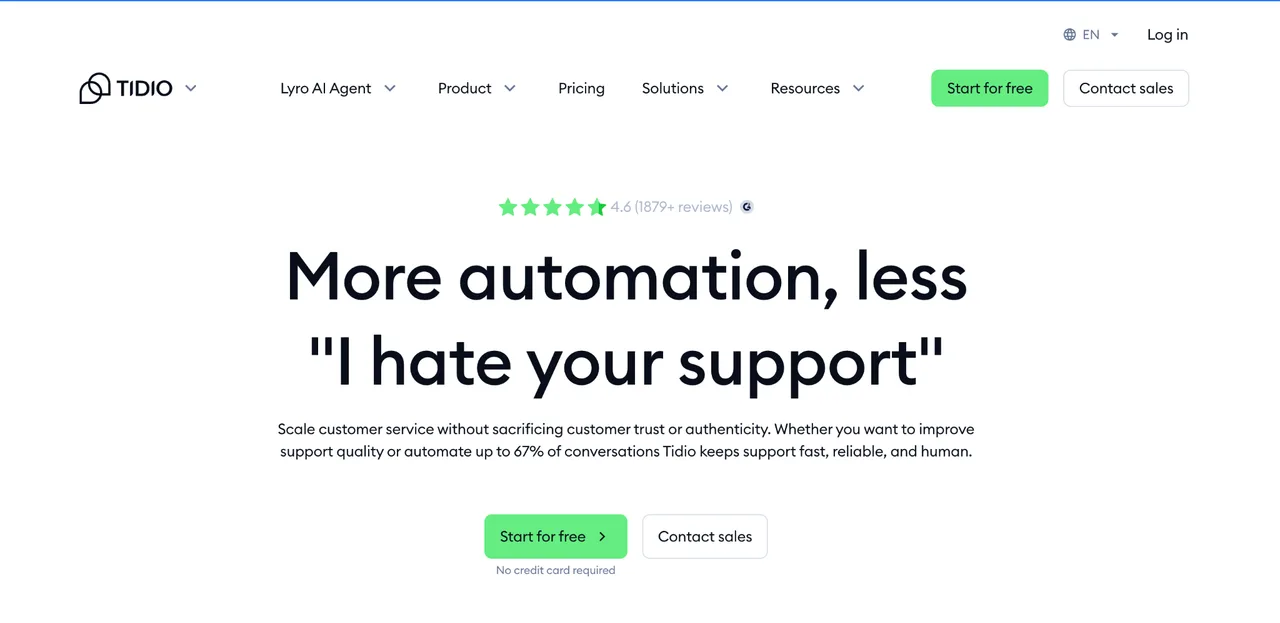
It is especially suited for early-stage Shopify brands that need basic support coverage across chat and website interactions.
Where it fits
Early-stage or bootstrapped DTC brands testing AI support for the first time, especially Shopify stores with low-to-moderate ticket volume that primarily need FAQ and basic support automation.
Pricing overview
| Plan | Price | Conversation Volume | Notes |
|---|
| Starter | $29/mo | 100 billable conversations | Basic live chat + Lyro AI starter features |
| Growth | $59/mo | From 250 conversations | Advanced automation + team features |
| Plus | $749/mo | Custom volume | Advanced workflows + scaling features |
| Premium | Custom | Enterprise volume | Dedicated support + full AI deployment |
Reviews
Tidio holds a 4.6/5 rating (1907 reviews) on G2.
Limitations
- Not designed for large-scale enterprise support operations.
- Pricing can increase significantly as conversation volume grows.
- Best performance is limited to repetitive or knowledge-base-driven queries.
- Less suitable for complex ecommerce workflows that require deep Shopify actions.
Best for
- Early-stage Shopify or DTC brands testing AI support for the first time.
- Teams that want fast setup and low-friction entry into automation.
- Brands prioritizing cost control over advanced workflow depth.
Explore our comparison guide on Yuma AI vs Tidio Lyro to find the right support automation tool for your store.
6. Richpanel
Richpanel is a helpdesk and AI support platform for mid-size ecommerce brands that want to reduce ticket volume through self-service. It lets customers handle orders, returns, and tracking through a portal, reducing the need to contact support.
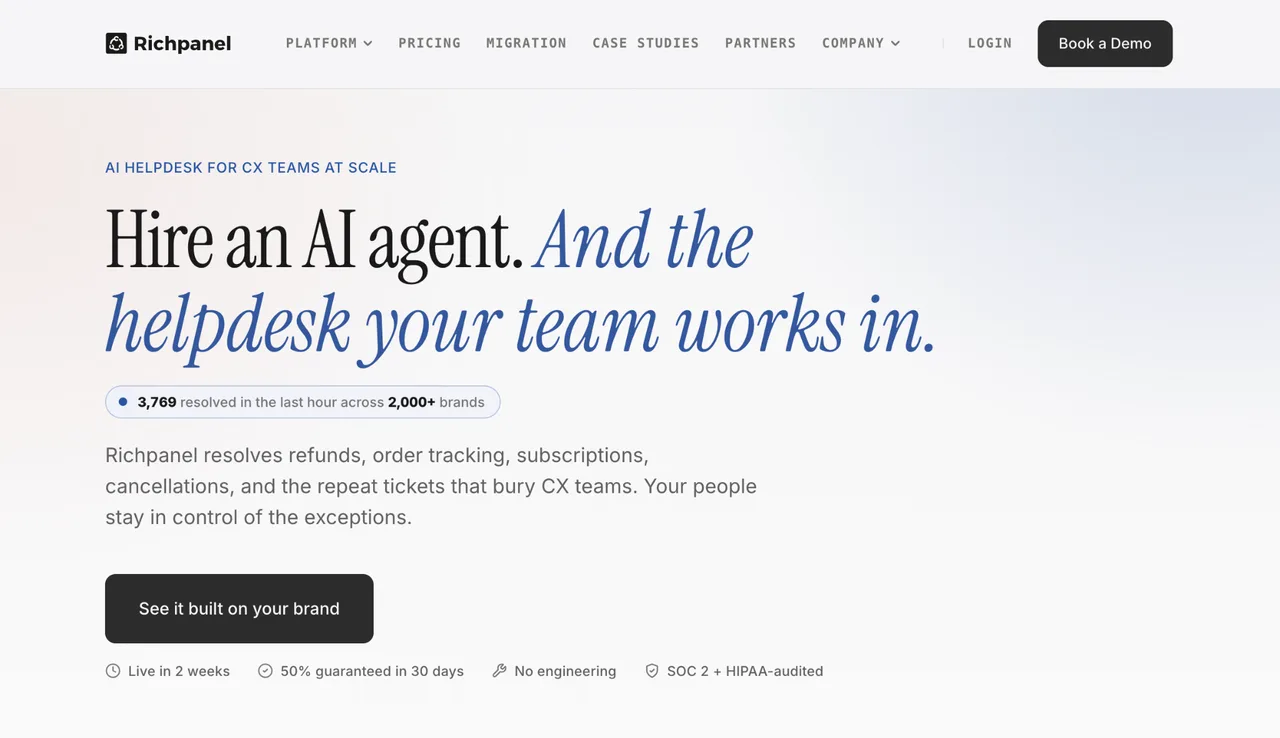
It combines this with an AI layer that resolves basic support queries inside the helpdesk and escalates complex cases to agents when needed.
Where it fits
Mid-size DTC brands already using a helpdesk like Gorgias or Zendesk that want to reduce ticket volume through self-service rather than fully autonomous AI resolution.
Pricing overview
$29/month (Starter) to $99/month (Pro), billed per store rather than per agent. Enterprise pricing is custom.
Reviews
Richpanel has a 4.7/5 rating on G2 based on 94 reviews. Most users report that it quickly reduces support workload by pushing customers into self-service, rather than flooding the inbox with repetitive tickets.
Limitations
- Per-agent pricing means costs increase with headcount rather than ticket volume.
- More focused on containment workflows than fully automated end-to-end resolution.
- Less effective for deeply multi-system actions that require heavy backend orchestration.
- Better at self-service deflection than full autonomous resolution across complex workflows.
Best for
- Mid-size ecommerce brands where most tickets are repetitive post-purchase queries like order tracking, returns, and refunds.
- Teams that want to reduce ticket volume through self-service portals rather than replace agents entirely.
- Gorgias or Zendesk users looking to layer self-service automation without rebuilding their helpdesk stack.
7. Zendesk AI
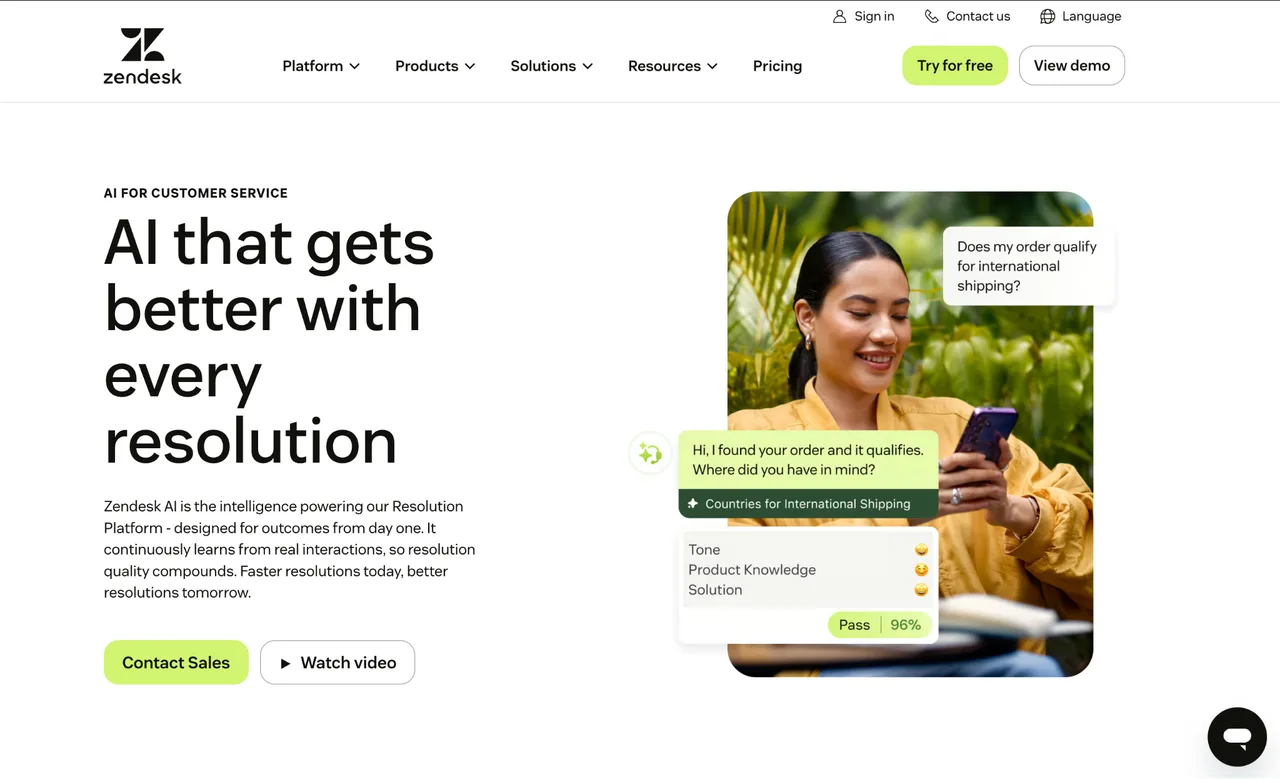
Zendesk AI is an enterprise customer service platform built for large-scale support operations. It combines ticketing, messaging, voice, knowledge base, and AI agents into one system. The platform is also customizable and supports complex, multi-brand workflows.
Where it fits
Large ecommerce enterprises with complex multi-brand or multi-region support operations require enterprise-grade compliance.
Compare Yuma AI vs Zendesk AI to select a better fit.
Pricing overview
| Plan | Price | Best For |
|---|
| Support Team | $19/agent/month (billed yearly) | Basic ticketing and support essentials |
| Suite Team | $55/agent/month (billed yearly) | Unified support across channels + AI agents |
| Suite Professional | $115/agent/month (billed yearly) | Advanced automation, reporting, and AI insights |
| Suite Enterprise + Copilot | Custom (contact sales) | Large-scale enterprises needing advanced AI, security, and governance |
Reviews
Zendesk is rated 4.3/5 on G2, based on nearly 7,000 reviews. Most users point to its depth, stability, and ability to handle large-scale support teams without breaking down.
But a recurring theme in feedback is that it can feel heavy and expensive, especially for smaller teams or those just starting to scale.
Limitations
- Advanced AI and QA capabilities often require additional paid add-ons.
- Shopify-specific workflows require configuration rather than a Shopify-native tool.
- High implementation complexity is required for a structured enterprise onboarding.
- Costs scale with the number of agents, making it expensive for teams with under 50,000 tickets/month.
Best for
- Large ecommerce enterprises with multi-brand or multi-region support operations that require enterprise-grade compliance.
- Brands with 50+ support agents where Zendesk's QA, SLA management, and workforce tools justify the cost.
- Teams that need deep workflow customization, audit trails, and an enterprise support infrastructure.
Q1: Does it resolve tickets, or just deflect them?
A deflection tool offers a help article. A resolution tool reads the order, issues the refund, updates the address, and closes the ticket. They are not the same.
Yuma bills only for a full-resolution ticket. This ticket is handled from start to finish with zero human involvement. So, however many steps the agent takes, it counts once. And the moment a human steps in, the ticket becomes free.
Since 68% of consumers confirmed that getting a complete resolution is the most important factor in any support interaction (Glance report, 2026), this makes Yuma a strong choice for fully automating customer support.
You can also ask each vendor to show you a ticket that the AI agent fully resolved from start to finish, without human involvement.
Learn why brands are choosing Yuma to resolve tickets.
Q2: Does it connect to your helpdesk natively, or through middleware?
This question is important because you want a plug-and-play helpdesk integration, not a webhook that a developer must build and maintain indefinitely. The latter places heavy reliance on a developer to manage the operations, leaving your customer support agents powerless.
So ask: "What exact data does your AI read from my helpdesk at the moment a ticket is created?" A vague answer is a red flag.
See how Yuma's AI support agent handles native integration.
Q3: What does it actually cost at your ticket volume?
The last, but not least, question evaluates the pricing model for resolving tickets. You need the AI tool for ecommerce that is not just efficient, but also economically sustainable for your business.
Here are the three common pricing models:
- Per-seat: this scales with agent headcount, not ticket volume.
- Per-resolution: you pay only when the AI fully closes a ticket.
- Per-interaction: charges for every exchange, resolved or not.
We further explore the cost-benefit ratio when choosing an AI tool for ecommerce customer service.
A quick way to decide based on your stack, scale, and the level of control you want over automation.
- If you are on Gorgias with 3,000 to 15,000 tickets per month and don't want to migrate: Yuma layers on top of your existing setup without disruption. It is especially useful for scaling customer support automation while maintaining operational stability. Gorgias AI Agent is the simplest native option, but you'll need to account for double-billing as usage grows.
- If you are on Zendesk and managing high-value orders with complex workflows, like inventory management automation: Zowie provides strong deterministic control across channels. Zendesk AI also works well if you are fully embedded in the ecosystem. Yuma is better suited for ecommerce-first automation across support and operational layers.
- If you are not ready for a full rollout: start with a single workflow. Many teams begin with WISMO or returns to validate accuracy, then expand into broader automation once performance is proven in real conditions.
You can also start with a free CX audit to identify automation opportunities in minutes.
Turn your support data into automation insights
In one session, Yuma breaks down your real ticket history and shows how automation would perform across your operation.
You'll see how AI fits into your existing stack, especially across marketing automation platforms, and where it can immediately reduce support load without disrupting your workflows.
Book a demo.