A practical 2026 guide to AI chatbot and AI agent tools for customer service, with honest limitations, pricing notes, ecommerce fit, and buying questions.
1 / 12What "chatbot" means in 2026 (and why the category has changed)
Key takeaways
Chatbot platforms answer questions and route to humans, while AI agents take actions and close tickets end to end.
Salesforce projects 50% of service cases will be resolved by AI by 2027, up from 30% in 2025.
Deflection only reduces agent workload, while resolution closes the ticket completely, which changes the ROI calculation.
Ask every vendor how it defines "resolved" and whether you can test on your actual ticket data before committing.
The ROI case for purpose-built AI agents tends to strengthen at 3,000+ tickets per month.
Not all tools in this category work the same way. This article covers seven options across two distinct categories: chatbot platforms that answer questions and route to humans, and AI agents that resolve tickets and take real actions.
The seven tools covered are Yuma AI, Siena AI, DigitalGenius, Gorgias AI, Zendesk AI, Ada, and Tidio Lyro. Yuma is listed first because this article is published by Yuma; all other tools are reviewed independently.
What "chatbot" means in 2026 (and why the category has changed)
In the context of customer service, the word "chatbot" could mean anything from a basic FAQ widget to a fully autonomous AI agent that closes tickets without human involvement.
Traditional chatbots work through decision trees and keyword matching. They handle predictable questions well and route complex ones to humans. But their limitations show up when a customer needs something done, not just answered. Without order context or the ability to trigger an action, there is no way to resolve the issue without a human. That is the gap that newer AI approaches were built to address.
Where chatbot platforms focus on answering questions and reducing ticket volume, AI agents powered by generative AI can take real actions inside connected systems. Modern AI chat solutions can process refunds, update addresses, manage subscriptions, and resolve tickets end to end without human intervention. The difference comes down to what happens at the end of a conversation: traditional chatbots deflect tickets, while AI agents can close the ticket entirely. If you are coming from frustrating ecommerce chatbot experiences, this distinction matters before you shortlist vendors.
The difference comes down to what happens at the end of the conversation.
The 7 best AI tools for customer service in 2026
The AI tools below span both categories: chatbot platforms and AI agents. The right choice depends on what your team needs to do, which helpdesk you are on, and the volume and type of tickets you are handling.
Remember: "AI agent" means it resolves tickets and takes real actions. "Chatbot platform" means it answers questions and routes to humans.
Tool
Type
Best for
Helpdesk compatibility
Yuma 2.0
AI agent
Ecommerce teams that want full resolutions, not just replies
Works alongside Gorgias, Zendesk, and others
Siena AI
AI agent
DTC brands prioritizing brand voice
Works alongside Gorgias and Zendesk
DigitalGenius
AI agent
Enterprise retail with visual AI needs
Enterprise helpdesks and ERPs
Gorgias AI
Chatbot platform + AI layer
Ecommerce teams already on Gorgias wanting basic deflection
Built into Gorgias
Zendesk AI
Chatbot platform + AI layer
Teams already on Zendesk, particularly SaaS and non-ecommerce
Built into Zendesk
Ada
AI agent
Large enterprise, multi-industry
Connects to Zendesk, Salesforce, Gorgias, and others
Tidio Lyro
Chatbot platform + AI layer
SMBs wanting an affordable entry point
Standalone on Tidio platform, or Lyro AI Agent only alongside other helpdesks
Pricing figures are sourced from vendor websites and third-party sources and are accurate as of May 2026, but should be verified directly with each vendor before purchase.
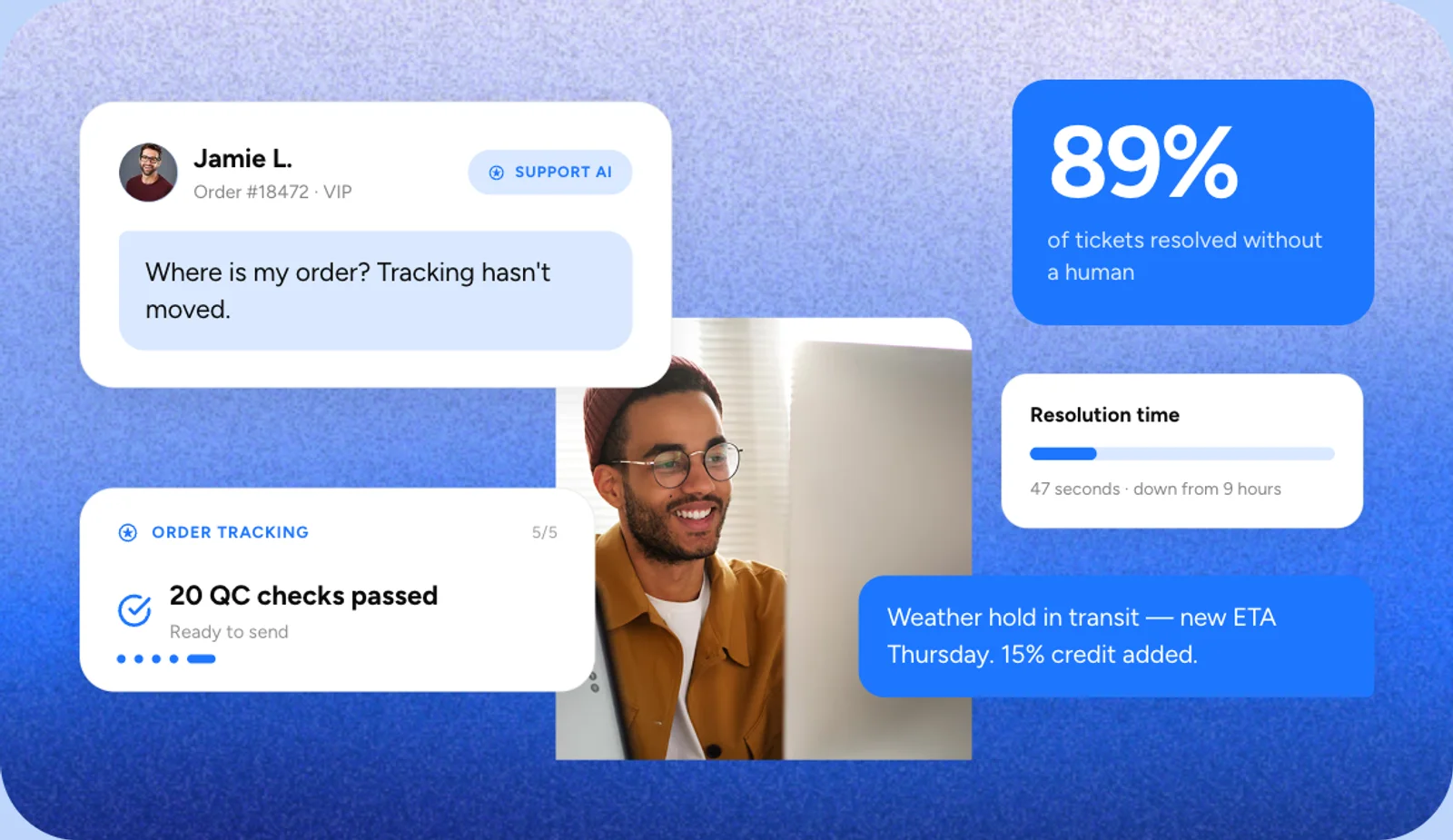
Yuma: best for ecommerce brands that need AI to take action
Image source: Yuma AI
Yuma is an AI customer service platform for ecommerce brands. With Yuma 2.0, one written Handbook, managed in plain language, runs every customer conversation across email, chat, SMS, WhatsApp, social DMs, outbound outreach and phone calls. Ask Yuma writes the Handbook from your SOPs or real tickets, every playbook carries its own tests, and changes roll out gradually.
Yuma works inside your existing helpdesk (Gorgias, Zendesk, Kustomer, Front, Salesforce, and others), takes actions in your backend, and with Web Actions can complete tasks in tools that have no API. It connects to your commerce stack: Shopify, Recharge, Loop Returns, ShipBob, Klaviyo, and more. That operational layer is what separates Yuma from traditional chatbot platforms: it can process a refund, cancel an order, update a shipping address, or pause a subscription without a human agent involved.
Actions, not just answers
Yuma executes real actions inside connected platforms. Out of the box, that includes:
Order cancellations and modifications
Full and partial refunds to original payment method or store credit
Shipping address updates
Subscription pauses, cancellations, resumes, and skips
Return and exchange creation including return label generation
Gift card and discount code issuance
Refund caps, daily cancellation limits, reship thresholds, and order identity validation are system-enforced, not soft guidelines the AI can work around. For instant resolution for common questions, those guardrails run in the background on every ticket.
Two newer capabilities extend this further. Web Actions let Yuma drive a real Chrome browser to complete tasks in tools that have no API, like carrier claim portals, supplier systems and return tools. You set one up by recording a video of yourself doing the task once. The tool needs to be reachable from a browser on the open web; on-premise and VPN-only systems aren't supported. Event playbooks start conversations from business events (an order placed, a parcel delivered, a signal from your own systems) and Yuma schedules the follow-ups itself, rather than leaving a human to hold the thread.
The same Handbook also runs the phone line. Yuma Voice answers calls 24/7 and takes backend actions mid-call, like address corrections, cancellations and refunds, each confirmed out loud first.
Quality architecture
Several components work together to keep accuracy high:
The Handbook: One versioned source of truth with brand pages (how Yuma sounds), playbooks (what to do in each customer situation) and procedures (the exact steps behind a playbook, written once and referenced everywhere). Every change is a draft until a human publishes it.
Tests: Every playbook carries example situations with the outcome you expect. On every change, Yuma reruns them as simulated conversations, with nothing real touched, and a failing test points to the page that needs fixing.
Gradual rollout: Any playbook can go live on a small share of matching conversations, for example 10%, with the rest handled as drafts your team reviews in the helpdesk.
Safety Guard: A pre-send quality gate that checks every AI-generated response for accuracy, brand voice alignment, and completeness before it reaches the customer. If it fails, Yuma retries. If it fails repeatedly, the ticket escalates to a human.
Hard Limits: System-enforced caps on destructive actions: maximum refund amounts, daily cancellation limits, gift card value ceilings, and discount code frequency. These cannot be overridden by the AI.
Fraud Shield: Order identity validation and per-customer limits on reships and gift cards, applied before any action is taken.
Playground: A simulation environment for testing Yuma's behavior on real tickets before going live, with destructive actions blocked so nothing executes during testing.
Ask Yuma: A conversational interface built into every page of the Yuma dashboard. Merchants upload an existing SOP or point at real tickets, and Ask Yuma writes the Handbook pages and their tests. The same interface diagnoses why a ticket was handled incorrectly, surfaces automation opportunities from escalated tickets ranked by impact, and generates reports across thousands of tickets without manual digging.
When the Handbook is silent, Yuma doesn't improvise. It hands the conversation to a person and logs the gap as an open question to answer once.
Verified results
EvryJewels automates 89% of its tickets with Yuma, with 63% lower cost.
Clove reached 70% automation and a 3x ROI in three months.
MFI Medical automated 64% of its tickets, with 87% faster first responses.
Yuma resolves ecommerce support tickets end to end, taking real actions inside connected platforms without human intervention. For more examples, see what AI for customer care in successful companies has in common.
Pricing
Yuma uses a per-resolved-ticket pricing model, so escalated tickets are not billed.
A 30-day free trial is included, and most brands are live within a week. Pricing is now published as illustrative annual tiers (Starter, Growth, and Scale) with per-resolution rates and a $0 implementation fee, and each bundle is sized to your forecast during a demo. See Yuma's pricing.
Limitations
Yuma works alongside a helpdesk rather than replacing one, so a supported helpdesk and commerce platform are both required.
It is built specifically for ecommerce, which means brands without that stack (SaaS companies, for example) will not get full value from it.
Best for
Ecommerce teams that want full resolutions, not just replies: DTC brands on Gorgias or Zendesk with Shopify, handling 3,000+ tickets per month, that need full autonomous resolution rather than suggested replies or ticket deflection.
See Yuma in action
Yuma resolves ecommerce support tickets (WISMO, returns, order edits, subscription changes) inside your existing helpdesk: Gorgias, Zendesk, Kustomer, Re:amaze. Most brands are live within a week. You only pay for tickets Yuma fully resolves.
Siena AI: best for DTC brands prioritizing brand voice
Image source: Siena AI
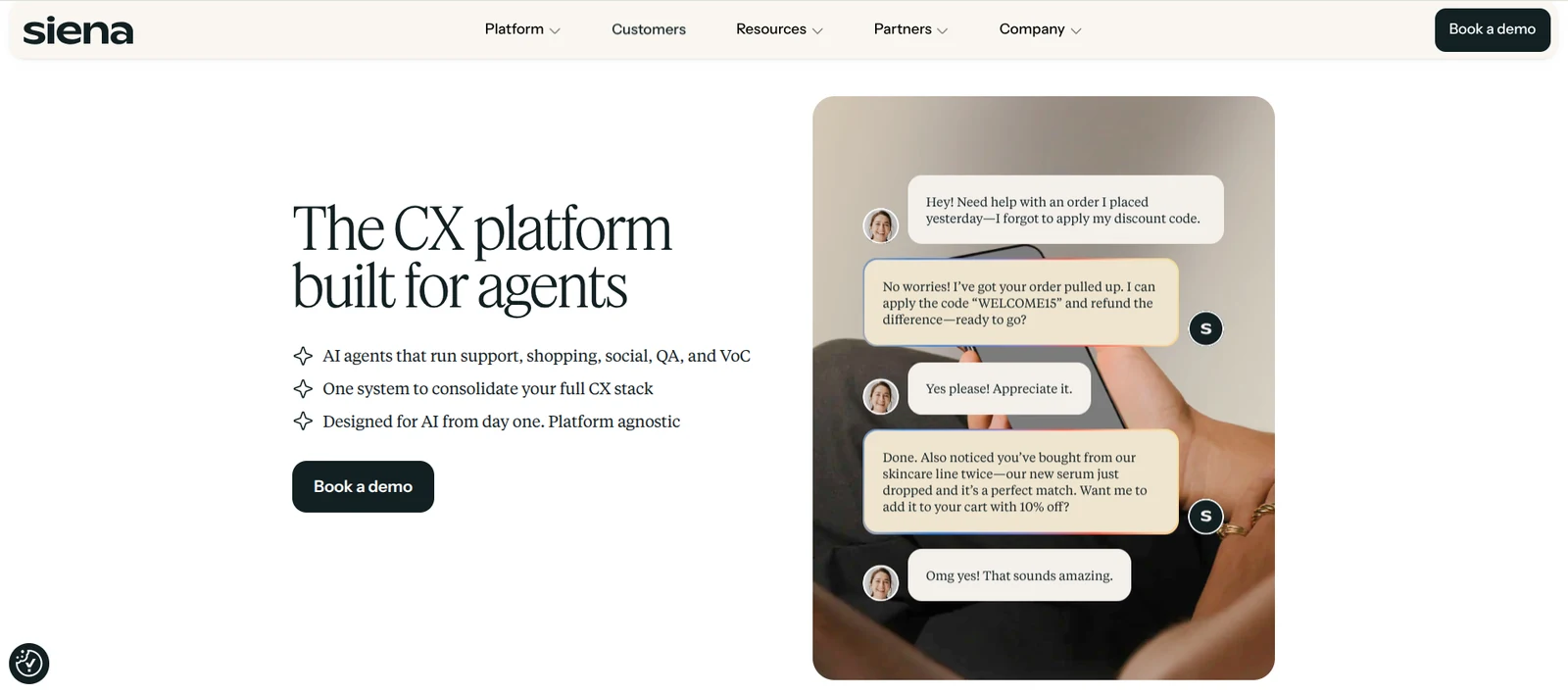
Siena is an AI agent platform built for commerce brands, connecting alongside Gorgias, Zendesk, Kustomer, and Shopify. Its core differentiator is conversational brand voice consistency rather than deep operational workflow automation. AI Personas let brands configure distinct tones per channel, a Memory capability retains customer context across conversations, and a video feature lets customers send footage of defects or issues for Siena to assess and resolve.
Where it fits
DTC brands in beauty, fashion, and lifestyle where tone and conversational warmth are the primary evaluation criteria
High-volume routine tickets across social channels including Instagram DMs, Facebook Messenger, and WhatsApp
Brands that want channel-specific brand voice configuration out of the box
Limitations
Platform fee of $750/month applies before any tickets are automated, with $0.90 per automated ticket on top, so costs compound at higher volumes.
G2 reviewers have reported the AI continuing to respond after a ticket is routed to a human agent, affecting CSAT scores.
Built exclusively for DTC and ecommerce, so it is not suited to brands outside that context.
Pricing
$750/month platform fee plus $0.90 per automated ticket. Support and implementation included.
See Yuma in action
Comparing tools? See Yuma on your own tickets
Yuma works inside your helpdesk and only charges for tickets it fully resolves.
DigitalGenius: best for enterprise retail with complex workflows
Image source: DigitalGenius
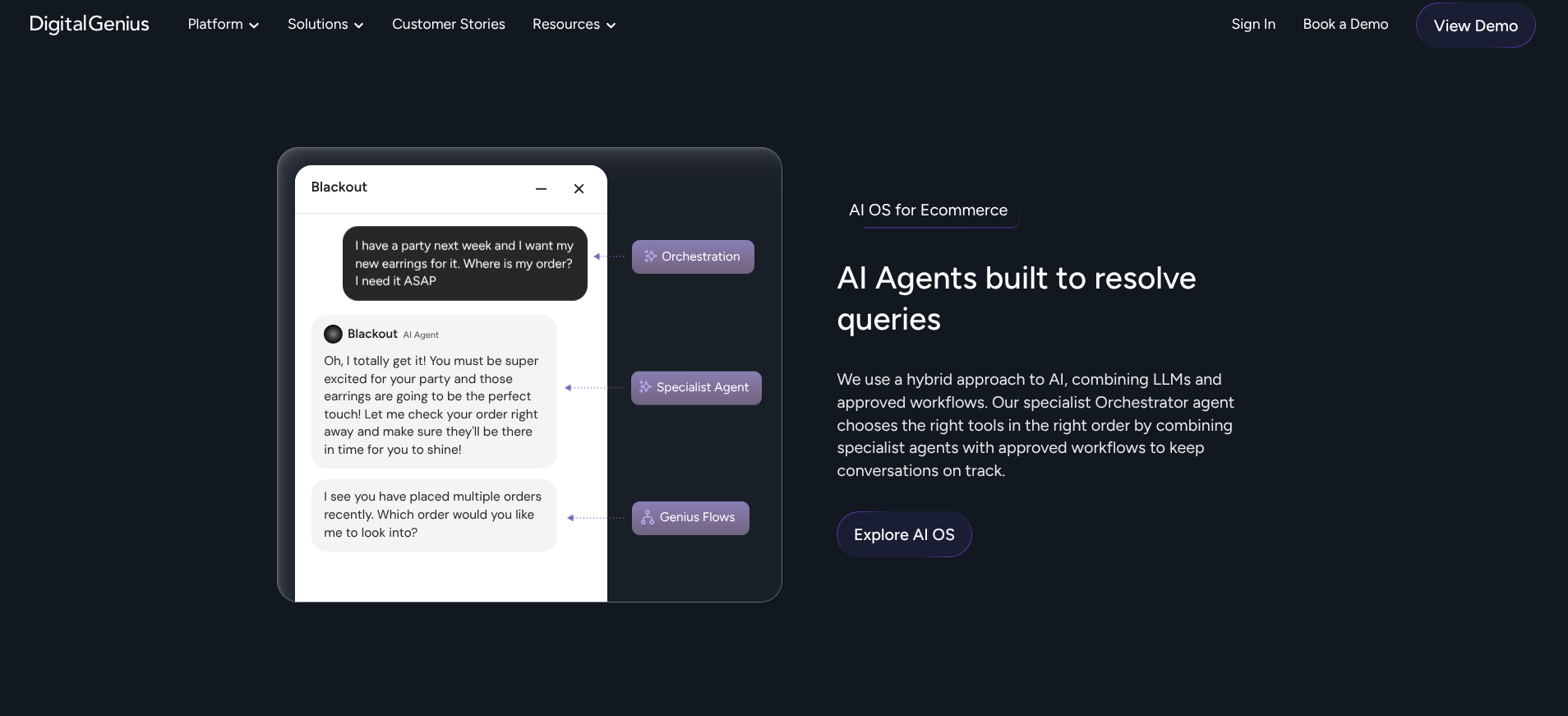
DigitalGenius is an AI agent platform built for enterprise ecommerce and retail, with over a decade of AI customer service experience and an ecommerce focus since 2020. The platform combines Conversational AI, Visual AI, Generative AI, and Voice AI to handle post-purchase support (WISMO, returns, refunds, warranty claims, and order changes) alongside pre-sales product recommendations.
DigitalGenius stands out most in environments where visual context (damaged products, warranty claims, barcode verification) is as important as conversational support. Visual AI reads customer-submitted images to assess defects and scan barcodes, enabling automated warranty resolution without human review. It connects to Zendesk, Gorgias, Salesforce, NetSuite, Microsoft Dynamics, and major carrier platforms.
Where it fits
Enterprise retailers with high volumes of warranty and defect tickets
Brands with complex logistics infrastructure requiring ERP and carrier integrations
Organizations with the technical resources and timeline to absorb a structured enterprise implementation
Limitations
Non-technical users may struggle with the portal and making adjustments independently, with training needed to get started.
No public free trial; all onboarding goes through a sales engagement.
Entry-level pricing can be high relative to other tools in this list.
Pricing
No public pricing page. From $1,000/month per the Shopify App Store listing; full pricing via sales.
Gorgias AI: best for teams wanting basic deflection without adding a new platform
Image source: Gorgias
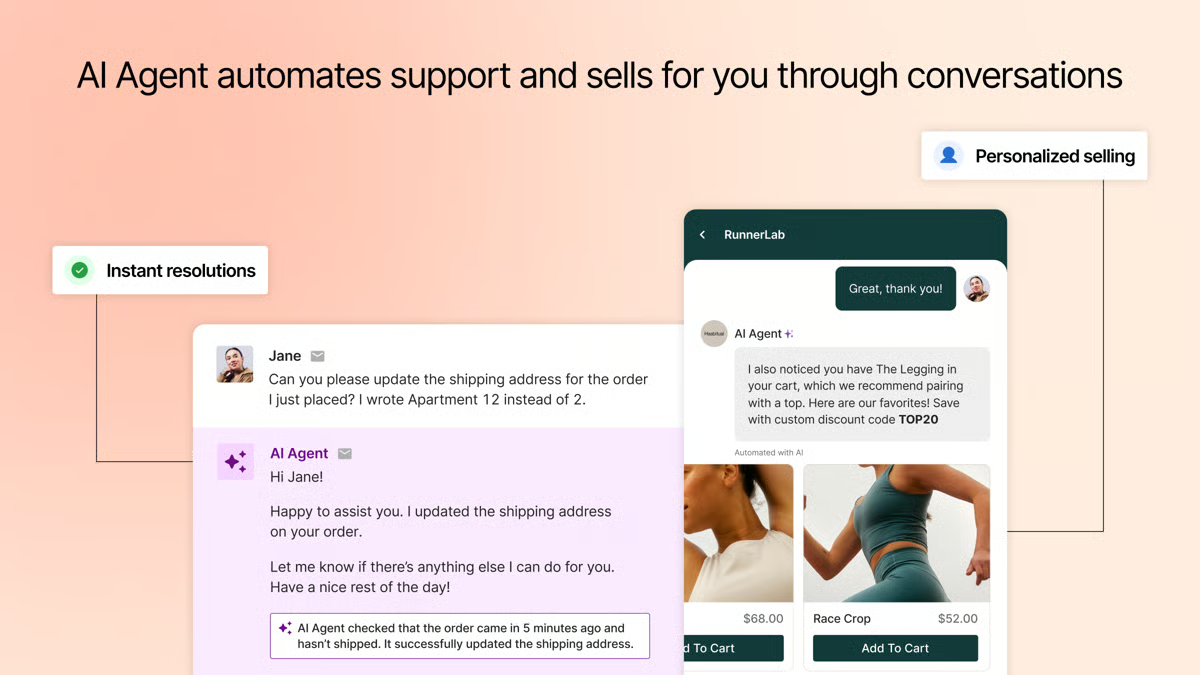
Gorgias is a helpdesk first, AI second. The AI Agent is built into the platform with two core functions: a Support Agent that handles post-purchase queries end to end, and a Shopping Assistant that engages pre-purchase shoppers with product recommendations and discounts. It runs on email, chat, and SMS, pulls live Shopify data, and can take real actions: updating addresses, cancelling orders, managing subscriptions via Loop.
Because the AI layer sits inside the helpdesk itself, teams benefit from a familiar workflow, but are also more constrained by the underlying ticketing architecture. For many teams, the tradeoff is convenience versus deeper autonomous workflows.
Where it fits
Ecommerce teams already running support through Gorgias who want automation without adding a new platform
Shopify-native brands wanting pre-purchase and post-purchase AI in a single inbox
Smaller teams with straightforward ticket types and lower volume
Limitations
AI Agent is billed separately from the helpdesk; each AI-resolved ticket also counts toward the helpdesk ticket limit, creating two charges for the same resolution.
Ticket-based pricing scales quickly during volume spikes, so peak seasons like the holidays can drive costs up significantly and make monthly budgeting difficult to predict.
Reviewers have said that configuring the AI Agent's knowledge base and automation rules has a steep learning curve, with complex rule logic that requires careful setup for advanced use cases.
Pricing
Helpdesk plans from $10/month to $750/month, based on ticket volume.
AI Agent billed separately at $0.90 per fully automated interaction.
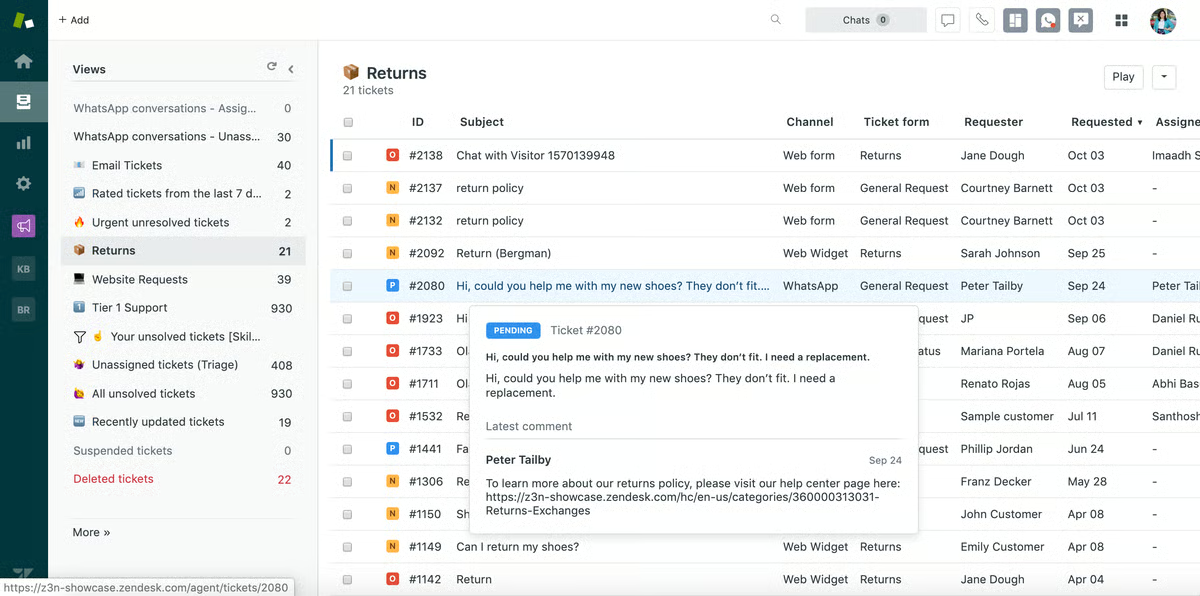
Zendesk AI: best for non-ecommerce teams already on Zendesk
Image source: Zendesk
Zendesk is a horizontal helpdesk platform serving over 100,000 companies across industries. Its AI capabilities have been built through a combination of acquisitions and internal development, and include AI agents for autonomous resolution, Copilot for agent assistance, intelligent triage, and ticket summaries.
In a recent announcement, Zendesk outlined a shift toward specialized AI agents priced on resolved outcomes rather than deflection. It runs across email, chat, voice, social, and SMS, and connects to hundreds of third-party tools: a broad coverage that suits teams wanting to gain the generative AI benefits for customer service without switching platforms.
Where it fits
Teams already standardized on Zendesk who want AI without migrating platforms
SaaS and non-ecommerce businesses needing broad industry coverage
Enterprise teams that require Zendesk's compliance, permissions, and ecosystem depth
Limitations
G2 reviewers note that AI features often require additional tuning and configuration to be effective for complex workflows, with costs compounding quickly as agent count and feature needs grow.
Reviewers also flag a steep admin learning curve. Building filters, business rules, macros, SLAs, and conditional triggers takes significant time to implement.
Ecommerce-specific workflows require more configuration than purpose-built tools.
Pricing
AI Agents are included from Suite Team ($55/agent/month, billed yearly) and above, but not available on the entry-level Support Team plan.
Copilot is a separate add-on, priced per agent per month on top of your Suite plan.
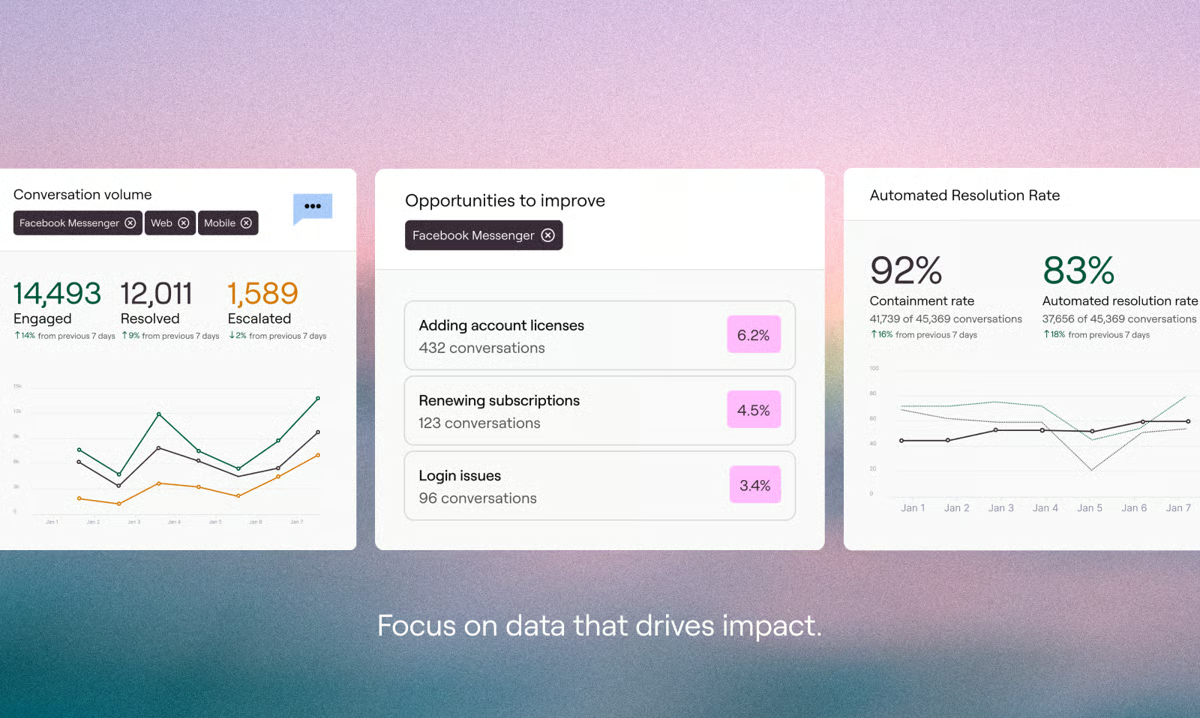
Ada: best for large enterprise across multiple industries
Image source: Ada
Ada is an enterprise AI agent platform serving ecommerce, financial services, gaming, health insurance, SaaS, and travel. It covers voice, messaging, and email, and connects to Zendesk, Salesforce, Freshworks, Gorgias, Dixa, and others via API. Its Reasoning Engine handles multi-step Playbooks (structured workflows for complex SOPs), and the platform is used by 350+ businesses including Ipsy, Pinterest, Square, and Monday.com.
Ada has an ecommerce-specific product vertical, though its architecture is built for cross-industry flexibility rather than native ecommerce workflows. Its strength is orchestration across channels and industries, rather than ecommerce-native actions out of the box.
Where it fits
Large enterprise brands needing voice, messaging, and email AI at scale across multiple industries
Organizations with dedicated implementation resources and enterprise budget
Teams needing coverage across every channel, including voice, at enterprise scale
Limitations
No public pricing; all contracts are sales-gated and custom.
Reviewers have noted that integrating Ada with existing helpdesk infrastructure required multiple workaround solutions.
Cross-industry architecture means ecommerce-specific workflows (returns, subscription management, WISMO) require custom configuration via Ada's Playbooks.
Pricing
No public pricing page. Custom enterprise contracts only. See Ada's website to request a demo.
Tidio Lyro: best for SMBs getting started with AI
Image source: Tidio
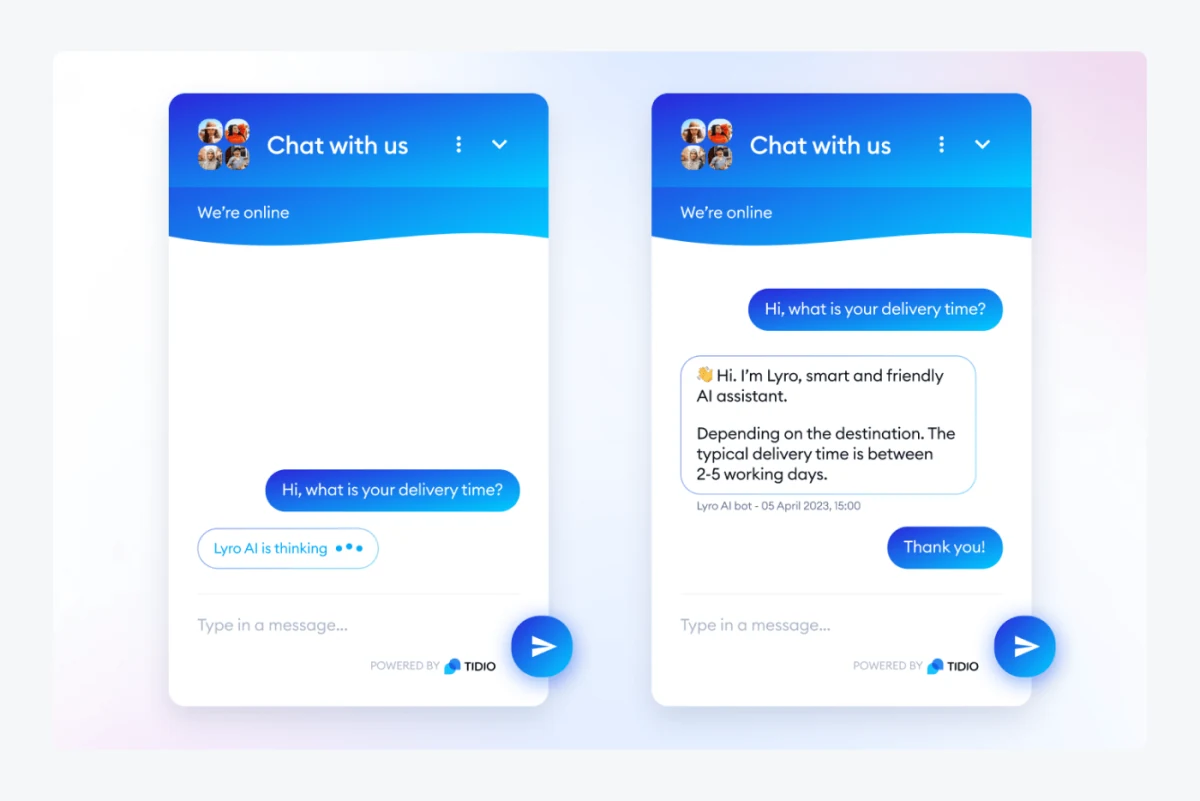
Tidio is a customer service platform combining live chat, automation Flows, and Lyro, its AI agent built for small and mid-sized teams. Lyro claims to automate up to 67% of customer queries, draws from your existing help content, and supports 47 languages. It runs on live chat, Messenger, Instagram, and WhatsApp, with native Shopify and WooCommerce integrations for order status, refunds, and product recommendations. Lyro is available as part of the Tidio platform or as a standalone product alongside other helpdesks. Over 300,000 businesses use Tidio, the large majority of them small teams.
Where it fits
Small to mid-sized businesses wanting an accessible AI entry point without enterprise complexity
Teams already using Tidio for live chat wanting to add AI without changing platforms
Teams where Lyro can draw from well-maintained help content
Conversation caps on lower-tier plans feel restrictive, and costs ramp up quickly when adding multiple operators, which can hurt growing small businesses with tighter budgets.
Lower-tier users may also need to manually re-sync content when their website or help documentation changes.
Combined Lyro + Tidio Help Desk plans from EUR32.50/month.
Lyro AI Agent standalone option available with pay-per-AI-conversation pricing.
Before you book a demo: what to work out first
You have likely reached this point having scanned the list and identified two or three tools worth a closer look. The questions below are designed to sharpen that shortlist before you spend time in vendor demos. For a broader evaluation framework, use our guide to choosing an AI tool for ecommerce support.
Deflection vs. resolution: know what you are actually buying
These two terms get used interchangeably in vendor marketing, but they describe fundamentally different outcomes.
Deflection means a customer finds an answer without a human agent getting involved. The ticket may or may not have been fully resolved. The key metric is volume reduction for your team.
Resolution means the customer's issue was closed end to end without human intervention. The key metric in this case is cost per ticket and customer satisfaction.
This distinction tends to change the ROI calculation significantly. A tool that deflects 60% of tickets reduces agent workload, whereas a tool that resolves 60% of tickets closes those tickets completely.
A useful test: ask any vendor whether the tool can process a return without human intervention. If the answer comes with caveats about configuration, custom development, or specific plan tiers, you are likely looking at a deflection tool.
Match the tool to your stack, volume, and vertical
The right fit tends to depend on your helpdesk setup, ticket volume, and vertical. Getting these wrong adds configuration overhead that slows deployment and distorts your automation rate.
Start with your helpdesk. Some tools are built into a helpdesk (Gorgias AI, Zendesk AI), others work alongside any helpdesk (Yuma, Siena). If you are evaluating a tool that sits inside your existing helpdesk, it is worth asking whether the AI layer was purpose-built for resolution or added on top of a ticketing architecture that was not originally designed for it.
Volume is another important factor. Entry-level tools like Tidio make sense for teams handling a few hundred tickets a month. The ROI case for purpose-built AI agents tends to strengthen at 3,000+ tickets per month, where per-resolved-ticket pricing becomes more favorable than per-agent pricing. If you are an ecommerce brand working out how generative AI fits into your support operation as you scale, our guide to ecommerce customer service with AI covers the full picture.
Vertical fit is worth checking separately. Ecommerce brands often need native integrations with Shopify, returns platforms, and subscription tools, which is why many teams start by comparing AI tools for customer support built specifically for ecommerce workflows. Enterprise retailers with high warranty claim volumes may benefit from visual AI that most ecommerce-specialist tools do not offer.
McKinsey's customer-care research also points to a broader pattern: AI can unlock large portions of addressable care volume, but the biggest gains come when teams invest at scale and design around trust, not just automation.
Five questions to ask in every vendor demo
Bring these to your next call:
Does this natively take actions like processing returns and cancellations, or does that require custom development? This separates tools that resolve from tools that deflect.
What happens when the AI cannot handle a ticket? Ask how escalation works, and whether the AI stays out of the conversation after handoff. Escalation logic varies significantly and directly affects CSAT.
How do you define "resolved" in your pricing model? Some vendors count a conversation as resolved when the customer stops replying. Others only count it when a specific action was completed.
Can I test this on my actual ticket data before committing? Trial access to real tickets is one of the more reliable ways to validate automation-rate claims.
Who handles setup: your team or mine? White-glove onboarding means the vendor configures everything. Self-serve means your team does. Both have tradeoffs, but you need to know upfront what your time commitment looks like.
Chatbots answered questions. AI agents close tickets.
There are good options in this list for different situations. If you are working out where to start, the deflection vs. resolution question is probably the most useful filter. It shapes the pricing model, the ROI calculation, and what your team stops doing with each tool.
For ecommerce brands that need end-to-end resolution inside their existing helpdesk, that is what Yuma is built for. Most brands are live within a week, with no engineering required from your team, and Yuma only charges for tickets it fully resolves.
See Yuma in action
Yuma resolves ecommerce support tickets (WISMO, returns, order edits, subscription changes) inside your existing helpdesk: Gorgias, Zendesk, Kustomer, Re:amaze. Most brands are live within a week. You only pay for tickets Yuma fully resolves.
Frequently asked questions about AI chatbots for customer service
What is the difference between an AI chatbot and an AI agent?
A chatbot answers questions using pre-written responses or knowledge base content. It can deflect tickets and route customers to humans, but it cannot take action on their behalf. An AI agent goes further: it connects to your systems, applies your business rules, and resolves tickets end to end without human involvement. For a deeper look, generative AI vs chatbots covers the distinction in detail.
Do I need to replace my helpdesk to use one of these tools?
No. Many tools in this list work alongside your existing helpdesk rather than replacing it. Yuma, Siena, and DigitalGenius all connect to helpdesks like Gorgias and Zendesk without requiring migration. Gorgias AI and Zendesk AI are built into their respective helpdesks, so if you are already on one of those platforms, the AI layer is available without adding a new tool.
Which of these tools works with Gorgias?
Several tools in this list connect to Gorgias. Yuma, Siena, DigitalGenius, and Ada all work alongside Gorgias as an AI layer on top. Gorgias AI is Gorgias's own native AI product, built directly into the helpdesk. For brands on Gorgias wanting full autonomous resolution rather than deflection, Yuma is purpose-built for that use case.
How do I know what automation rate to expect?
Vendor automation-rate claims vary significantly depending on how "automated" and "resolved" are defined. Some vendors count a conversation as resolved when the customer stops replying, even if the issue was not closed. Others only count fully resolved tickets where an action was taken. Before evaluating any number, ask the vendor for their specific definition. The metric most worth comparing is fully resolved tickets: conversations the AI closed without any human involvement.
Is AI customer service right for a small ecommerce brand?
Entry points exist across most tiers of this list. Tidio's free plan, for example, gives small teams access to Lyro at low cost. That said, the ROI case for purpose-built AI agents tends to strengthen meaningfully at 3,000+ tickets per month, where the cost per resolved ticket starts to work in your favor. Below that threshold, a simpler deflection tool or a well-maintained help center may deliver more value for less investment.