A comparison of eight AI customer service platforms scored for ecommerce teams, organized around one distinction the rest of the category ignores: whether the AI takes actions and closes tickets, or only drafts replies a human still has to send. Covers what each tool does, where it fits, what it costs, and where it falls short.
1 / 12The best AI customer service platforms for 2026
Key takeaways
The first test for any platform is whether it resolves tickets by taking actions or only drafts replies for a human to send.
The post compares eight platforms: Yuma, Gorgias AI, Siena AI, Zendesk AI, Ada, DigitalGenius, Sierra and Tidio (Lyro).
Tools that act only through APIs escalate tickets needing web-only portals or third-party waits, where automation rates plateau.
Yuma plans start at $14,400 per year for 12,000 resolutions, roughly $1.20 per resolution.
At $0.99 per outcome and 10,000 conversations a month, per-resolution pricing adds $9,900 in AI costs on top of seat fees.
If you're evaluating AI customer service platforms for an ecommerce brand, the first question is whether the tool resolves tickets or just responds to them. A platform that takes actions, such as processing refunds, pulling tracking data, and canceling orders, closes tickets without anyone touching them. A platform that drafts replies still requires a human to send them.
This list evaluates eight platforms through that lens, covering what each tool does, where it fits, what it costs, and where it falls short.
See Yuma in action
The tickets burying your team are the same ones AI handles best. See it on your own data.
The eight tools below are evaluated for ecommerce teams that need AI to take real actions inside their commerce stack. Information is current as of July 2026, gathered from each vendor's website and G2 reviews. SaaS moves quickly and some features or pricing may have changed. Always check the vendor's website directly.
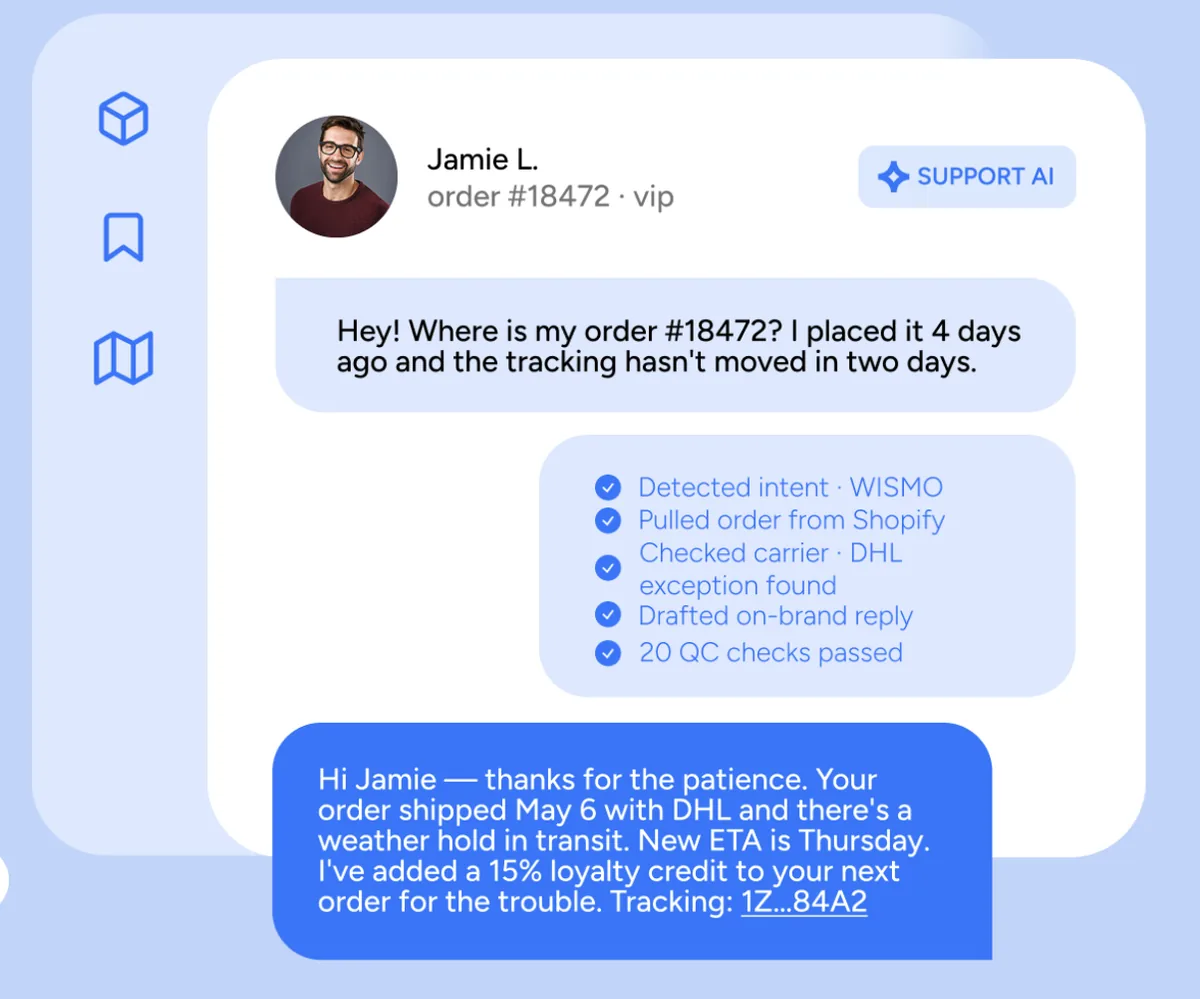
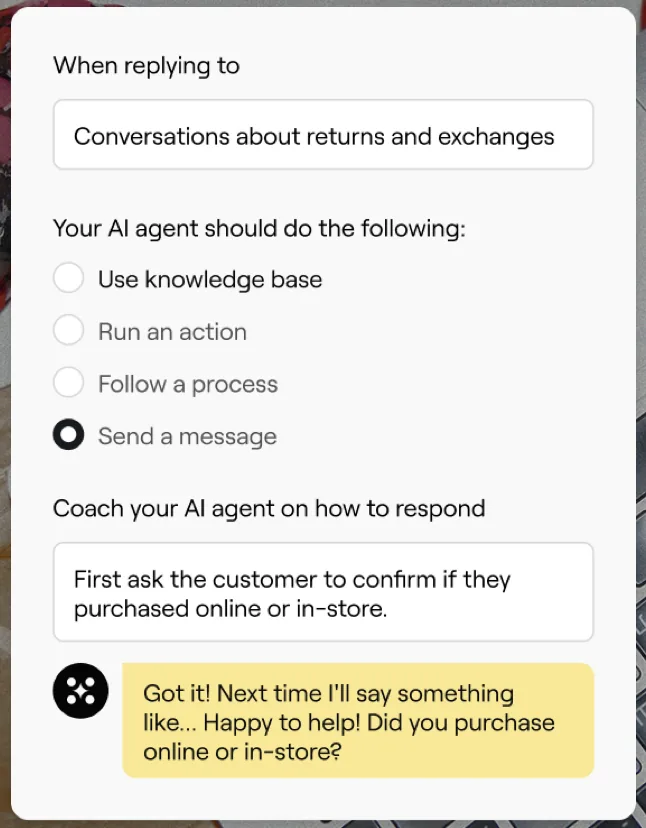
Yuma is an AI customer service platform for ecommerce brands. With Yuma 2.0, one written Handbook, managed in plain language, runs every customer conversation across email, chat, SMS, WhatsApp, social DMs, outbound outreach and phone calls. Ask Yuma writes the Handbook from your SOPs or real tickets, every playbook carries its own tests, and changes roll out gradually. Yuma works inside your existing helpdesk, takes actions in your backend, and with Web Actions can complete tasks in tools that have no API.
Best for: ecommerce teams that want full resolutions, not just replies.
Proof: EvryJewels 89% of tickets automated, Petlibro 79%, Clove 70%.
Yuma resolves tickets end to end inside your existing helpdesk, processing refunds, pulling tracking data, canceling orders, and managing subscriptions. Rather than a separate configuration for every ticket type, one Handbook of brand pages, playbooks and procedures sets how each situation is handled. Yuma is backed by Y Combinator and serves household-name brands including Glossier, Clove, and EvryJewels, and taking real actions is one of the key reasons generative AI for customer support outperforms traditional automation approaches.
Two capabilities extend Yuma's reach beyond what API-connected tools can do. Web Actions let Yuma drive a real Chrome browser to complete tasks in tools that have no API, such as carrier claim portals, supplier systems, and legacy return tools. You set one up by recording a video of the task, and the tool needs to be reachable from a browser on the open web, without a VPN. Outbound event playbooks start conversations from business events, like an order placed or a parcel delivered, and Yuma schedules multi-day follow-ups itself, so no human has to hold the thread.
Clove switched to Yuma after their previous AI partner lacked guardrails. Within three months, they reached 70% automation and achieved 3x ROI, with much faster first responses and lower CX costs.
"It's refreshing to have a partner that's just really trying to make our experience with the product as successful as possible."
Gabe Walker, Customer Service Manager, Clove
Key features
One Handbook of brand pages, playbooks and procedures runs every channel, so there's one set of rules to maintain
Ask Yuma writes and updates the Handbook in plain language from your SOPs or real tickets, and every change lands as a draft until you publish
Per-playbook tests, rerun as simulated conversations before a change goes live, plus gradual rollout on a share of conversations
Extensive Shopify actions including refunds, cancellations, order edits, reships, and gift card creation
Web Actions for tools with no API, like carrier claim portals and supplier systems, as long as they're reachable on the open web
Outbound event playbooks that start conversations by email or SMS from order and delivery events
Support AI, Sales AI and Yuma Voice on the same Handbook, covering post-purchase resolution, pre-sale conversion, on-site chat, social, and the phone line
Brand pages per channel, store and language, so email, chat and social can each keep their own tone
Flows for deterministic logic when you want a fixed process rather than AI judgment
Deep Search for CX intelligence, surfacing patterns across your ticket history to find automation opportunities
Auto-translation with regional dialect support, handling formal vs. informal address in French, German, Spanish, and Portuguese
Pros
End-to-end ticket resolution with real actions inside connected platforms.
Works inside Gorgias, Zendesk, Kustomer, and Gladly without re-platforming.
Answers the phone too: Yuma Voice takes calls 24/7 and makes changes in your backend mid-call, reading the same Handbook as email and chat.
Web Actions and outbound event playbooks reach the tools and moments that API-only setups leave to humans.
White-glove onboarding, with most brands live within a week.
Performance-based pricing where only resolved tickets are billed.
SOC 2 Type II certified.
Limitations
Ecommerce only, so SaaS companies and brands without a supported commerce platform won't get full value.
Setup requires onboarding with Yuma's team rather than instant self-serve.
Every plan carries a 12-month commitment, so it isn't built for month-to-month experimentation.
Pricing: Outcome-based pricing. Plans start at $14,400 per year for 12,000 resolutions, which works out to roughly $1.20 per resolution, and the effective rate drops at higher volume bands.
Ideal use case: Mid-to-large ecommerce and DTC brands on Shopify with Gorgias or Zendesk, handling 3,000+ tickets per month, that need autonomous resolution across every channel, including the phone. Especially strong for brands dealing with web-only carrier portals or multi-step workflows that previously required human handling.
2. Gorgias AI
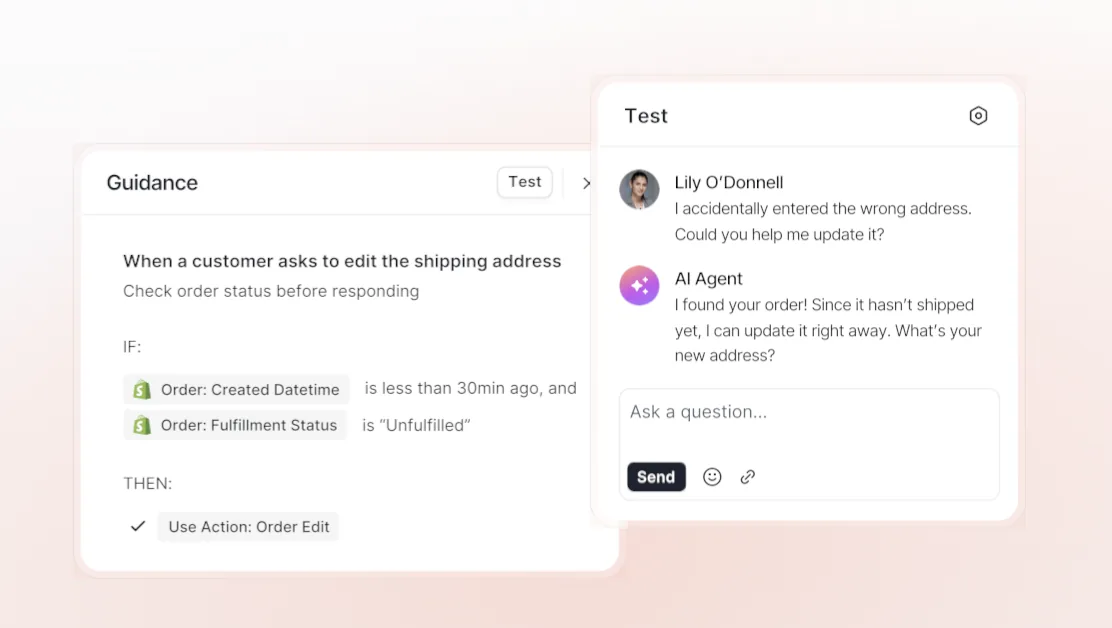
Gorgias is an ecommerce helpdesk with a built-in AI Agent that handles both pre-purchase and post-purchase conversations. The Shopping Assistant engages shoppers with product recommendations and discounts, while the Support Agent can resolve post-purchase tickets including order tracking, refund processing, subscription edits, and return initiation.
AI Agent with Shopping Assistant and Support Agent modes
Shopify Actions for order edits, refunds, and returns within the conversation
Guidance rules for custom behavior
Unified inbox across email, chat, social, SMS, and voice
Pros
Deep Shopify integration.
Helpdesk and AI share a single platform, so agents and AI work from the same context.
AI trained on millions of ecommerce scenarios through an OpenAI partnership.
Limitations
AI pricing is separate from helpdesk plan costs, with rates varying by tier and an overage rate of $1.50 per interaction on most plans.
Interactions are billed as automated once 72 hours have passed without human handover, so there can be a reporting delay.
Pricing: The Starter plan with an AI Agent costs $40 per month, with $1.50 interaction fees if you go past your limit. Helpdesk features are another $10 monthly fee.
Ideal use case: Shopify brands that want helpdesk and AI in one platform without adding a third-party AI layer.
3. Siena AI
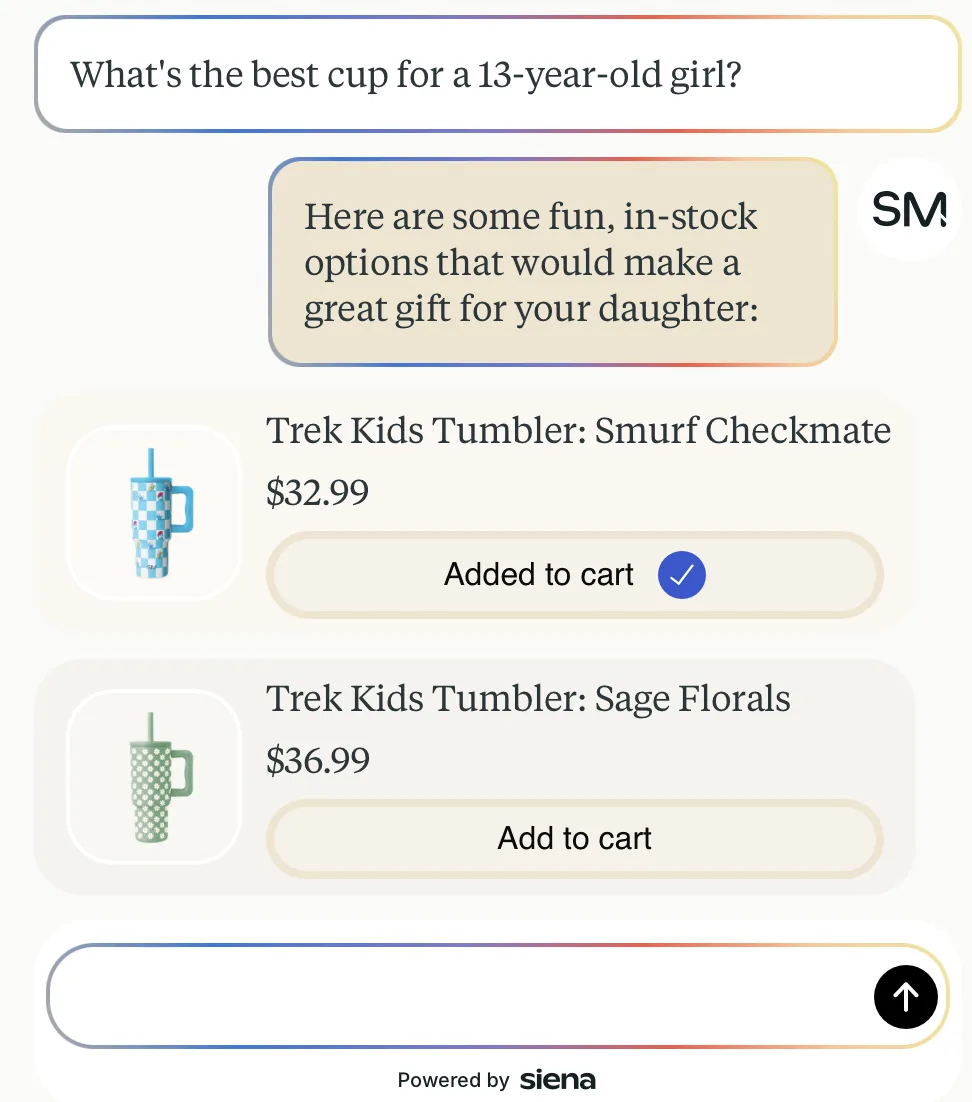
Siena is an autonomous customer service platform built for DTC ecommerce. It uses a Cognitive Reasoning-Based Engine (CORE) and AI personas to handle conversations with brand-specific empathy across email, chat, WhatsApp, Instagram DMs, and SMS.
Siena connects to Shopify, Zendesk, and Kustomer, and takes real actions including processing returns, editing orders, tracking shipments, and managing subscriptions. If brand voice is your main criterion but the price tag gives you pause, we've compared the Siena AI alternatives for ecommerce customer service in more depth.
Ecommerce actions for returns, refunds, and order edits
Multi-channel support including social DMs and WhatsApp
Subscription management via integrations like Loop
Pros
Strong brand voice fidelity.
Good customer support.
Handles both routine and moderately complex ecommerce tickets.
Limitations
$750/month platform fee plus $0.90 per automated ticket, so costs compound at higher volumes.
G2 reviews flag a routing issue where the AI sometimes fails to escalate or prematurely closes a ticket.
Requires a separate helpdesk.
Pricing: $750/month platform fee plus $0.90 per automated ticket. Support and implementation included.
Ideal use case: DTC brands in beauty, fashion, and lifestyle that prioritize brand voice and empathic AI and are willing to invest $750+/month for a dedicated AI layer on top of their helpdesk.
See Yuma in action
Comparing tools? See Yuma on your own tickets
Yuma works inside your helpdesk and only charges for tickets it fully resolves.
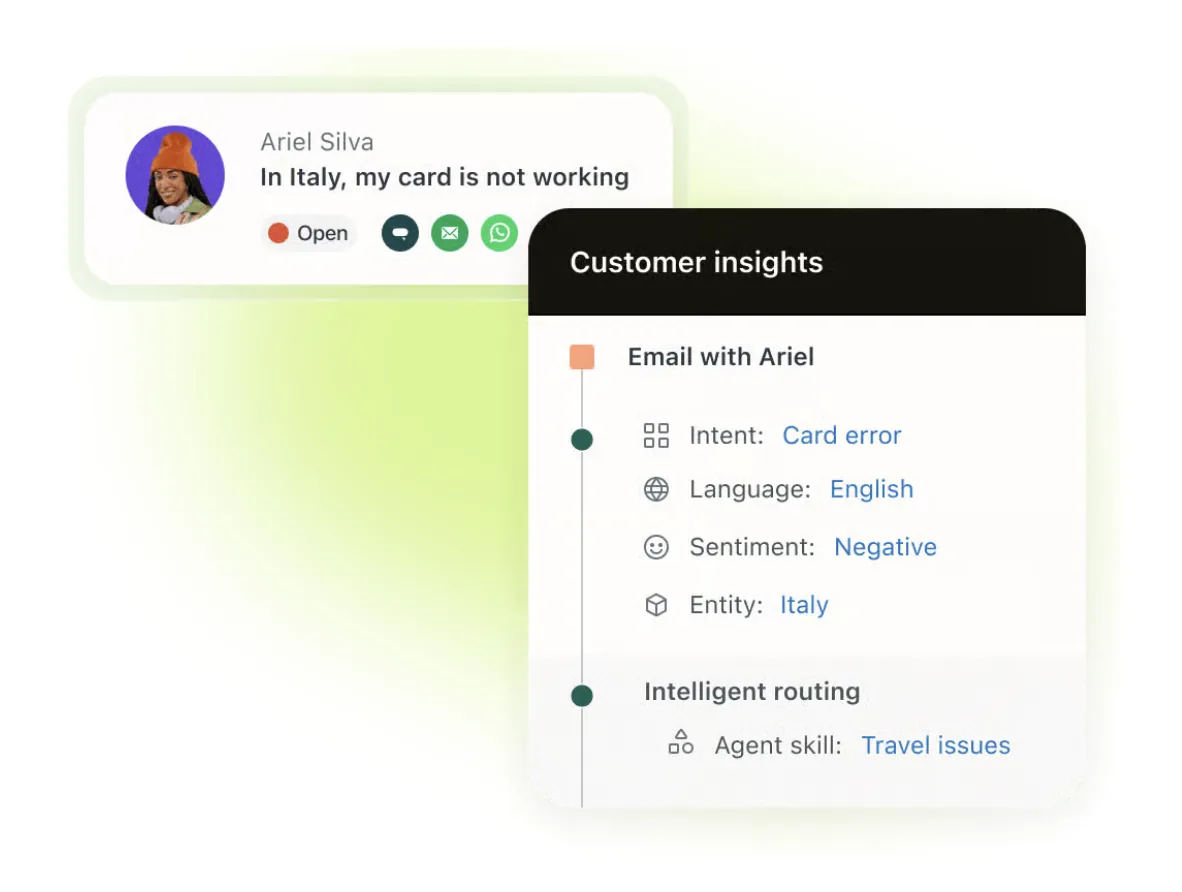
Zendesk is an enterprise customer service platform with AI features layered across its Suite plans. AI capabilities include AI Agents for autonomous resolution, intelligent triage for automatic ticket classification and routing, AI-generated reply suggestions for agents, and Answer Bot for self-service deflection.
The platform supports email, chat, messaging, voice, and social with an extensive marketplace of third-party integrations.
Intelligent triage that auto-classifies and routes
Unified agent workspace with full customer history
Pros
Enterprise-grade with a massive integration ecosystem.
Strong reporting and analytics.
Works across industries and scales to large teams.
Limitations
AI agent features require higher-tier Suite plans, and some AI features like Copilot come at an extra add-on cost.
Ecommerce-specific workflows such as Shopify order actions require third-party marketplace apps rather than native integrations.
G2 reviewers note a steep learning curve for complex features like automation and workflows.
Pricing: AI Agents included from Suite Team ($50/agent/month billed yearly) and above. Copilot is a separate add-on priced per agent per month on top of the Suite plan.
Ideal use case: Enterprise teams already standardized on Zendesk who want native AI features without adding a third-party tool, particularly SaaS and non-ecommerce businesses that benefit from Zendesk's broad industry coverage.
5. Ada
Ada is an AI-native customer service platform. Its Unified Reasoning Engine connects to CRMs, billing platforms, and commerce tools to resolve multi-step issues across chat, email, voice, SMS, and social. SOP-driven playbooks structure how the AI resolves issues. Ada supports 60 languages and is positioned for enterprise buyers across industries.
Multi-channel resolution across chat, email, voice, SMS, and social
60 language support
Native integrations with Salesforce and Zendesk
Pros
AI-native architecture.
No-code builder accessible to non-technical teams.
Strong multi-channel and multilingual coverage.
Limitations
Enterprise-priced with a sales-led process and no publicly listed rates.
No Shopify integration at the time of publishing.
G2 reviewers flag integration complexity during workflow setup.
Cross-industry architecture means ecommerce-specific workflows like returns and subscription management can require custom configuration via playbooks.
Pricing: No public pricing page. Custom enterprise contracts only.
Ideal use case: Enterprise brands with high conversation volume across industries that need multi-channel, multilingual AI and have the budget for a sales-led engagement.
6. DigitalGenius
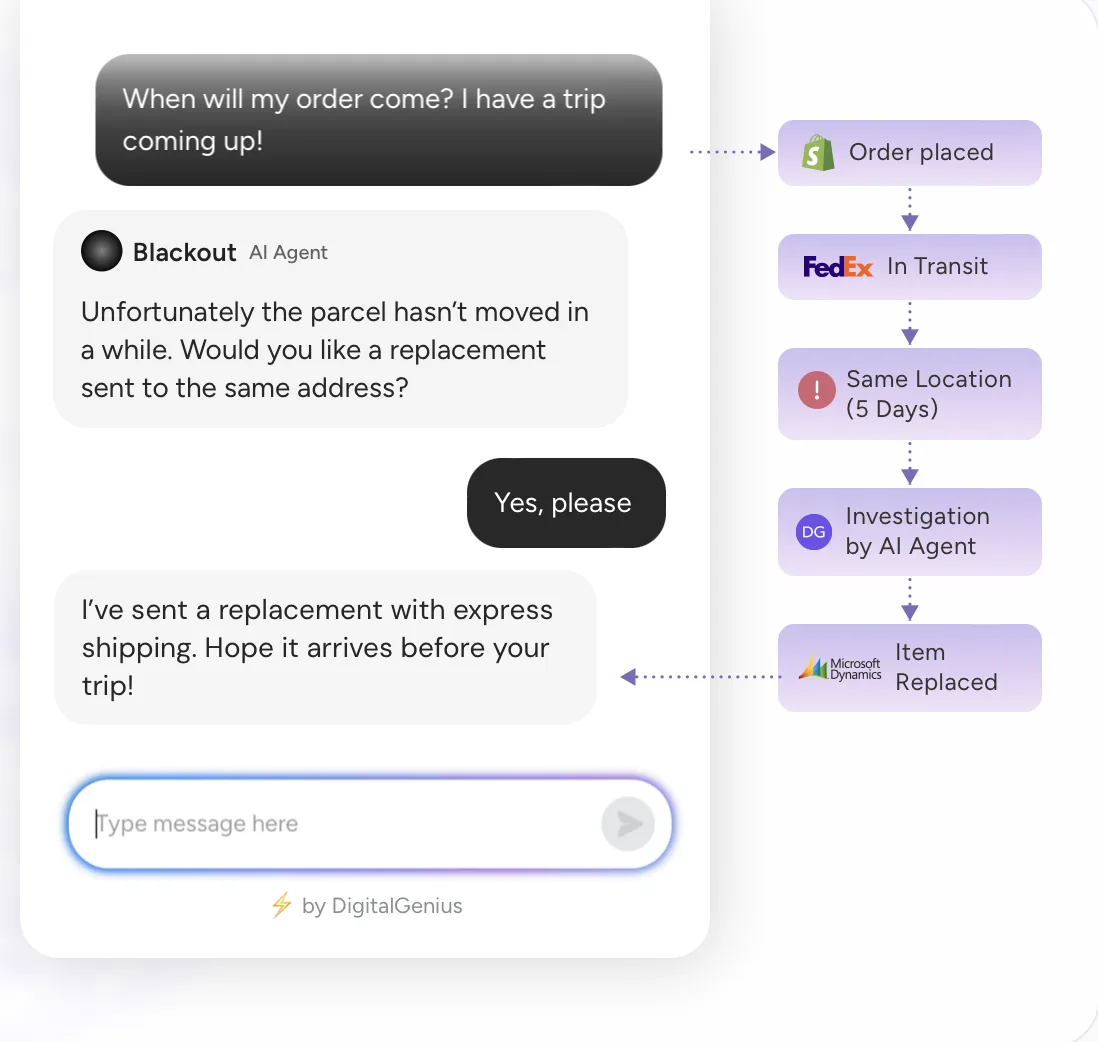
DigitalGenius is an AI customer service platform built for ecommerce with 50+ pre-built use cases covering order status, returns, exchanges, shipping inquiries, refund processing, and product questions.
The platform includes visual AI for analyzing customer-submitted photos of damaged items or wrong products, and deep carrier integrations for real-time shipping data. It also offers voice AI for phone support. If its pre-built library doesn't line up with your workflows, we've mapped the DigitalGenius alternatives for ecommerce brands worth shortlisting instead.
Visual AI for product defect detection from photos
Pre-built ecommerce use cases
Deep carrier and shipping integrations
Voice AI for phone support
Conversational AI for ticket handling
Pros
Ecommerce-specific with strong shipping and logistics integrations.
Visual AI is a genuine differentiator for damage claims and warranty tickets, where a photo determines the resolution.
Pre-built use cases reduce configuration time for common scenarios.
Limitations
Some G2 reviewers note complex processes.
Other reviewers note limited reporting capabilities.
Less flexibility for edge cases outside the pre-built library.
Pricing: No public pricing page.
Ideal use case: Ecommerce brands with complex shipping, logistics, and damage-claim workflows that need carrier-level integrations and visual AI.
7. Sierra
Sierra is an AI-native customer service platform co-founded by Bret Taylor (former Salesforce co-CEO, current OpenAI board chairman) and Clay Bavor (18-year Google veteran). It uses outcome-based pricing where customers are billed based on business results achieved by the AI agents. The company raised $950 million in May 2026 at a $15.8 billion valuation.
Agentic resolution with autonomous multi-step workflows
Outcome-based pricing
Enterprise-grade security and compliance
Multi-channel support
Pros
Founded and led by proven enterprise leaders.
Outcome-based pricing aligns vendor incentives with results.
Strong enterprise customer base.
Limitations
One G2 review said the pricing model made it difficult to predict costs long-term.
Advanced configurations can be challenging or time-consuming to learn.
Pricing: No public pricing page, though they use outcome-based pricing.
Ideal use case: Enterprise retailers with high ticket volume and the budget for a sales-led engagement who want pricing tied to business outcomes.
8. Tidio (Lyro)
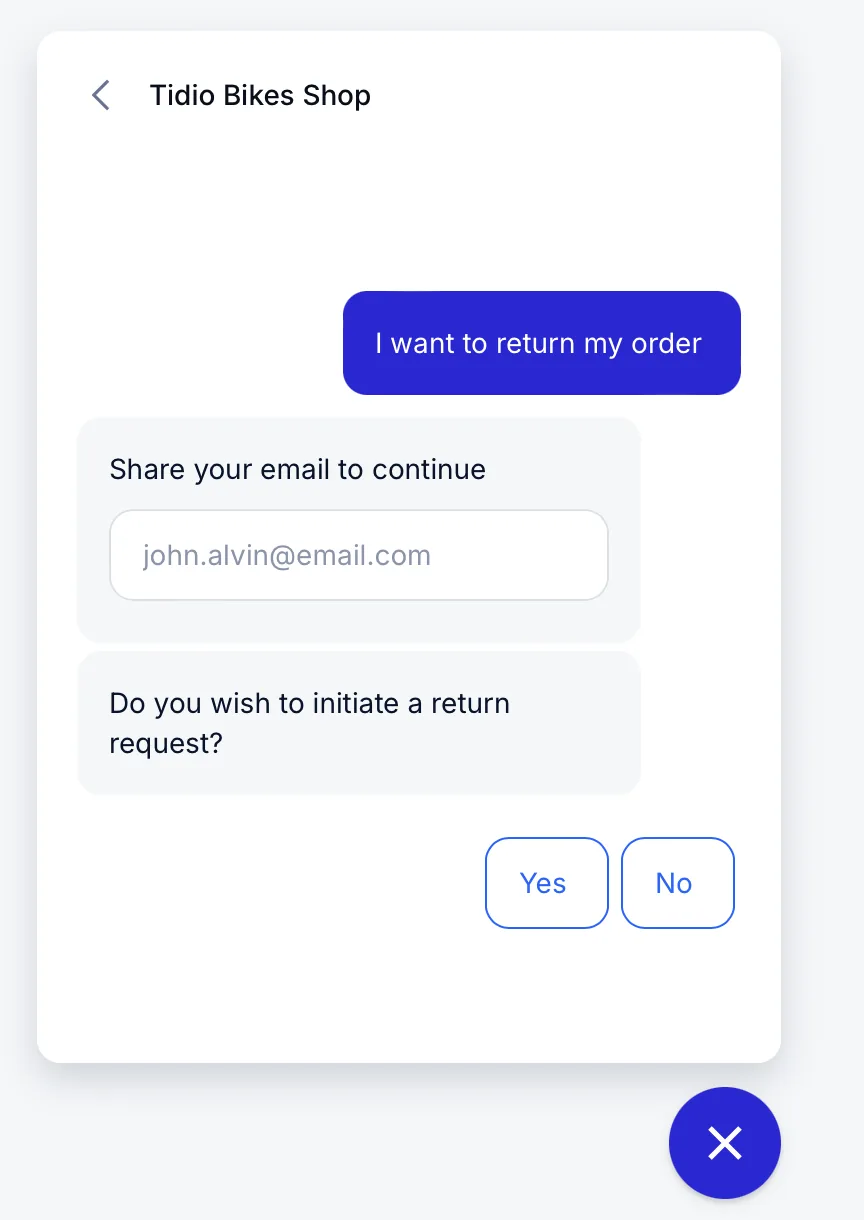
Tidio is a customer service platform built for small and mid-sized businesses. Lyro, its AI agent, handles repetitive questions from help center content and hands off to human agents with context when it can't resolve. The platform supports chat, email, Instagram, Messenger, and WhatsApp with a visual Flows builder for custom automations.
Multi-channel inbox across chat, email, Instagram, Messenger, and WhatsApp
50 free AI conversations to start
Live chat
Pros
Low starting entry cost, with one-off 50 free AI conversations.
Free tier available for testing.
Visual builder accessible to non-technical teams.
Easy setup.
Limitations
Tidio is conversational but limited on actions. It answers questions, but needs to escalate to a human to process refunds.
The free tier's 50 conversations are one-time and do not reset.
Some users report website performance issues with the widget.
Pricing: Free plan with 50 lifetime Lyro conversations. Combined Lyro pricing itself starts at approximately $32.50/month, and includes 50 conversations.
Ideal use case: Small Shopify stores testing AI for customer service for the first time, with low volume and a limited budget.
A buying guide for AI customer service platforms
Before booking demos, three questions will help you narrow the AI customer service software field to the platforms that actually fit your operation.
Actions vs. answers: can it actually resolve tickets?
The first question when evaluating any platform on this list is whether the AI takes actions or only drafts replies. For ecommerce brands, this determines whether you're getting real automation or just a slightly faster inbox. The CX Automation Benchmark 2026 report found that automating 70% of key tasks is a strong result across ecommerce brands of all sizes, which means the gap between tools that act and tools that answer has a direct impact on how close you get to that ceiling.
But even among tools that take actions, there's a second layer worth examining. AI platforms that act through APIs can only reach systems with API access. If a carrier portal, supplier system, or return platform is web-only, the ticket gets escalated to a human regardless of how capable the AI is.
Similarly, platforms that handle single-turn workflows can't manage resolutions that require waiting for a third party to respond, such as a warehouse confirmation or a brand partner reply. A human has to hold the thread.
When evaluating customer service automation software, ask whether the tool can reach web-only systems and whether it can pause and resume across multi-party workflows. Those two gaps are where automation rates plateau.
Integration fit: does it work with your existing stack?
Forrester predicts service quality will dip in 2026 as companies rush to scale AI without addressing the operational gaps that scaling exposes. One of the fastest ways to create those gaps is choosing a tool that doesn't fit your stack.
Check three things:
Helpdesk compatibility: Does it work inside Gorgias, Zendesk, Kustomer, or whatever platform your team uses today?
Commerce platform requirements: Does it connect natively to Shopify or BigCommerce, or does it require middleware?
Existing tech stack alignment: Does it work alongside your current setup or force a platform migration? A tool that requires re-platforming is a six-month project before you automate a single ticket.
Pricing: what are you actually paying for?
It's important to understand how pricing will impact your ability to scale. Be clear about contract terms upfront so you can choose a tool that scales alongside you.
There are three common pricing models in this category:
Per-seat charges based on how many agents use the platform. You get predictable monthly costs, but the vendor has no incentive tied to how many tickets the AI actually resolves.
Per-resolution or per-outcome charges for each conversation the AI closes or hands off with a billable result. This model aligns cost with output, but scales fast at volume. At $0.99 per outcome and 10,000 conversations per month, that's $9,900 in AI costs alone on top of seat fees.
Outcome-based pricing charges only for tickets the AI fully resolves without human involvement. Escalated tickets aren't billed, which aligns vendor incentives with results.
Finding the right AI customer service platform for your ecommerce brand
The Forrester State of Agentic AI report finds that while adoption of agentic AI is widespread, few organizations have closed the gap between pilot and production. The right tool can make all the difference in your success.
Enterprise brands with high volume across industries should look at Ada or Sierra.
Small Shopify stores testing AI for the first time should start with Tidio.
If your team runs on Shopify with Gorgias or Zendesk and the bulk of your volume is WISMO, returns, and subscriptions, Yuma was built for that stack. Every playbook, integration, and guardrail exists to close ecommerce tickets autonomously. You can see how it stacks up against each of these tools on our compare Yuma AI hub.
See Yuma in action
The tickets burying your team are the same ones AI handles best. See it on your own data.
Frequently asked questions about AI customer service platforms
What is an AI customer service platform?
An AI customer service platform uses AI to handle support interactions across email, chat, social, and SMS. Platforms range from chatbot tools that answer questions and route to humans, to AI agents that resolve tickets end-to-end by taking actions inside connected systems.
How much do AI customer service platforms cost in 2026?
Pricing models vary across the category, and the right one depends on your volume and how much control you want over costs. Per-seat pricing gives predictable monthly costs but doesn't tie spend to what the AI actually resolves. Per-resolution or per-conversation pricing aligns cost with output but scales with volume. Performance-based pricing charges only for tickets the AI fully resolves, so escalated tickets aren't billed. Enterprise platforms typically require custom contracts through a sales process. When comparing, ask how each vendor defines "resolved" and whether AI billing is separate from your helpdesk subscription.
Can AI customer service platforms handle ecommerce tickets like returns and WISMO?
Ecommerce-built platforms like Yuma, Gorgias AI, Siena, and DigitalGenius take real actions on tickets to help process returns, pull tracking data, manage subscriptions, and issue refunds. General-purpose platforms like Zendesk AI and Ada can handle them but require more configuration. Tidio's Lyro answers questions about these topics but does not take the actions itself.
What is the difference between an AI agent and a chatbot for customer service?
An AI chatbot for customer service answers questions and routes to humans. An AI agent connects to your systems, applies your business rules, and resolves tickets end-to-end. Ultimately, you want to determine whether or not it can complete tasks like processing a return or looking up order information without a human touching it. The same distinction shows up between generative AI vs chatbots more broadly.
How long does it take to implement an AI customer service platform?
Self-serve tools like Tidio can be configured in a day. Platforms with white-glove onboarding, like Yuma, get most brands live within a week. Enterprise platforms like Ada and Sierra may require professional services and multi-week cycles.
Do AI customer service platforms replace human agents?
AI customer service platforms don't replace human agents, but they typically change what human agents do. AI handles high-volume, repeatable tickets while human agents focus on conversations that require judgment or empathy. Teams handle higher ticket volumes without proportional headcount increases.