
eesel AI adds an AI agent to helpdesks like Zendesk, Freshdesk, Intercom, and Gorgias, and it can automate Shopify actions. It's built to start out being heavily supervised by humans, so when the AI isn't confident, it writes a draft for an agent to review. However, as ticket volume grows, reviewing those drafts can take up more of your team's time.
Below are 7 eesel AI alternatives, compared by which ecommerce actions each one can take without an agent approving it.
What eesel AI does and why teams look for alternatives
eesel AI is an AI support agent that sits on top of a team's existing helpdesk. It works inside tools like Zendesk, Freshdesk, Intercom, HubSpot, Gorgias, Front, Help Scout, and Salesforce, so teams don't have to switch tools in order to benefit from AI automation.
To answer tickets, eesel learns from a team's existing content, including Confluence, Notion, Google Docs, SharePoint, past tickets, and public help centers. It can reply in the helpdesk, Slack, a website chat bubble, or email. When it's confident, it replies automatically, and when it isn't, it writes a draft for a human agent to review.
For ecommerce companies specifically, eesel connects to Shopify to look up orders and tracking, issue refunds, create returns, cancel unfulfilled orders, and update shipping addresses. Teams choose whether each action runs automatically, asks first, or stays with human agents entirely. eesel also integrates with other ecommerce platforms like BigCommerce, WooCommerce, and Magento.
The supervised approach works well when volume is manageable. However, Gartner predicts that by 2029, agentic AI will autonomously resolve 80% of common customer service issues without human intervention. As more teams aim for that high automation goal, a few parts of eesel's setup may lead some companies to compare other options. These include:
- Supervised by design. Low-confidence tickets become drafts for review, so the more tickets fall below eesel's confidence threshold, the more drafts your agents review.
- Action coverage. eesel's Shopify actions cover refunds, returns, cancellations, and address updates. Subscription management and return label generation aren't among them.
- Channels. eesel's AI agent runs in the helpdesk, Slack, chat, and email, with no voice or phone channel.
- Security. eesel's SOC 2 Type II audit is in progress, with the audit scheduled for early 2027. Some alternatives already offer SOC 2 Type II compliance.
- Pricing. Credits are counted per ticket or chat the agent works on, so it's worth asking eesel whether tickets that end as drafts still use a credit.
7 eesel AI alternatives for ecommerce teams
Every tool below can answer questions from a knowledge base. The difference is what happens next, since some draft a response for your team to approve and others take the action and close the ticket. While both options can work under the right circumstances, autonomous action can speed up processes significantly.
Speed is particularly critical in customer service, and you may not always know it's an issue until you see your revenue take a hit. Fewer than 1 in 3 consumers give companies feedback, so a customer who waits too long for a refund may just switch to a competing company without saying anything.
The seven tools here span several kinds of AI customer service companies, from helpdesk add-ons to standalone platforms that can help balance accuracy alongside speed. The table compares each solution's type, ecommerce actions, and pricing model.
| Tool | Type | Best for | Ecommerce actions | Pricing model |
|---|---|---|---|---|
| Yuma | Works inside your helpdesk | Shopify brands that want the AI to take actions without agent approval | Refunds, address changes, cancellations, subscription changes; Web Actions for tools without an API | Per full resolution |
| Gorgias AI Agent | Helpdesk with native AI | Shopify brands already on Gorgias | Cancel orders, edit shipping addresses, replace or remove items, free reships | Pay per ticket replied to + per AI resolution |
| Zendesk AI | Helpdesk with native AI | Brands on Zendesk wanting one vendor | Through marketplace apps such as Shopify for Zendesk | Plan allotment + additional resolutions |
| Fin by Intercom | Works inside your helpdesk | Teams wanting multilingual AI | Cancellations, refunds, returns, and exchanges through Shopify and Stripe | Per outcome |
| Freshdesk (Freddy AI) | Helpdesk with native AI | Teams wanting helpdesk and AI in one platform | Refunds, record updates, subscription plan changes through Shopify, Stripe, PayPal | Per agent + AI session add-ons |
| My AskAI | Works inside your helpdesk | Teams wanting a setup similar to eesel's | Refunds and cancellations through API-based AI Tasks | Monthly tiers with ticket allotment + overage |
| Tidio (Lyro) | Standalone chat and helpdesk platform | Small businesses testing AI for the first time | Tracking, order changes and cancellations, refunds, subscriptions | Free plan + paid tiers |
1. Yuma
Best for: Shopify brands that want refunds and cancellations sent without an agent approving each one.
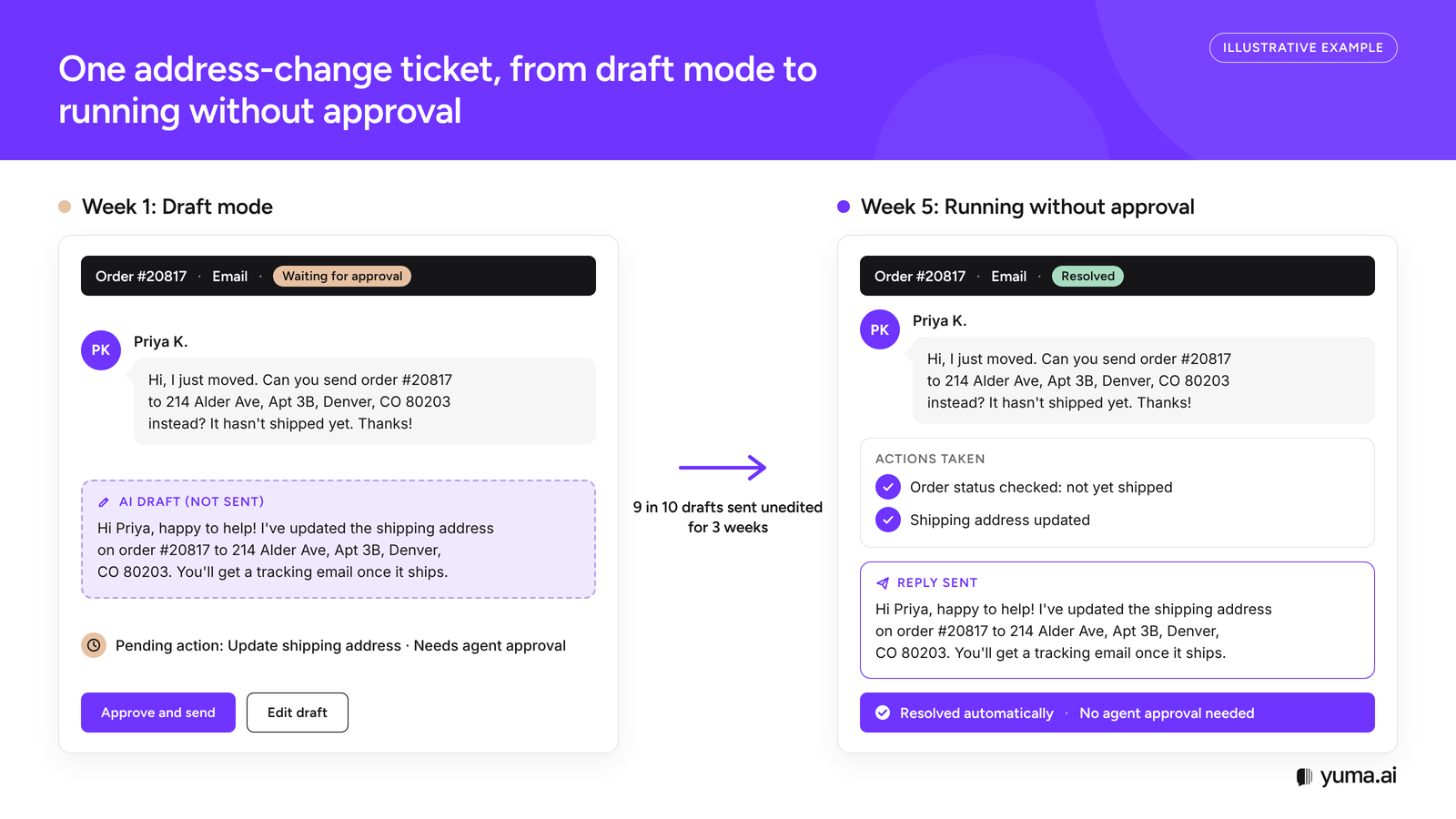
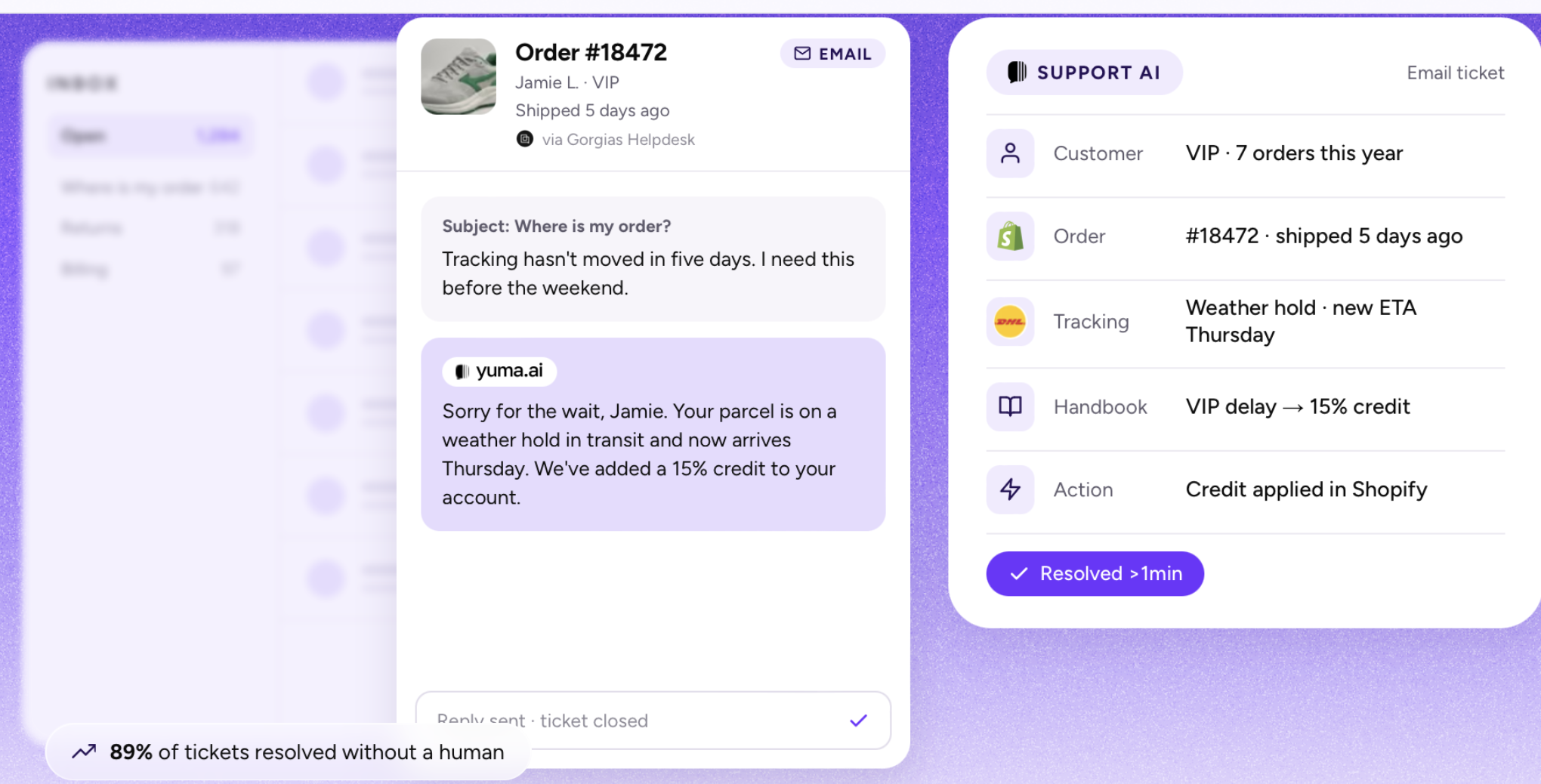
Yuma is an AI agent built exclusively for ecommerce customer support. Like eesel, it works inside your existing helpdesk. A key difference between the two, however, is how Yuma handles uncertainty. Yuma relies on automatic checks and caps instead of drafts. Hard Limits cap the refund amount the AI can issue, so a refund above the brand's limit goes to a person on your team, and everything under it is resolved without waiting in a draft queue.
All of it runs on the Handbook, which Yuma's team builds with you from your existing SOPs, brand voice, and policies. A ticket moves through 3 steps:
- The Handbook sets the rules. Playbooks say what to do in each situation, procedures determine the exact steps the agent needs to take, and brand pages set how Yuma sounds.
- Yuma takes the action. It processes refunds, updates addresses, cancels orders, and changes subscriptions through 100+ pre-built actions. For tools with no API, Web Actions drives a real browser to finish the work.
- Guardrails check the work. Safety Guard checks every AI response for accuracy, policy compliance, and confidence, and Hard Limits set caps on refund amounts, coupon values, and loyalty points that the AI can never exceed.
Yuma offers support for multiple channels including voice, and is compliant with critical security and industry regulations, including SOC 2 Type II, GDPR, CCPA, and the EU-U.S. Data Privacy Framework.
Trade-offs
- Your team owns the Handbook, so someone needs to keep playbooks current as policies change.
- Yuma runs alongside a helpdesk, such as Gorgias, Zendesk, Kustomer, Front, or Re:amaze, so teams that want helpdesk and AI from one vendor should look elsewhere.
2. Gorgias AI Agent
Best for: Shopify brands committed to Gorgias that want AI with minimal setup.
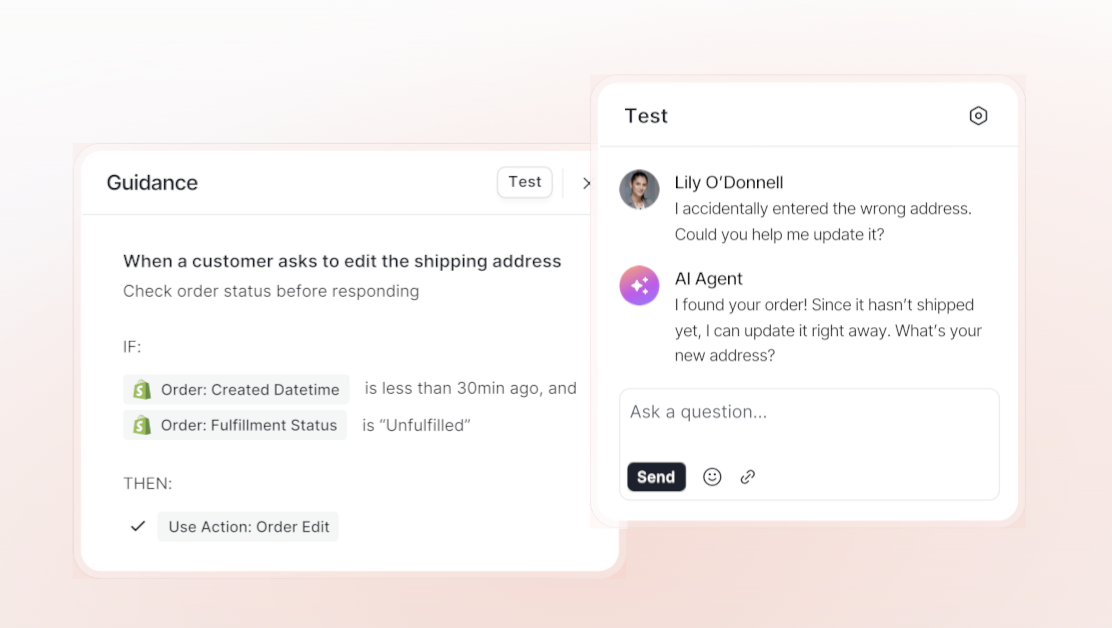
If your team already runs on Gorgias, its native AI Agent lives inside the helpdesk your agents already use. It can resolve tickets automatically or hand them to your team, and it can make changes to Shopify orders. You pay for each ticket you reply to from your helpdesk, with AI agent conversations having an additional fee.
Strengths
- There's no new tool to onboard, since agents keep working in the same workspace.
- AI Agent can cancel orders, edit shipping addresses, remove or replace items, and reship orders for free in Shopify, and custom actions connect it to other apps.
- Gorgias charges an outcome-based fee, so you pay for tickets the AI Agent resolves.
Trade-offs
- Some G2 users report limited customization, including around the chat interface.
- Multiple users noted that the platform was complex, confusing, or lacked an intuitive interface.
- The fee per resolution depends on your helpdesk tier, with overage fees past your plan's limit; voice and SMS are additional costs.
And if you love Gorgias helpdesk but want a different AI agent? Gorgias and Yuma can also run together, since Yuma is available as an app inside Gorgias. The Yuma vs Gorgias AI comparison shows the two side by side.
3. Zendesk AI
Best for: Brands already on Zendesk that want helpdesk and AI from one vendor. Ecommerce teams staying on Zendesk can also run Yuma inside it.
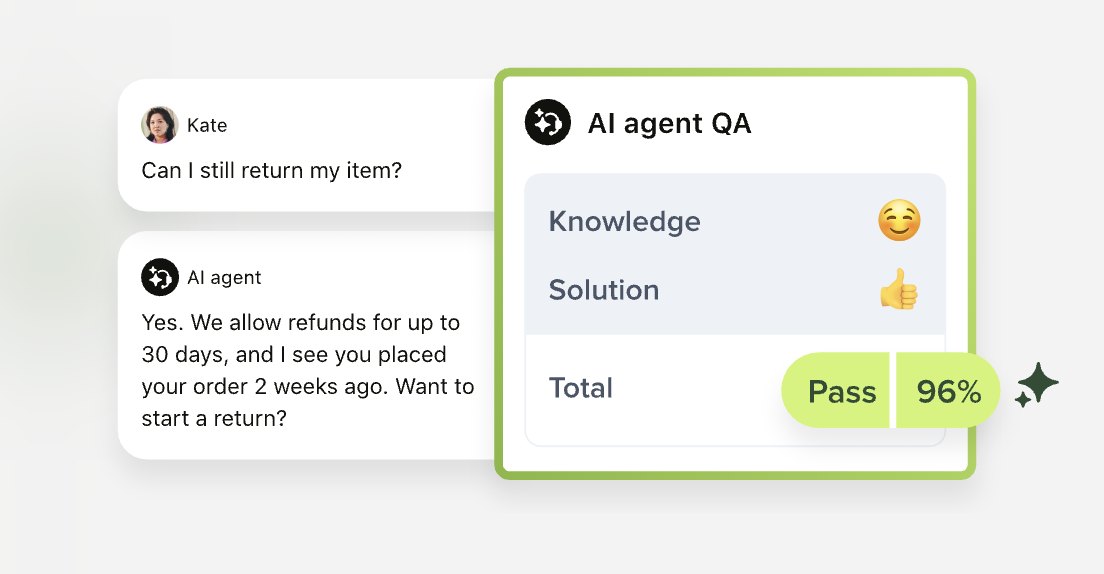
Zendesk has made some significant moves to expand AI, including by acquiring Ultimate in 2024 and Forethought in March 2026. Its AI agents now sit inside the Zendesk helpdesk, which has an impressive app marketplace that can be useful for brands with large tech stacks.
Strengths
- Helpdesk and AI come from one vendor, so there's no separate tool to connect.
- It's built for support teams across industries, which suits brands with support needs beyond ecommerce.
Trade-offs
- Shopify actions run through marketplace apps such as Shopify for Zendesk so each ecommerce action may take extra setup.
- Plans include an allotment of automated resolutions per agent each month, with additional resolutions billed on top.
- Some reviewers felt the platform was complex, including one customer that noted it was difficult to tell when tickets would be escalated instead of handled by an AI agent.
4. Fin
Best for: Teams that need multilingual AI and want to keep their existing helpdesk.
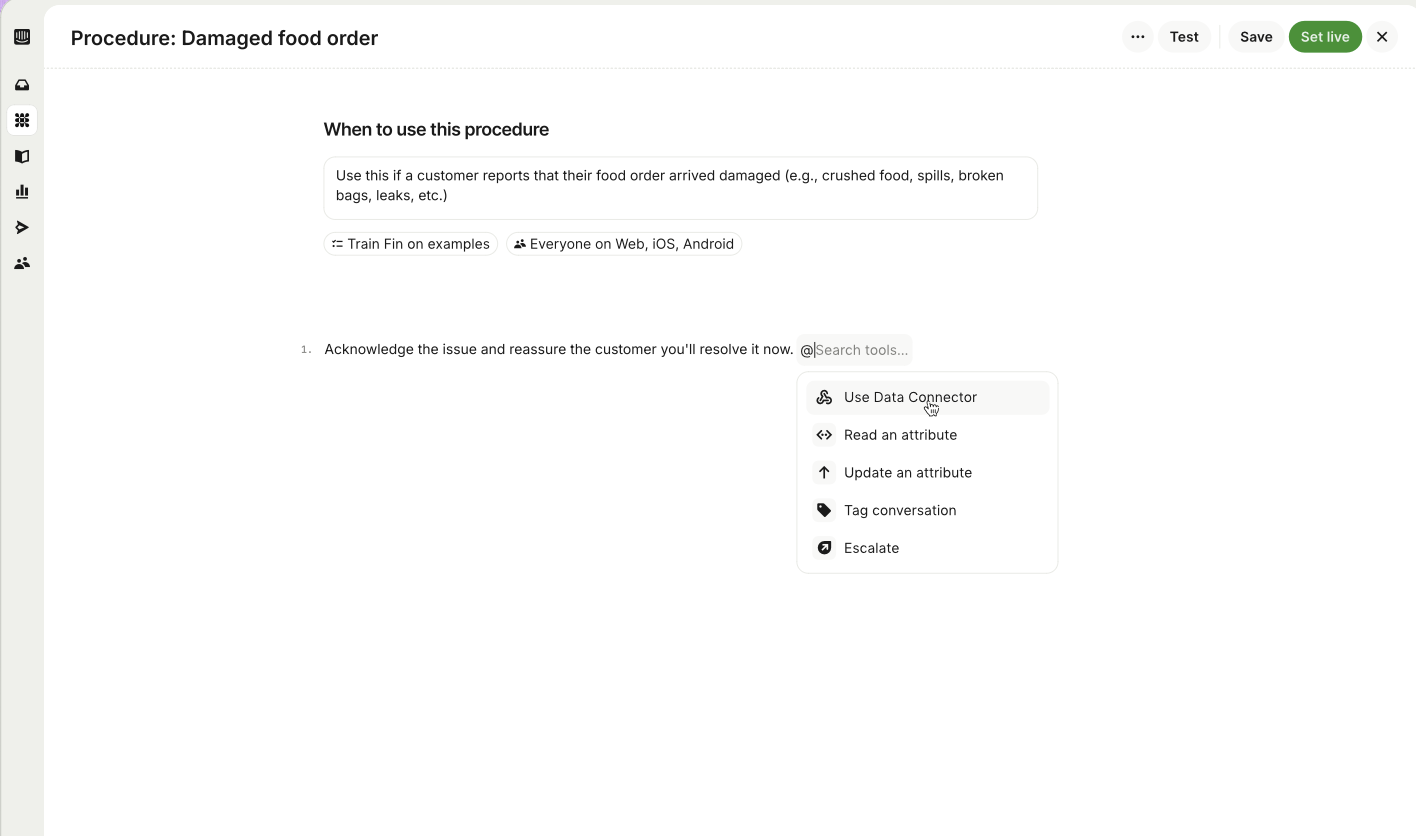
Fin is the AI agent originally developed by Intercom. It answers in 45+ languages and works with Intercom, Salesforce, HubSpot, Zendesk, and Freshdesk, so teams can add it without changing helpdesks.
Strengths
- Fin can process partial or full cancellations, issue refunds, and handle returns or exchanges, with integrations for Shopify and Stripe.
- Intercom reports a 76% average resolution rate across its customers.
- Enterprise grade security, including SOC 2, ISO 27001, and GDPR.
Trade-offs
- Pricing is per outcome, which can be a positive, but in Fin's particular pricing model, you're paying for some handoffs that complete a configured procedure.
- Fin was recently acquired by Salesforce, and acquisitions can sometimes mean long-term product shifts.
- Fin's ecommerce page doesn't mention subscription platforms, so subscription-heavy brands should confirm coverage.
5. Freshdesk (Freddy AI)
Best for: Teams open to switching helpdesks that want AI and helpdesk in one platform.
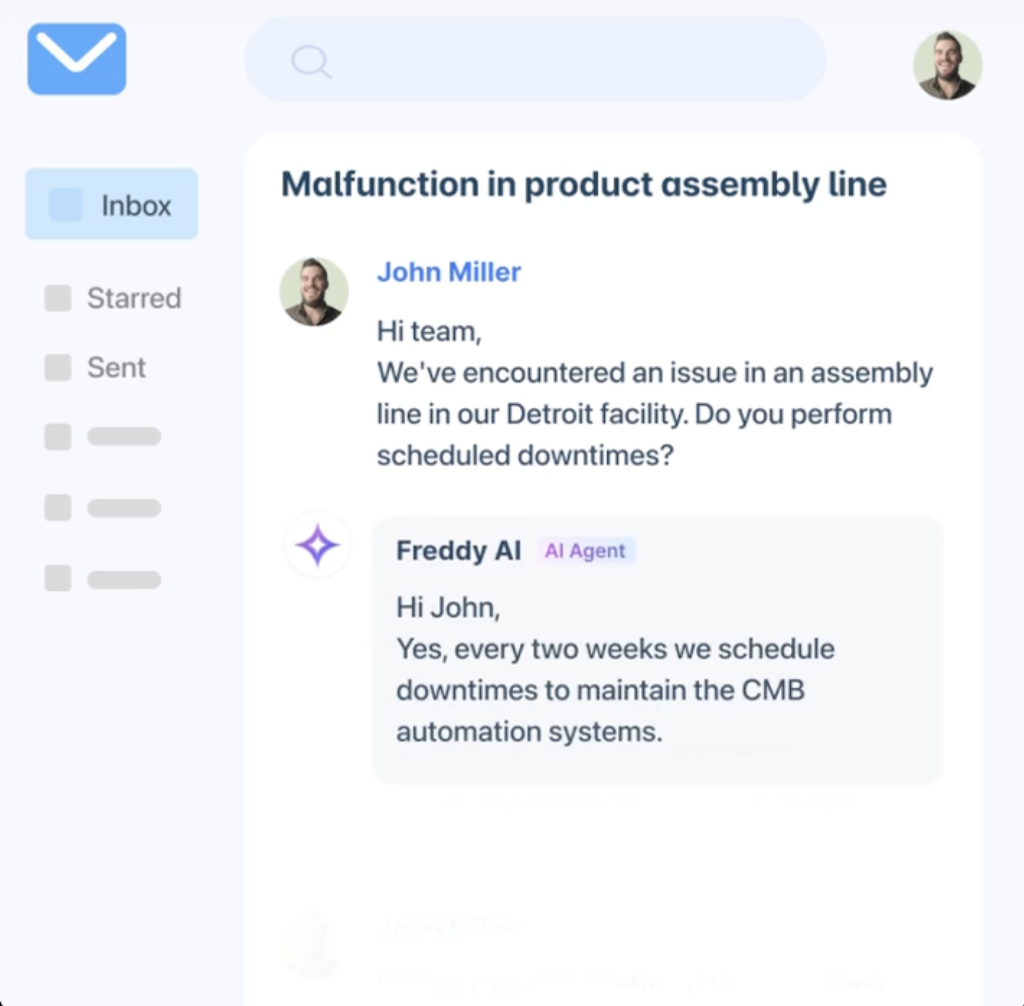
Freshdesk is Freshworks' helpdesk, and Freddy AI Agents are the platform's built-in AI. They use pre-built agentic workflows across chat, messaging, and email, and Freshworks reports they resolve up to 80% of queries.
Strengths
- Freddy AI Agents can update records, process refunds, and change subscription plans, with integrations for Shopify, Stripe, and PayPal.
- Helpdesk, AI agent, and agent copilot all come from one vendor.
Trade-offs
- Pricing is per agent seat, with a set number of AI Agent sessions included. Extra sessions and the Copilot add-on cost more, so costs grow with both team size and volume.
- If you already have another helpdesk, you'd need to migrate to Freshdesk since it has its own helpdesk solution.
6. My AskAI
Best for: Teams that like eesel's setup and want a similar alternative, but who don't need advanced analytics.
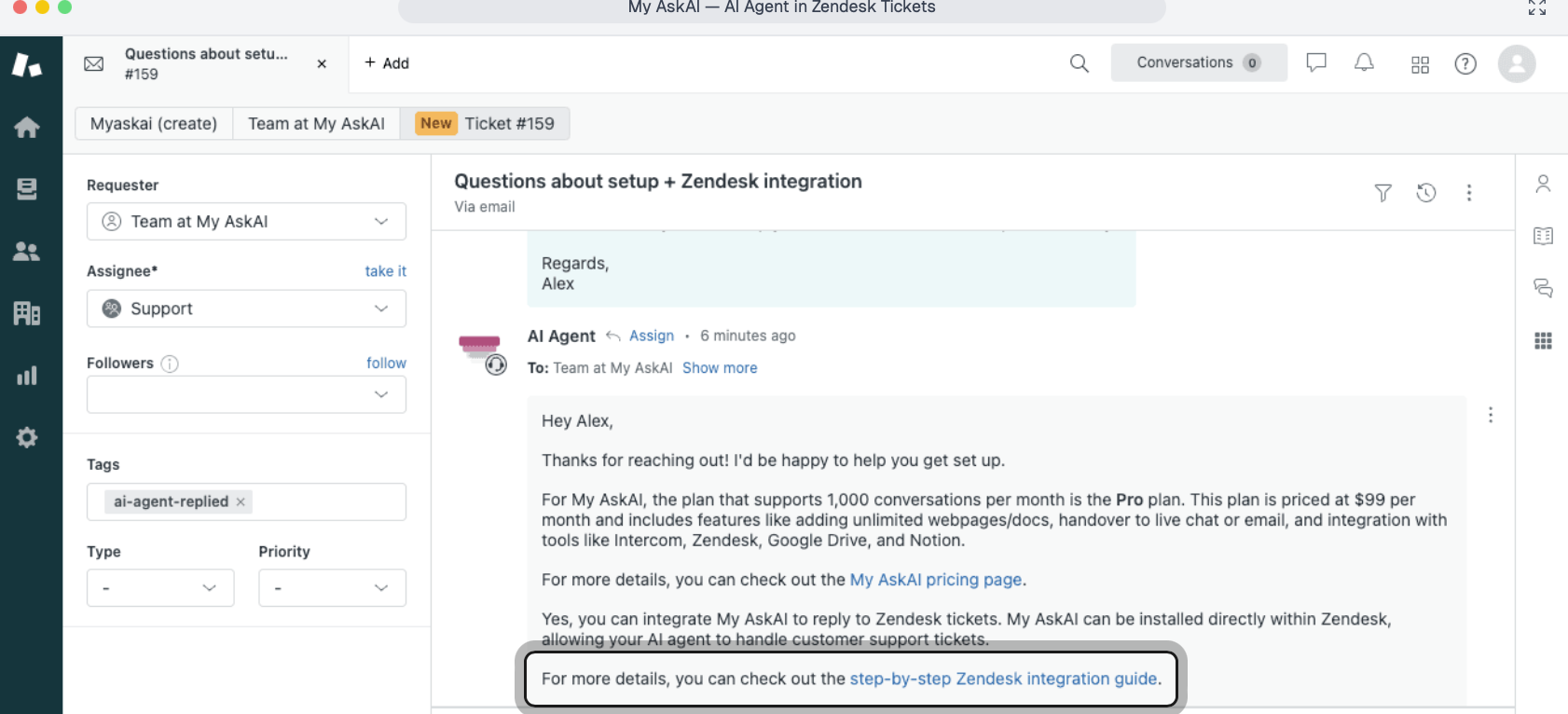
My AskAI is a close match to eesel's model. It works inside Zendesk, Intercom, Freshdesk, Gorgias, Freshchat, and HubSpot, answers from your knowledge base, and hands the ticket to your team inside the helpdesk when it can't help.
Strengths
- On the Pro plan, AI Tasks can call your APIs to take actions such as refunds and cancellations, and the AI can pull live Shopify data.
- SOC 2 Type II and GDPR compliant.
- Shopify integration offers automation for common customers queries, including WISMO.
- Connects to your helpdesk and internal documentation for training.
- Testing against real customer questions from past tickets before going live.
Trade-offs
- Some customers reported limited analytics.
- SOC 2 compliance only available on higher-priced tiers.
- Plans include a monthly ticket allotment, with overage charged per ticket.
7. Tidio (Lyro)
Best for: Small brands testing AI for the first time.
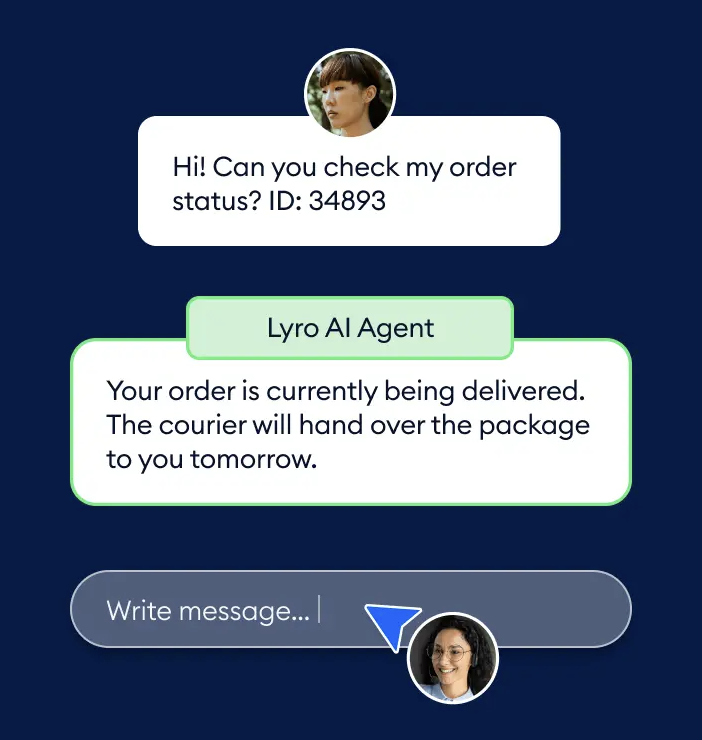
Tidio is a chat and helpdesk platform, and Lyro is its AI agent, designed for small and medium businesses.
Strengths
- Tidio has a free plan, and Lyro is free for the first 50 conversations.
- Every account has Lyro Actions, which can share tracking links, cancel or modify orders, issue refunds, and manage subscriptions.
- When Lyro can't help, it hands the conversation to a person on your team.
Trade-offs
- Free Lyro usage covers only the first 50 conversations, so ongoing use needs a paid plan.
- Lyro Actions don't include return label generation, so returns-heavy brands should confirm how labels get created.