Growing ecommerce teams face two decisions in sequence. First, whether AI automation makes sense versus hiring more agents or getting more out of your helpdesk's built-in macros. Second, if AI is the path, which type of company fits your operation. It's good to ask both questions, and this guide addresses the second one.
If you've made that call and decided AI is the right move, the next challenge is navigating a market with hundreds of vendors, inconsistent terminology, and pricing models that range from per-seat to per-conversation to outcome-based. This guide starts with the categories of AI customer service companies that exist today, then narrows to nine worth evaluating.
What types of AI customer service companies exist?
Not every AI customer service software does the same thing, and understanding the categories saves weeks of evaluating tools that were never built for your operation.
HBR Analytic Services and Appian's 2026 survey of 385 business decision-makers found that while 59% of organizations have AI in production, the impact is concentrated in productivity and efficiency rather than revenue or ROI. One reason is that companies pick tools that don't align with their actual workflows, sometimes because they're drawn in by a flashy feature list or a big name.
The market breaks down into four categories.
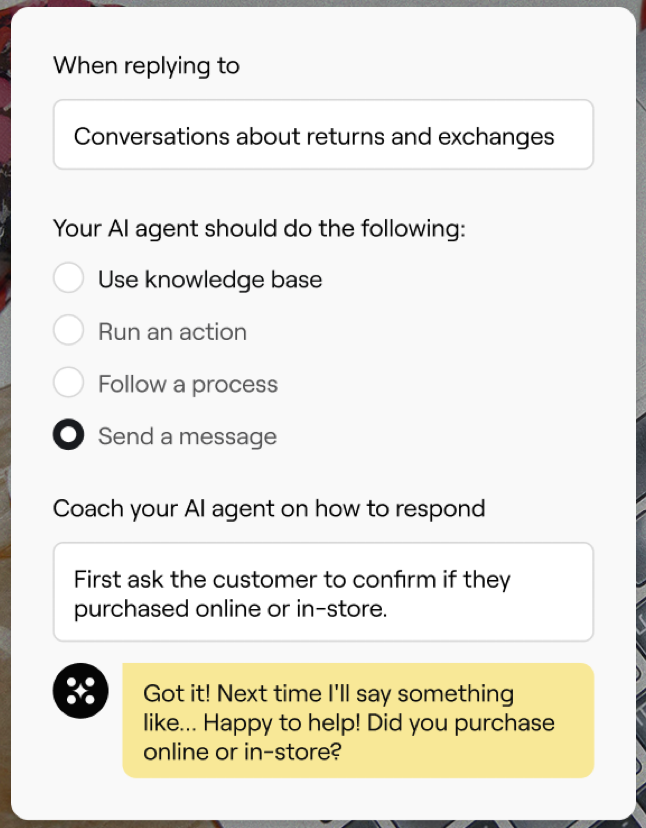
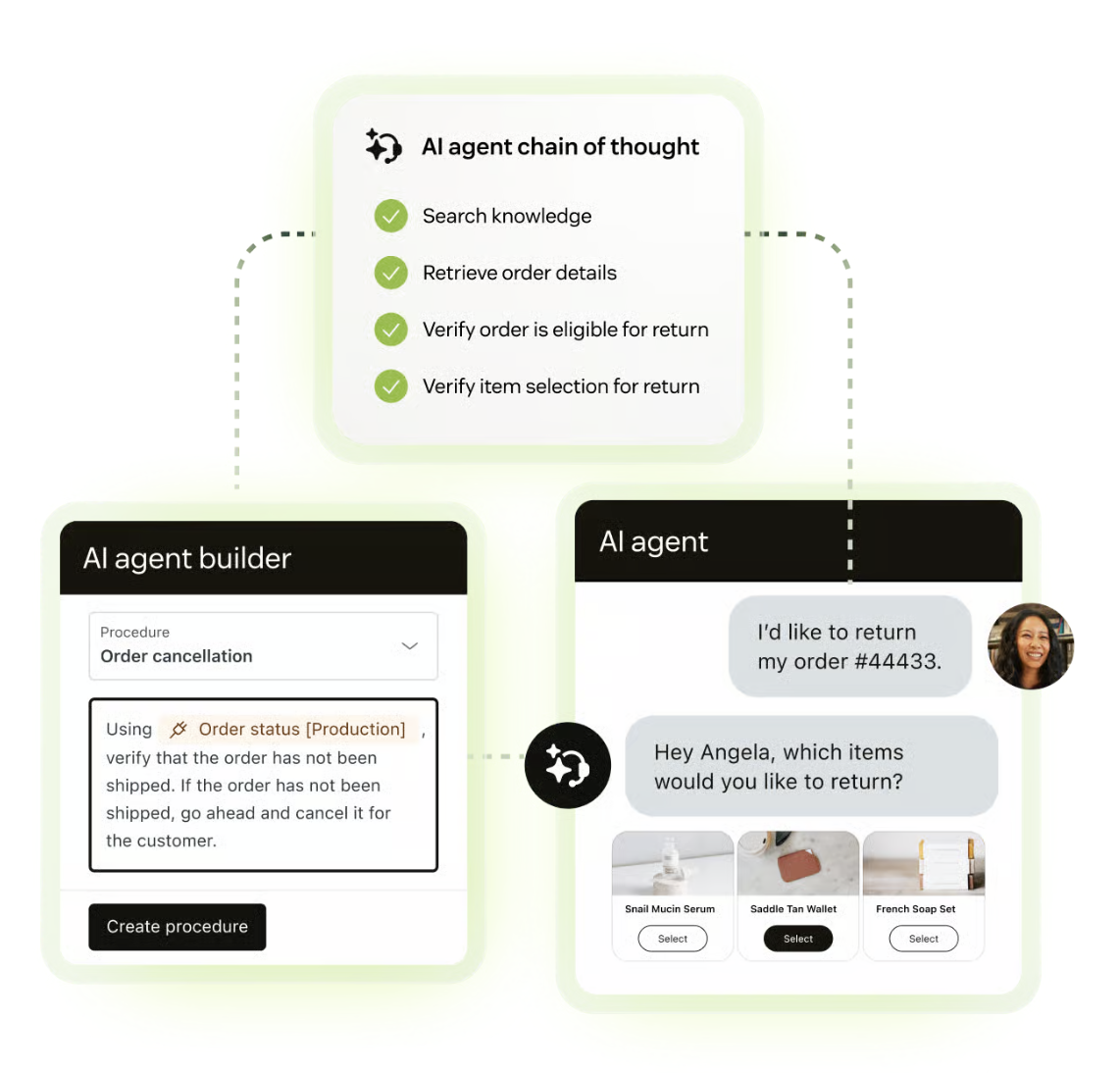
Ecommerce specialists are built for Shopify and DTC brands. They connect natively to commerce platforms, subscription tools like Recharge and Loop, and returns systems. They resolve the ticket types that dominate ecommerce queues, like WISMO, returns, order changes, and subscription management. They do this by taking autonomous actions, not just drafting replies.
Enterprise AI agent platforms serve multiple industries at scale. They handle complex, multi-step workflows and typically require six-figure annual contracts. Ecommerce-specific workflows like Shopify refund processing usually need configuration rather than arriving pre-built.
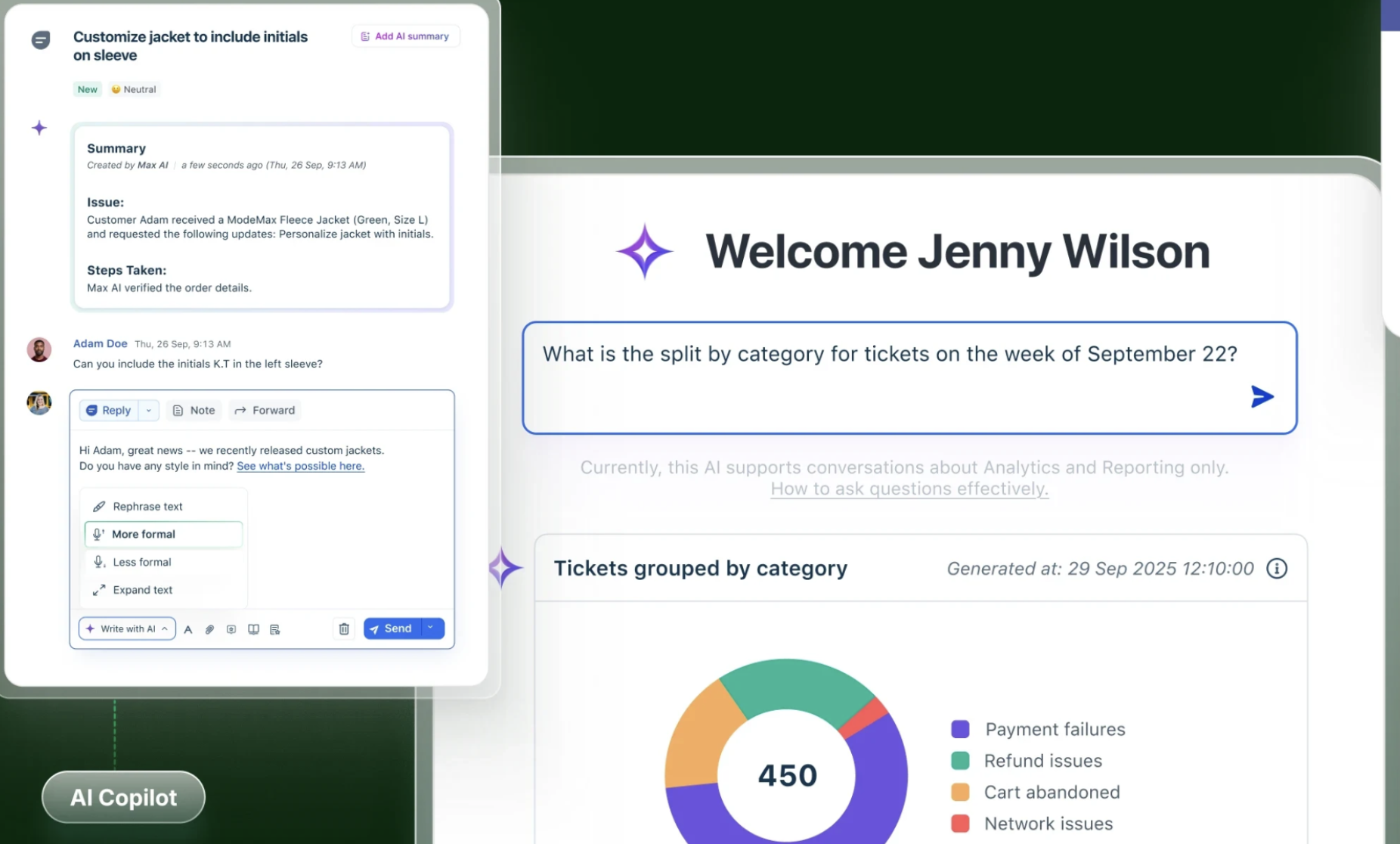
Helpdesk platforms with built-in AI layer AI onto an existing ticketing system. They're a fit for teams that want one vendor handling both helpdesk and automation. Some ecommerce-specific AI tools like Yuma also install inside helpdesks like Zendesk as an overlay, giving ecommerce teams specialized AI without switching platforms.
SaaS and product-led AI is designed for software companies where tickets center on product questions, billing issues, and account management rather than order fulfillment.
Whichever category fits, integration capability is important to keep in mind. A separate 2026 study by HBR Analytic Services and Hyland found that 94% of leaders say well-connected data and processes are critical for AI success, but only 27% say they actually have that today. Having a solid AI customer service framework in place before choosing a vendor closes that gap.
9 AI customer service companies worth evaluating in 2026
The AI customer service market was valued at an estimated $15.78 billion in 2025 and is projected to grow at 23.2% annually through 2033. That means there are plenty of tools on the market, and the companies below represent the range of approaches available today.
| Company | Category | Best for | Pricing model |
|---|---|---|---|
| Yuma AI | Ecommerce specialist | Shopify + Gorgias/Zendesk brands | Outcome-based, ~$1.20/resolution |
| Gorgias AI | Ecommerce specialist | Shopify brands wanting helpdesk + AI in one | From $40/month + interaction fees |
| Siena AI | Ecommerce specialist | DTC brands prioritizing brand voice | $750/month + $0.90/conversation |
| Sierra | Enterprise AI agent | Enterprise retailers | Custom, outcome-based |
| Ada | Enterprise AI agent | High-volume, cross-industry | Custom enterprise |
| Zendesk | Helpdesk with AI | Enterprise teams already on Zendesk | From $55/agent/month + add-ons |
| Fin (Intercom) | SaaS/product-led | SaaS and product-led teams | $0.99/resolution |
| Salesforce Agentforce | SaaS/product-led | Teams already on Salesforce | $2/conversation |
| Freshdesk | Helpdesk with AI | Budget mid-market | From $29/agent/month |
Ecommerce specialists
These companies were purpose-built for online retail. Their AI agents connect to Shopify, subscription platforms, and returns tools, and they arrive with the workflows ecommerce teams need rather than requiring weeks of configuration.
Yuma AI
Yuma serves ecommerce brands exclusively. Its AI agents, called Auto-Pilots, handle individual ticket types with dedicated processes and guardrails. When a customer asks to cancel a subscription, the Auto-Pilot checks the account in Recharge, processes the cancellation, confirms with the customer, and closes the ticket.
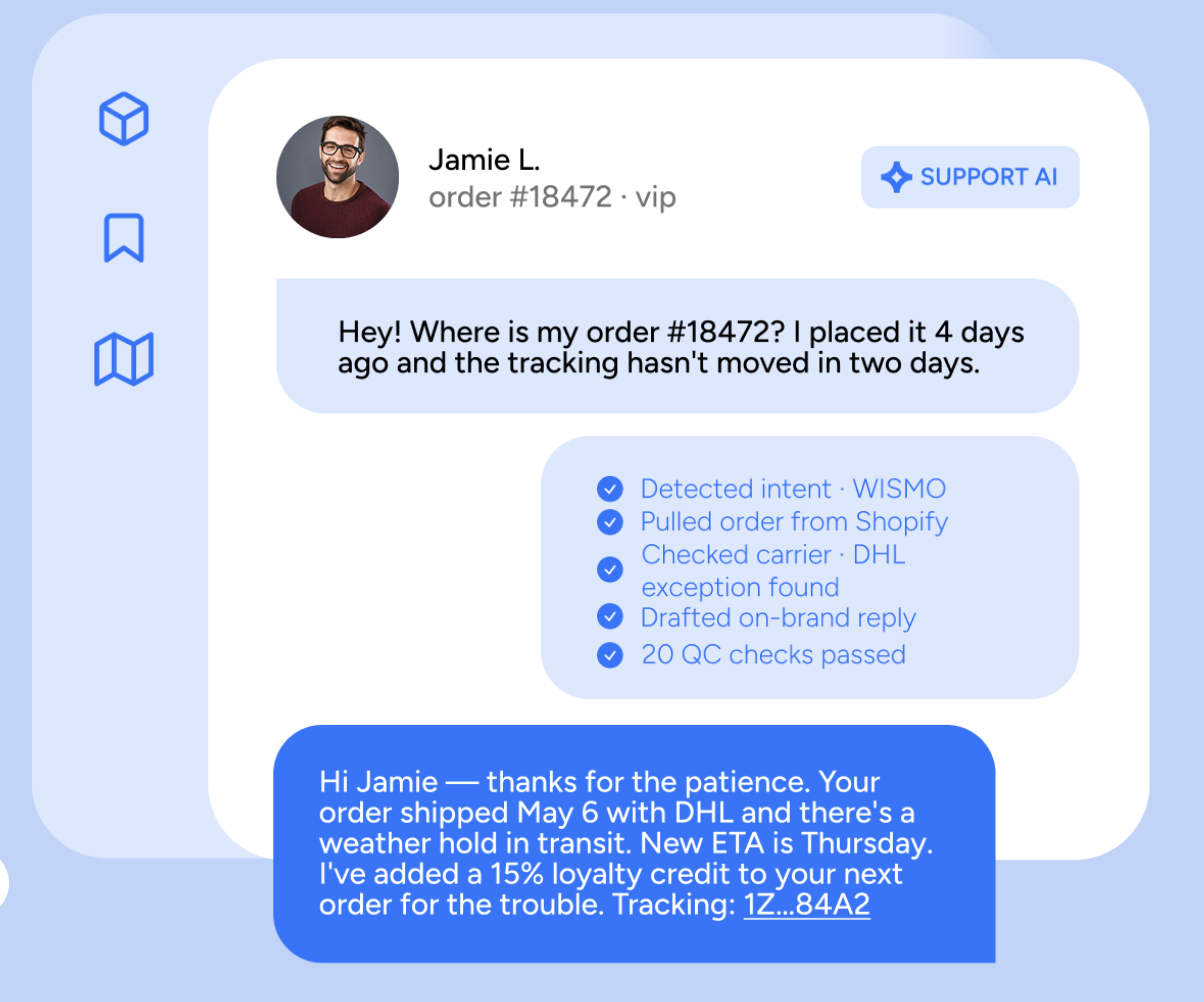
What separates Yuma architecturally is how it prevents errors. Its anti-hallucination system (Safety Guard, Hard Limits, Fraud Shield, and Playground testing) uses context minimalism to limit what the AI sees per ticket, runs every response through a quality gate before sending, and enforces hard caps on destructive actions like refund amounts and daily cancellations. When the AI isn't confident, it escalates the ticket to a person rather than attempting an answer.
Yuma installs inside your existing helpdesk and syncs your macros, triggers, and routing rules. No re-platforming required. This is what ecommerce customer service with generative AI looks like when the AI takes actions rather than suggesting replies.
Pros:
- 75+ Shopify actions with autonomous execution
- Anti-hallucination architecture with Safety Guard, Hard Limits, Fraud Shield, and Playground
- Installs inside Gorgias, Zendesk, Kustomer, or Gladly without re-platforming
- White-glove onboarding, with the 30/30 promise on the Growth plan: 30% automation in 30 days, depending on your internal processes and integration speed
- SOC 2 Type II certified
- Browser Actions for web-only platforms and Event-Driven Automation for multi-party workflows
Cons:
- Ecommerce only. SaaS and non-commerce brands won't get value
- No voice or phone channel
- Onboarding goes through Yuma's team rather than self-serve
Pricing: Outcome-based. You pay only for tickets the AI fully resolves. Escalated tickets aren't billed. First 30 days free.
Want to learn more? Compare Yuma AI to other competitors to see how it stacks up.
Gorgias AI
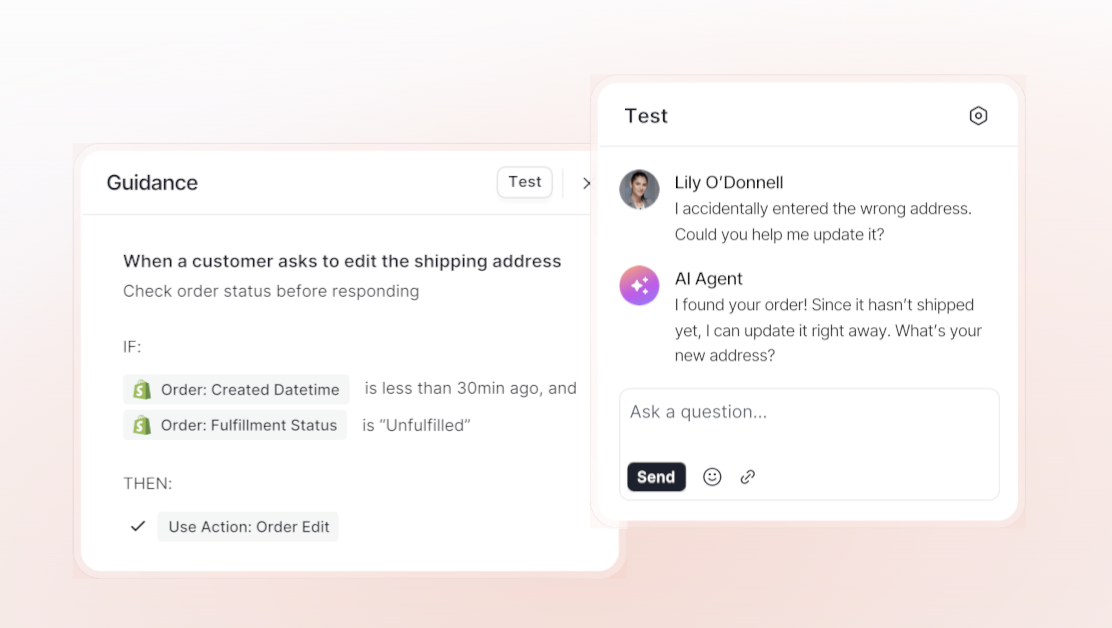
Gorgias is a helpdesk built for Shopify with AI added on top. Its AI Agent operates in two modes: a Shopping Assistant for pre-purchase product recommendations and a Support Agent for post-purchase resolution, including refunds, order tracking, and returns. The core advantage is that helpdesk and AI share a single platform, so agents and AI work from the same ticket context.
Pros:
- Deep native Shopify integration, making it a solid option for ecommerce businesses
- Helpdesk and AI in one platform with shared context
- Unified inbox across email, chat, social, SMS, and voice
Cons:
- AI pricing is separate from helpdesk costs, with $1.50 interaction fees when volume exceeds plan limits. During peak seasons, this can create unpredictable bills
- Per Gorgias's documentation, interactions are billed as automated after 72 hours without human handover
Pricing: Starter plan with AI Agent at $40/month, plus interaction fees, and helpdesk is an additional $10/month.
Siena AI
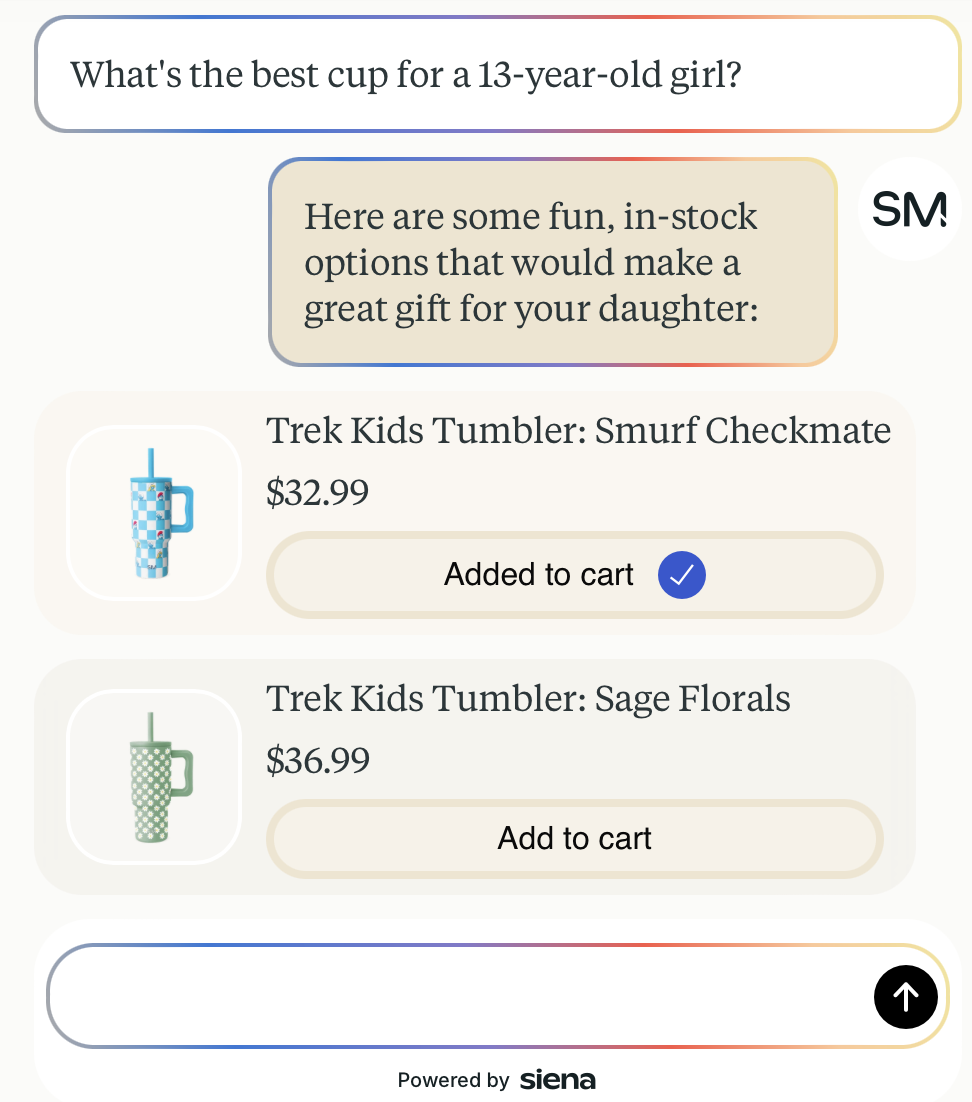
Siena is built for DTC ecommerce brands where conversational tone shapes the customer relationship. Its CORE reasoning engine and AI persona system let brands configure distinct voices across email, chat, WhatsApp, and Instagram DMs. Siena connects to Shopify, Zendesk, and Kustomer, and takes actions including processing returns, editing orders, and managing subscriptions.
Pros:
- Strong adherence to brand voice instructions for better consistency across customer experiences
- Multi-channel coverage including WhatsApp and Instagram DMs
- Takes real ecommerce actions that go beyond simple conversational responses
Cons:
- $750/month platform fee plus $0.90 per conversation compounds at higher volumes
- G2 reviews flag occasions where the AI fails to escalate or closes a ticket prematurely
Pricing: $750/month plus $0.90 per automated ticket. Support and implementation included.
Enterprise AI agent platforms
These companies operate at enterprise scale across multiple industries. They handle complex, multi-step workflows and serve buyers with dedicated engineering resources and six-figure automation budgets.
Sierra
Sierra deploys AI agents across chat, email, and voice for large consumer and retail brands. The company was co-founded by Bret Taylor (former Salesforce co-CEO) and Clay Bavor (18-year Google veteran) and uses outcome-based pricing tied to business results.

Pros:
- Leadership team with proven enterprise credibility
- Outcome-based pricing aligns vendor incentives with results
- Multi-channel resolution across chat, email, and voice
Cons:
- Reported annual minimums around $150,000
- No published pricing, free trial, or self-serve option
- Cross-industry platform, so ecommerce-specific workflows may require more configuration
Pricing: Custom enterprise contracts. Outcome-based model with per-resolution rates negotiated per deal.
Ada
Ada's no-code builder lets non-technical teams design AI conversation flows through SOP-driven playbooks. The platform supports 60 languages and resolves issues across chat, email, voice, SMS, and social. Ada targets enterprise buyers and serves multiple industries.

Pros:
- No-code builder accessible to non-technical teams
- Strong multilingual and multi-channel coverage
- SOP playbooks give structure to complex workflows
Cons:
- No public pricing. Custom enterprise contracts only
- No native Shopify integration at time of publishing
- G2 reviewers flag integration complexity during workflow setup
Pricing: No public pricing page.
Helpdesk platforms with built-in AI
These companies layer AI onto an existing helpdesk. They work for teams that want one vendor managing both ticketing and automation, though ecommerce teams on Zendesk can also add ecommerce-specific AI through overlay tools like Yuma without switching platforms.
Zendesk
Zendesk is one of the largest customer service platforms in the world. Its AI capabilities have expanded significantly through acquisitions, adding agentic resolution on top of the existing helpdesk architecture. The platform serves every industry and scales to large teams.

Pros:
- Enterprise-grade with a massive integration ecosystem
- Strong reporting and analytics
- Forethought acquisition added agentic AI capabilities
- AI features may work well for companies that are already Zendesk customers and don't have complex automation workflows
Cons:
- Pricing stacks multiple layers, which can increase overall cost quickly
- Some ecommerce-specific workflows beyond Shopify may require marketplace apps
- There can be a learning curve for some complex automation features
Pricing: Pricing for plans with AI agents starts at $55/agent/month (billed yearly) for Suite plans, with AI features and Copilot billed separately.
Freshdesk
Freshdesk is a budget-friendly alternative to Zendesk with Freddy AI for routing, ticket suggestions, and knowledge base deflection. It's simpler to administer and cheaper at equivalent agent counts.

Pros:
- Lower price point than Zendesk at comparable team sizes
- Free tier available for small teams
- Freddy AI handles routing and suggestions
Cons:
- AI capabilities are narrower than Zendesk's post-Forethought stack
- Freddy AI assists agents rather than resolving autonomously
- Ecommerce integrations aren't as deep as purpose-built platforms
Pricing: Free tier available. Paid plans from $29/agent/month.
SaaS and product-led AI
These companies are designed for software businesses where tickets center on product questions, billing issues, and account management rather than order fulfillment.
Fin (Intercom)
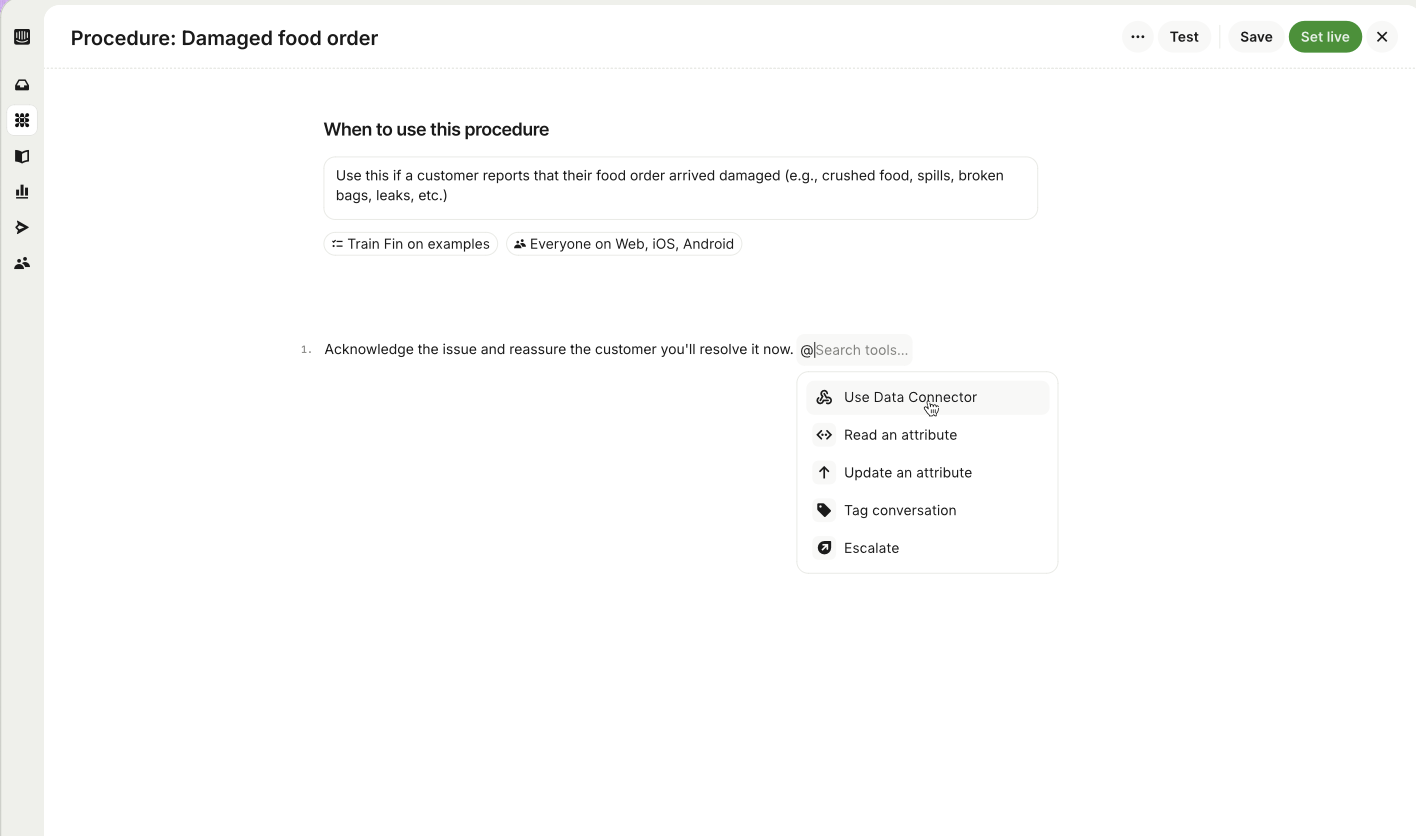
Fin's AI Agent runs on a proprietary model called Apex and resolves conversations across chat, email, voice, SMS, and social in 45+ languages. It works standalone with any helpdesk or natively inside Intercom. The distinction between generative AI and traditional customer support is clear here, as Fin operates as a true AI agent taking actions through Data Connectors rather than following scripted trees.

Pros:
- Transparent $0.99/resolution pricing with a low 50-outcome monthly minimum
- 45+ language support
- Fast to deploy with minimal configuration
Cons:
- G2 reviewers flag that Fin needs precise phrasing for accurate responses
- Ecommerce actions like returns and subscription management require custom API work
- The currently pending acquisition by Salesforce may introduce some uncertainty about future development
Pricing: Standalone at $0.99 per outcome, 50-outcome monthly minimum.
Salesforce Agentforce
Agentforce uses an Atlas Reasoning Engine with native CRM context to resolve service interactions. It's strongest for teams already on Salesforce who want AI that reads directly from their CRM data. Pricing has shifted multiple times since launch, which is worth factoring into any evaluation.

Pros:
- Native Salesforce CRM integration gives agents full customer context
- Supports customer-facing and employee-facing agent deployments
- Large, established brand with an impressive customer roster
Cons:
- Three different pricing models running simultaneously (per-conversation, Flex Credits, per-user) can be complex for brands trying to keep track
- Smaller companies may find the pricing hard to justify without clear ROI visibility
Pricing:
- Free tier available for Salesforce Foundations plans, but conversations require credits
- $500 per 100,000 Flex Credits, with actions starting at around 20 credits
- Option to pay per conversation at $2 per conversation
How to choose the right AI customer service company
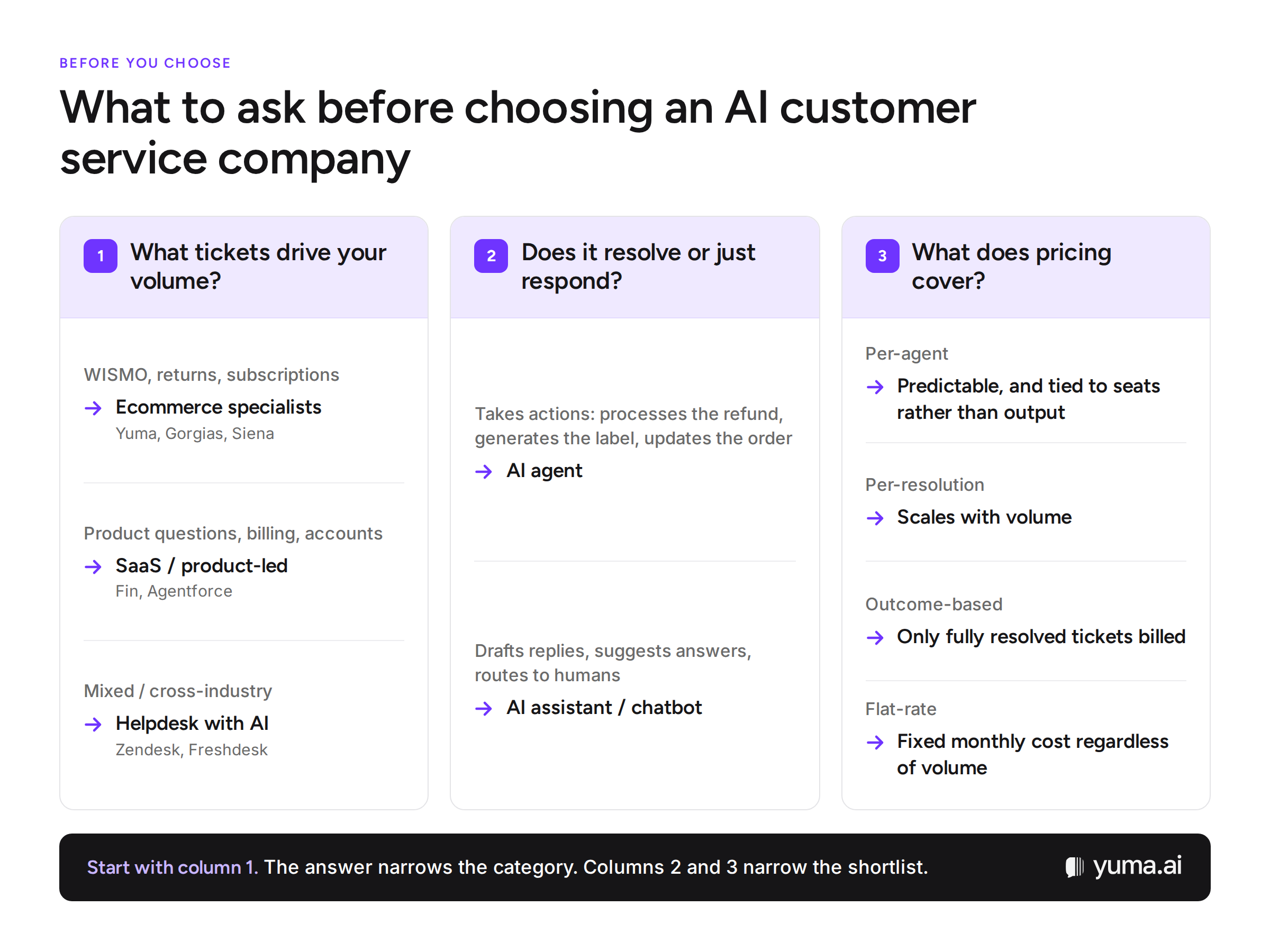
Once you know which category fits, these three questions help you compare companies within it and build a shortlist you can defend to leadership.

What type of tickets drive your volume?
Ecommerce tickets like WISMO, returns, and subscription changes need ecommerce specialists that can take actions inside Shopify and Recharge. Product and billing tickets need SaaS-focused tools. General support across verticals fits a helpdesk with built-in AI.
The type of tickets your team handles every day determines which category of company to evaluate first when choosing an AI tool for an ecommerce business.
Does it resolve or just respond?
Some conversational AI customer service tools answer questions and route to humans. Others connect to your systems and close tickets autonomously. A tool that tells a customer the refund policy and a tool that processes the refund are solving two different problems. Before committing, ask whether the AI can take the action that resolves the ticket, or whether an agent still needs to step in.
Conversational AI can handle the conversation, while an AI agent can handle both the conversation and the resolution. Teams that buy a conversational tool expecting autonomous actions run into the kind of AI customer service implementation mistakes that set the whole project back.
What does pricing actually cover?
Per-agent models (Zendesk, Freshdesk) give predictable monthly costs but don't tie spend to what the AI resolves. Per-resolution models (Fin, Gorgias) scale with output but can spike during peak months. Outcome-based models (Yuma, Sierra) only charge for fully resolved tickets, aligning vendor incentives with your results.
The pricing model you choose affects how your costs grow alongside your ticket volume. A per-agent model costs the same whether the AI resolves 500 tickets or 5,000. A per-resolution model rewards high automation but means a busy BFCM week hits your bill directly. Outcome-based pricing ties your spend to actual results, which makes cost easier to justify to leadership when it's time to renew.
Skip the feature comparison and match the company type to your operation first
Comparing features across customer service automation tools built for different buyers is where evaluation time gets wasted. An ecommerce specialist and an enterprise cross-industry platform aren't solving the same problem, and ranking them on the same criteria produces a misleading picture.
Start with the category. If your ticket volume runs through Shopify and your team lives in Gorgias or Zendesk, ecommerce specialists like Yuma will get you to autonomous resolution faster than configuring a cross-industry platform for your workflows. If you're running a SaaS product with billing and account tickets, helpdesk-native or product-led tools are the better fit.
Once you know the category, the shortlist shrinks to two or three companies rather than nine, and the evaluation gets a lot more productive.
Frequently asked questions about AI customer service companies
What is an AI customer service company?
An AI customer service company provides AI-powered tools that handle support interactions across email, chat, social, and SMS. They range from companies that offer AI chatbots for basic deflection to companies that deploy autonomous AI agents capable of taking actions like processing refunds, managing subscriptions, and closing tickets without human involvement.
How much do AI customer service companies cost?
Pricing models vary by category.
- Per-agent charges a flat monthly rate per team member regardless of AI output
- Per-resolution charges for each conversation the AI closes
- Outcome-based charges only for tickets the AI fully resolves, so escalated tickets aren't billed
- Custom enterprise contracts go through a sales process with negotiated rates
- Free tiers exist for teams testing AI for the first time
The right model depends on your volume and how you want costs to scale as automation increases.
What's the difference between an ecommerce AI specialist and an enterprise AI platform?
Ecommerce specialists (Yuma, Gorgias, Siena) are more likely to arrive with native Shopify integrations, return processing, subscription management, and WISMO workflows ready to deploy. Enterprise platforms (Sierra, Ada) serve multiple industries and can handle ecommerce use cases but require configuration to support those specific workflows.
Can small businesses use AI customer service companies?
Yes. Several platforms on this list offer free tiers or low-commitment entry points that let smaller teams test AI on real ticket data before scaling up. Look for per-resolution pricing with low monthly minimums or free trials that give you enough volume to measure results before committing to a longer contract.