





The Best Siena Alternative
Siena bills per conversation, resolved or not. Yuma charges only for tickets it fully resolves, with up to 89% automation inside the helpdesk you already use. Free for 30 days on real tickets.
- Pay only for resolved tickets
- Works inside your helpdesk
- 30-day free trial
Brands that chose Yuma



















At a glance
Yuma AI vs Siena at a glance
The differences that decide most evaluations.
See full detailsYuma AISSienaCompetitor details come from Siena's public materials as of October 2026. Sources are listed at the bottom of the page.
Why teams switch
Why ecommerce brands choose Yuma over Siena
What changes when the AI resolves the ticket, not just the first reply.
Up to 89% automation for named brands
Siena says its agents automate up to 80% of tickets. Yuma's results are public and named: EvryJewels automates 89% of tickets across 150k+, Petlibro 79% and MFI Medical 64%, each in a published case study.
- EvryJewels: 89%
- Petlibro: 79%
- MFI Medical: 64%
Pay for resolved tickets, not attempted conversations
Siena lists a $750 monthly platform fee plus $0.90 per ticket, and bills per conversation whether or not it was resolved. Yuma charges only when a ticket is fully resolved: the price depends on your volume, the median is $0.74, and there's no platform fee.
- Billed only for fully resolved tickets
- No platform fee, no per-agent cost
- Every billed ticket listed with the reason
Results in your first week, instead of months
Yuma goes live within a week on a share of real tickets, so you see quality before you scale. A 100% ROI guarantee means you pay nothing if the savings don't outweigh the fee, and Clove reached 3x ROI in 3 months.
- Time to go live: Within a week
- ROI guarantee: 100%
- Clove ROI in 3 months: 3x
Every channel, every language, 24/7
Yuma handles email, live chat, WhatsApp, Facebook Messenger, Instagram DMs, SMS and product review responses (Trustpilot, Yotpo) from one agent, in the customer's own language. The Voice AI agent covers your support line with the same guardrails.
- Email, live chat and SMS
- WhatsApp, Instagram and Facebook
- Product review responses
- Voice AI agent on your support line
Enterprise-grade security, minimal data footprint
Yuma is SOC 2 Type II certified, with a public Trust Center monitored in real time by Vanta. The agent works through your helpdesk's existing API, with no separate copies of your order, payment or product tables.
- SOC 2 Type II certified
- Public Trust Center
- Minimal data scope
Proof
Results on real tickets, not industry averages
 89%automation across 150k+ ticketsRead the story
  79%of tickets fully automatedRead the story
  70%automation, 24h → 12 min response timeRead the story
  3xROI in 3 monthsRead the story
ROI calculator
See exactly how much you save switching from Siena
Enter your Siena setup and ticket volume. See what you pay today, and what you'd pay with Yuma.
Estimated monthly savings
$4,077
$48,924 a year
Cost per resolution: Siena vs Yuma
Price per resolution depends on monthly volume. Yuma's figure is the median across customers. Yuma's side assumes 79% automation, based on named customer results. Human cost per ticket defaults to $2.50 (industry average $2.00 to $3.00).
Full comparison
Yuma AI vs Siena: full comparison
AI automation & performance
Helpdesk & platform flexibility
Pricing & ROI
Yuma AISSiena* Price per resolution depends on monthly volume.
Channels & coverage
Yuma AISSienaSecurity & compliance
Sources
- Siena pricing page, checked 2026-10-12
- Siena integrations directory, checked 2026-10-12
- Siena homepage, checked 2026-10-12
- Siena comparison page: Siena AI vs Gorgias AI (FAQ), checked 2026-10-12
- Siena blog: conversation vs outcome-based pricing, checked 2026-10-12
- Siena blog: 6-week enterprise implementation blueprint, checked 2026-10-12
- Siena blog: Test Runs, checked 2026-10-12
- Siena Shopify integration page, checked 2026-10-12
- Siena order tracking page, checked 2026-10-12
- Siena Trust Center, checked 2026-10-12
- Siena blog: seed round announcement, checked 2026-10-12
- Siena customer story: Canopy, checked 2026-10-12
- Siena customer story: Dossier, checked 2026-10-12
- Siena customer story: Comfrt, checked 2026-10-12
- Siena Social Agent page, checked 2026-10-12
- Siena blog: preventing AI hallucinations, checked 2026-10-12
Customers
Why ecommerce leaders switched to Yuma
Before Yuma, we were drowning in a sea of over 10,000 tickets, and our first response time was a staggering 1 week. Other AI solutions we tried were unreliable, hallucinating, and didn't align with our guidelines.
 Alejandro ReyesCustomer Service Director, EvryJewels
- 89%Automation
- 63%Lower cost
We barely had to think about the technical side. Yuma just worked, right out of the box. That was a huge relief, so we could focus on customer experience rather than implementation.
 Amy KempDirector of Omnichannel Customer Experience, Glossier
- 87%Faster response
- 16hSaved per ticket
We were blown away by Yuma’s product in contrast to our previous provider and we were promised a 1 or 2 days turn around for support. I was so amazed by the product and the team’s support that all my worries disappeared.
 Gabe WalkerCustomer Service Manager, Clove
- 70%Automation
- 3xROI in 3 months
Demo
See how brands go from setup to automation
A return request, from the customer's email to the label in their inbox, inside your helpdesk.
Products
One agent platform, every channel

Support AI
AI customer service agents that resolve WISMO, returns, exchanges, refunds and order changes end to end. Only the conversations that need human judgment are escalated, with full context.
Learn more
Sales AI
An AI shopping assistant for Shopify storefronts that answers product questions, recommends items and recovers abandoned carts.
Learn more
Social AI
Automated replies to comments, DMs and mentions across Instagram, Facebook, TikTok and more, 24/7.
Learn more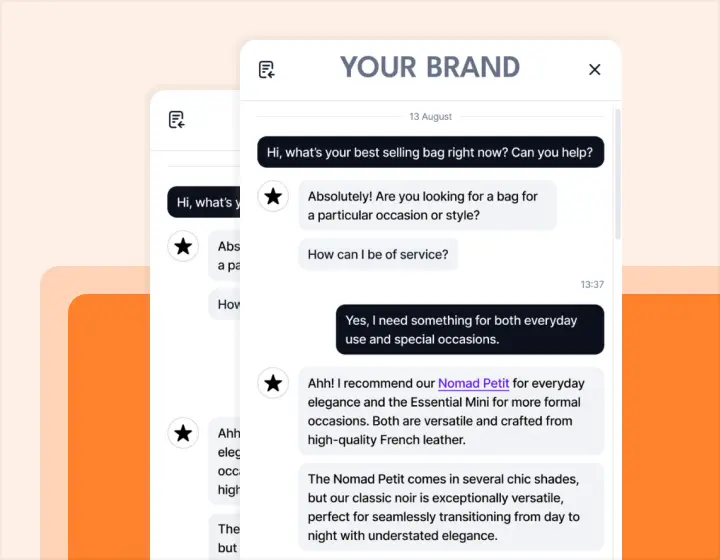
Chat AI
An AI-native live chat widget that installs in minutes on any storefront and resolves product, shipping and policy questions instantly.
Learn more
Voice AI
An AI voice agent that answers the support line 24/7 and takes real backend actions mid-call, with the same agent and guardrails as email and chat.
Learn more
FAQ
Frequently asked questions
Why do ecommerce brands switch from Siena to Yuma AI?
The reasons that come up most are pricing and time to value. Siena bills per conversation whether or not the ticket was resolved; Yuma charges only for tickets fully resolved end to end. Yuma goes live within a week and works inside the helpdesk you already use, backed by a 100% ROI guarantee.
How does Siena's pricing compare to Yuma?
Siena lists a $750 monthly platform fee plus $0.90 per ticket, and counts a conversation as billable whether it was resolved or handed back to a human. Yuma charges only for fully resolved tickets. The price per resolution depends on your volume, and the median across customers is $0.74. There's no platform fee and no per-agent cost.
Is Yuma a replacement for my helpdesk?
No. Yuma isn't a helpdesk; it's the AI layer for ecommerce brands. It works inside Gorgias, Zendesk, Kustomer, Re:amaze, Gladly, Salesforce and more, so your queues, macros and routing stay as they are.
How long does it take to go live with Yuma?
Within a week. Yuma connects to your helpdesk and reuses your existing macros and knowledge base, then starts on a share of live tickets so you can check quality before scaling.
What if we're not on Shopify?
Yuma works with Shopify, WooCommerce, Magento and custom backends. Siena's published ecommerce integrations are Shopify and Fulfil.
What is Yuma's Safety Guard, and does Siena have an equivalent?
Safety Guard is Yuma's built-in hallucination prevention. Every AI response is checked for accuracy, policy compliance and confidence before it reaches a customer, and low-confidence replies go to a human with full context. Siena publishes guardrails and granular controls for its agents.
Can I try Yuma on my real tickets before committing?
Yes. Yuma offers a 30-day free pilot on real tickets, starting on a share of your volume so you can review quality before you scale.
Can I switch from Siena to Yuma without changing my helpdesk?
Yes. Yuma works inside Gorgias, Zendesk, Kustomer, Gladly and other helpdesks, so you don't need to change your helpdesk, migrate tickets or retrain agents.
More comparisons
More comparisons

Yuma AI vs Kim.cc
Compare fully automated resolution inside your helpdesk with Kim.cc's AI-plus-human review model, on pricing, setup and automation.
View comparison →
Yuma AI vs DigitalGenius
Compare ecommerce automation depth, helpdesk integrations, setup time and pricing models.
View comparison →
Yuma AI vs Gorgias AI
Compare Yuma AI and Gorgias AI on helpdesk flexibility, automation depth, integrations, multilingual coverage, deployment speed, and ecommerce ROI.
View comparison →
Final step
Ready to automate your customer service?
Join hundreds of e-commerce brands using Yuma AI to deliver faster, better support at a fraction of the cost.
Book a demo- 30-day free trial
- No engineering needed
- Deploy across channels
