Blog
Article

The Best 6 Siena AI Alternatives to Automate Ecommerce Customer Service in 2026

Rafid Imran
Friday, February 20, 2026
Sunday, February 22, 2026
16
min read
Complete guide to the best 6 alternatives to Siena AI to automate ecommerce customer service

In This Article

  1. What Siena AI Does Well (And Where It Can Fall Short)
  2. 10 Questions to Ask Any AI Customer Service Vendor Before Purchasing
  3. Quick Comparison: Siena AI Alternatives at a Glance
  4. Yuma AI
  5. eDesk
  6. Tidio (Lyro AI)
  7. Fin by Intercom
  8. Ada
  9. Richpanel
  10. Frequently Asked Questions (FAQs)
  11. Conclusion

If you're comparing AI customer service platforms for your ecommerce brand, you've probably noticed something about the existing "Siena AI alternatives" articles: they're all written by Siena's competitors, they barely describe what Siena actually does, and they spend most of their word count promoting themselves. We know because we read them all before writing this one.

We're Yuma AI. Yuma is an alternative to Siena in the ecommerce customer service space, and we're not going to pretend otherwise. What we will do is give Siena a more thorough and honest evaluation than any of those articles bother with, then walk through five other alternatives with the same lens.

Here's why this matters - when we talk to CX leaders evaluating AI platforms, the same concern comes up in nearly every conversation: "What happens when the AI gets it wrong?" That question rarely appears in comparison articles. Instead, you get feature checklists and vague claims about automation rates. Nobody talks about quality architecture, how the AI decides when to escalate to a human, or what safeguards sit between the AI's response and your customer's inbox. Everyone is busy comparing features and pricing (which are things that almost never really determine success).

So we've written this article around the questions that actually determine whether an automated customer service will work for your team or create a new set of problems. We'll cover: how each platform handles quality control, whether it can execute real ecommerce actions (processing refunds, canceling orders, generating return labels) or only answer questions, what implementation looks like in practice, and how pricing models affect your costs as automation scales.

We evaluated six alternatives to Siena AI: Yuma AI, eDesk, Tidio (Lyro), Fin by Intercom, Ada, and Richpanel. Each one serves a different type of buyer. Some are full autonomous AI agents. Others are AI-assisted ecommerce help desks. Knowing the difference before you start demos will save you weeks. Let's start with reviewing Siena!
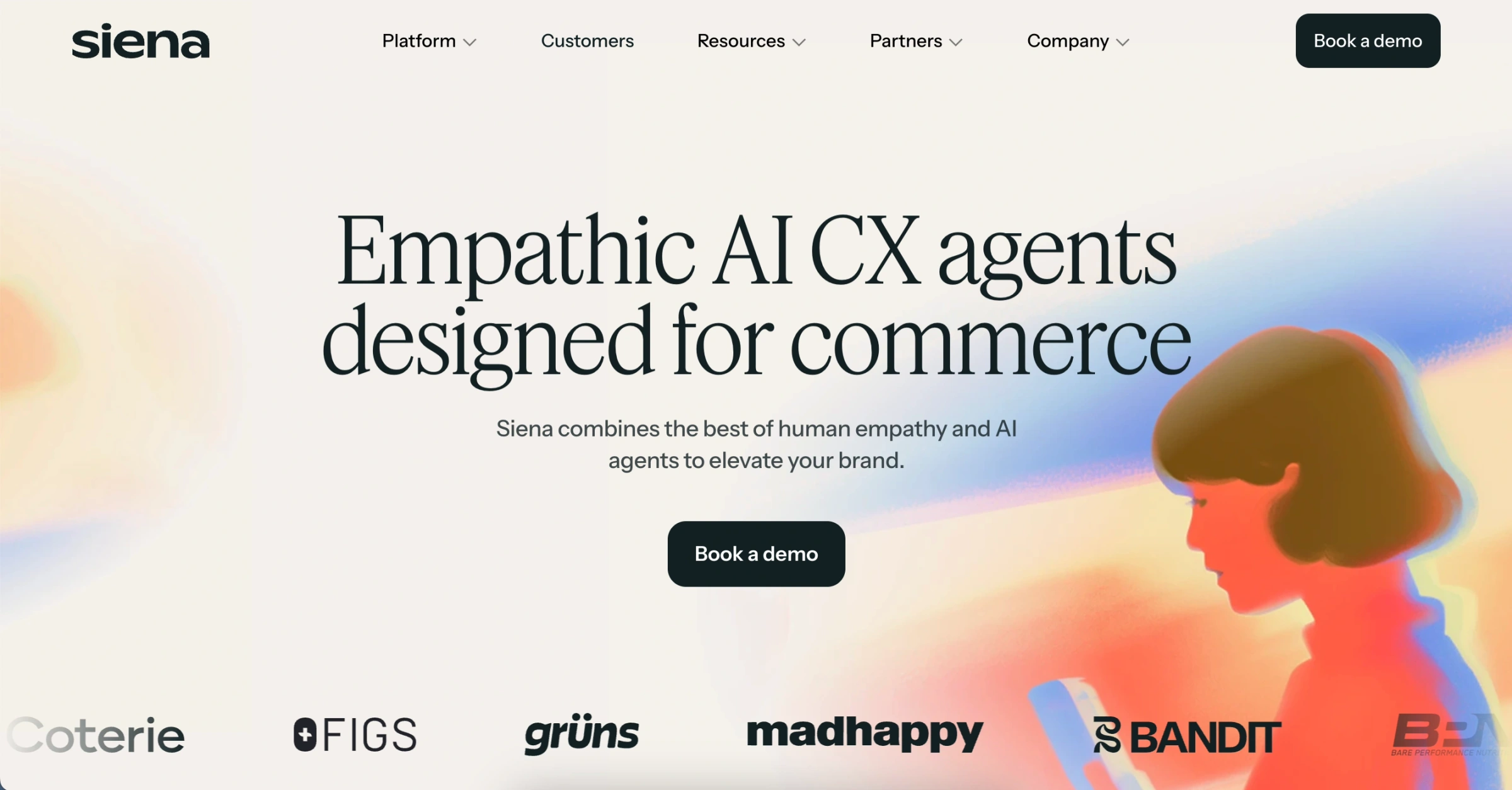
Siena AI website homepage hero
Source: Siena website

What Siena AI Does Well (And Where It Can Fall Short)

Siena AI positions itself as the "first empathic AI customer service platform" for ecommerce, and there's substance behind the branding. The platform has earned a real foothold among mid-market DTC brands, with customers like K18, Kitsch, Simple Modern, HexClad, and Eight Sleep on its portfolio.

The technical foundation is worth understanding. Siena's Cognitive Reasoning Engine (CoRE) handles complex, multi-intent queries, which means a customer who asks about a return and a new order in the same message gets a coherent answer to both. The platform also offers AI Personas, allowing brands to configure distinct tones and communication styles so the AI matches their brand voice. For brands where personality is part of the product (think beauty, fashion, lifestyle), this matters.

Siena Vision, the platform's visual AI, adds another useful layer. Customers can send photos of damaged products or warranty issues, and the AI can interpret the image as part of its response. The platform covers email, SMS, social DMs, and social comments, giving teams a single omnichannel customer support system for the channels where most ecommerce customer support conversations happen.

Siena claims up to 80% automation rate with a 4.81 out of 5 CSAT score across its customer base. Those are strong numbers if they hold up in your specific context, and they suggest the platform can handle high ticket volumes without sacrificing customer satisfaction.

Where users can run into friction

Pricing is the most common concern we hear from prospects who've evaluated Siena. The platform uses conversation-based pricing at roughly $0.90 per conversation, with full pricing details gated. Some prospects have noted that Siena counts every automated interaction as a billable conversation, regardless of whether the issue was actually resolved. At scale, that distinction can meaningfully affect your cost per ticket.

Implementation timelines are another area where expectations and reality can diverge. Siena's marketing references being "90% faster to deploy" than traditional solutions, but the platform's own enterprise implementation guide outlines a 6-week blueprint to reach full operational autonomy. Third-party reviews note a learning curve around advanced features like AI persona customization and multi-platform automation configuration, and Siena's Aday case study describes the customer investing significant time building the automation library and fine-tuning persona settings before reaching production quality.

A few other limitations are worth noting for specific buyer profiles. The platform focuses exclusively on DTC, so brands selling across Amazon, eBay, Walmart, or other marketplaces alongside their Shopify store might need a separate solution for those channels. And while the AI Personas feature gives strong brand voice control, some user reviews mention a learning curve in configuring the system and occasional unpredictability in edge cases.

None of these are dealbreakers for every buyer. Siena is a capable platform with genuine strengths in brand voice, multi-intent reasoning, and visual AI. The question is whether it fits your specific requirements around pricing model, omnichannel customer support coverage, implementation timeline, and quality control architecture. If any of those areas are creating hesitation, the alternatives below are worth evaluating.

10 Questions to Ask Any AI Customer Service Vendor Before Purchasing

Before evaluating specific ecommerce customer service platforms, these are the questions we'd recommend asking every vendor on your shortlist. They're based on patterns we've seen across hundreds of ecommerce customer support evaluations.

Quality and Safety

1. How does the AI decide when to hand off to a human?

A platform that tries to answer everything will eventually say something wrong to a customer who needed a person.

2. Is there a quality control layer before responses reach the customer?

Some platforms send the AI's first draft straight to your customer's inbox. Others run validation checks before anything goes out.

3. Can you set hard caps on refunds, cancellations, and discounts?

If the AI is making its own judgment calls on high-stakes financial decisions, that's a risk worth understanding early.

4. Can you enforce strict rules for critical processes?

For refunds over a certain dollar amount, VIP customers, or legally sensitive requests, you need deterministic workflows, not AI judgment alone.

E-commerce Depth

5. Can the AI execute actions, or does it only answer questions?

There's a meaningful difference between an AI that explains your return policy and one that generates the return label, processes the refund, and restocks the item.

6. How many systems does it connect to natively?

The gap between five integrations and fifty can be the difference between a clean demo and a painful production deployment. Ask about helpdesks, subscription providers, return tools, and shipping carriers.

7. Does it understand e-commerce-specific edge cases?

Order identity validation before taking action, restock-on-cancel logic, lost-package day thresholds, per-customer reship limits. These are where generalist platforms break down.

8. How does it handle knowledge?

Does it separate factual data (product specs, shipping windows) from behavioral instructions (tone, escalation rules)? Does it pull live order data or rely on a static customer knowledge base?

Operations and Scale

9. Can you test at 5% before going to 100%?

A platform that requires all-or-nothing deployment from day one is asking you to take on unnecessary risk.

10. Does it support multiple stores or brands under one account?

Distinct knowledge bases, policies, and AI personas per brand, without managing separate accounts.

Quick Comparison: Siena AI Alternatives at a Glance

Alternative Best For AI Approach Can Execute Actions? E-commerce Integrations Starting Price
Yuma AI Ecommerce, DTC, retail brands wanting quality-first AI for complete automation of customer support. Full autonomous AI agents Yes: refunds, cancellations, subscriptions, returns, gift cards, address changes Native integrations across helpdesks, e-commerce platforms, subscription, returns, and shipping providers Custom (30-day free trial)
eDesk Multi-marketplace sellers AI-assisted helpdesk assists agents who take actions 200+ marketplace connections From $39/agent/mo
Tidio (Lyro) SMBs starting with AI LLM-powered chatbot (Claude + in-house models) Yes, via Lyro Actions (scope depends on setup) Shopify, WooCommerce, BigCommerce, and others Free tier available
Fin by Intercom Companies already on Intercom Resolution-based AI agent Yes, via Fin Tasks + Data Connectors (setup required) Intercom platform + third-party connectors $0.99/resolution + seat costs
Ada Global enterprise Enterprise conversational AI agent Varies: native integrations + APIs (depends on stack) Mix of native integrations and custom APIs no public pricing available
Richpanel Budget e-commerce teams AI-assisted helpdesk with self-service Self-service actions (order tracking, returns); AI assists agents Shopify, WooCommerce, Magento From $59/agent/mo

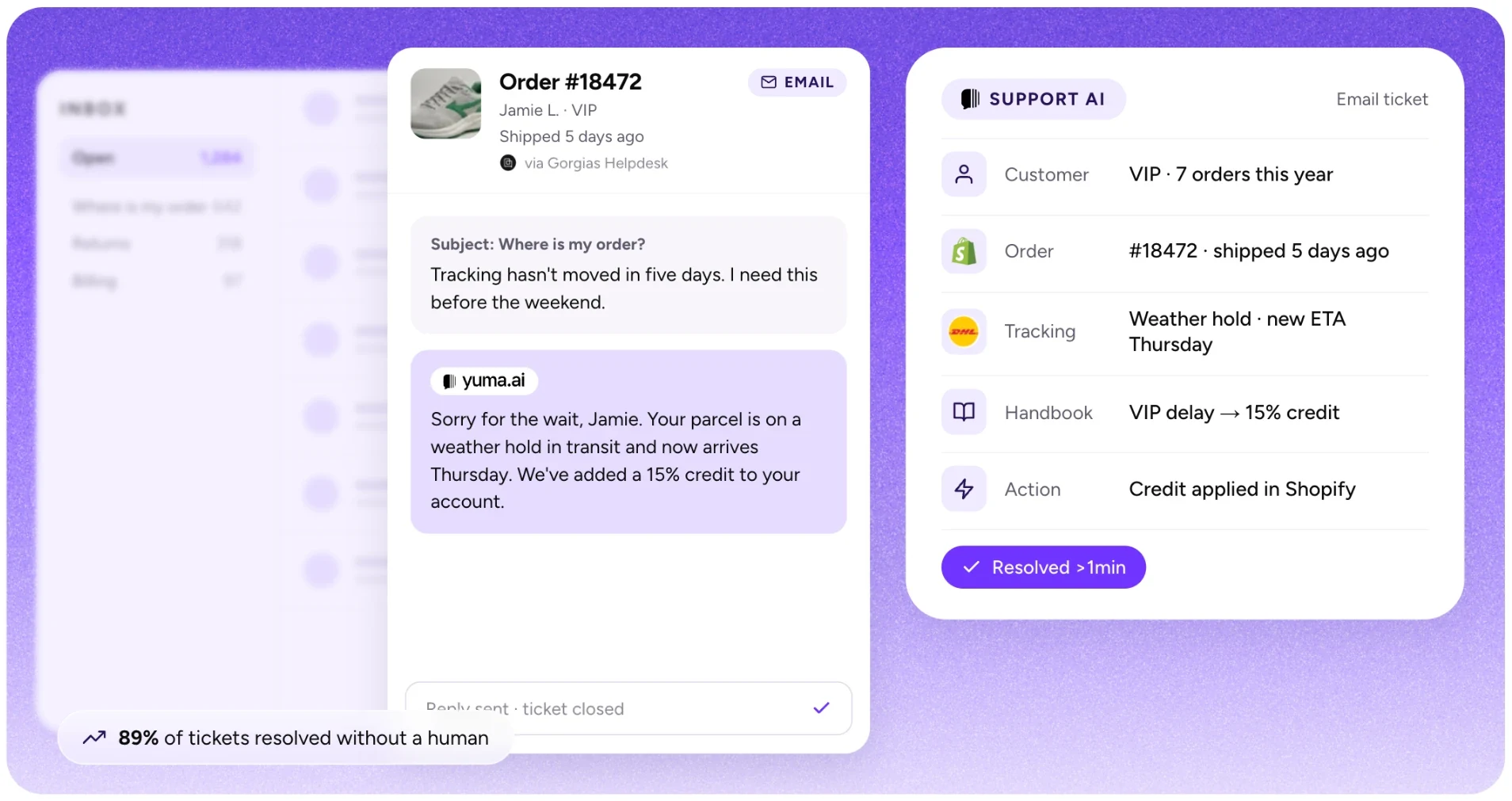
Yuma AI - best alternative to Siena AI for ecommerce customer support
Source: Yuma AI website

1. Yuma AI

We'll cover our platform the same way we cover every other alternative in this article, with specific capabilities, verified results, honest limitations, and a clear picture of who we're built for.

Yuma is an AI platform built exclusively for ecommerce customer service. The platform integrates with helpdesks including Gorgias, Zendesk, Salesforce Service Cloud, Kustomer, Re:amaze, Front, and Gladly, and works with Shopify, Shopify Plus, Magento, Woo-commerce, and more. Since inception, Yuma has automated millions of customer interactions for ecommerce brands across the U.S. and Europe.

What Yuma covers

The platform includes four core products. First - Support AI. The flagship, deploys autonomous AI agents that handle customer support across email, chat, social DMs, WhatsApp, SMS, review platforms, and almost any support channel imaginable. It includes a natural-language AI automation builder for designing automations in plain text, plus Flows, a visual drag-and-drop builder for enforcing strict deterministic logic on high-stakes processes (refund thresholds, VIP routing, cancellation rules). Every step in a Flow is explicit, enforced, and traceable. One unique feature loved by users of Support AI is Deep Search. Which is a conversational search engine built on your entire support ticket history, letting teams ask questions in plain language and get sourced answers from real customer conversations.

Second - Sales AI, which is an AI-powered pre-sales Q&A widget that sits on your product pages, answering pre sales questions before they become support tickets. Shoppers can add to cart inside the chat, helping reduce cart abandonment.Third - Social AI that puts Facebook and Instagram management on autopilot, classifying each comment and engagement by intent and sentiment and applying configurable automation rules. This includes social media customer support across comments, DMs, and mentions.

Fourth - Chat AI, which is an AI powered chat widget for website that can be easily deployed on any website or storefront in minutes.

Actions, not just answers

Yuma executes real ecommerce actions autonomously: canceling orders, processing refunds, pausing and reactivating subscriptions, changing subscription frequency, modifying shipping addresses, issuing gift cards, creating discount codes, generating return labels, and restocking canceled items. Each action follows configurable business rules with hard limits you control. The platform validates order identity before taking any action and enforces per-customer limits on reships and gift cards. Yuma takes action across tools and platforms while keeping full context of the whole process, just like human agents.

Quality architecture

Yuma runs multiple LLM calls per ticket, with separate models handling intent classification, sentiment analysis, response generation, and quality validation. A validation layer sits between the AI's generated response and the customer's inbox. Operational guardrails let you set hard caps on things like refund amounts, discount percentages, and cancellation windows. For processes that are sensitive, Flows enforce deterministic rules that execute the same way every time.

Verified results

Named customers with published case studies: Glossier (91% accuracy on WISMO tickets, 87% decrease in customer service response time), Clove (70% AI automation, 3x ROI in 3 months), EvryJewels (89% full automation, 63% cost-per-ticket reduction), CABAIA (74% cost reduction), and MFI Medical (64% automation of 22,000 monthly tickets, 87% first response time reduction).

Implementation

White-glove onboarding at no extra cost. A dedicated account manager handles the full setup. Yuma recommends a gradual rollout: start at 5-10% of ticket volume, review accuracy and customer satisfaction, then scale to full coverage. No engineering resources required from your team. Yuma is known amongst it's customers for the dedicated customer support and continuous proactive engagement to get the brand to success.

Pricing

Custom pricing discussed during a demo call. Yuma offers a 30-day free trial and only charges for tickets the AI resolves.

Limitations

Yuma is not a helpdesk. It works alongside Gorgias, Zendesk, and other supported helpdesks, not as a replacement. The platform is built exclusively for ecommerce. It requires a commerce platform to connect and a supported helpdesk. Custom pricing means you need a sales conversation to get a quote. However, the decision to not create a helpdesk is very much intentional as we believe that helpdesks and AI automation are two different games and it takes the best effort to be the best in any one of them.

Best for

Retail, DTC and ecommerce brands who need high-accuracy automated customer service with hands-off implementation, and want a platform that covers support, pre sales conversion, social comment management, and CX intelligence under one roof.

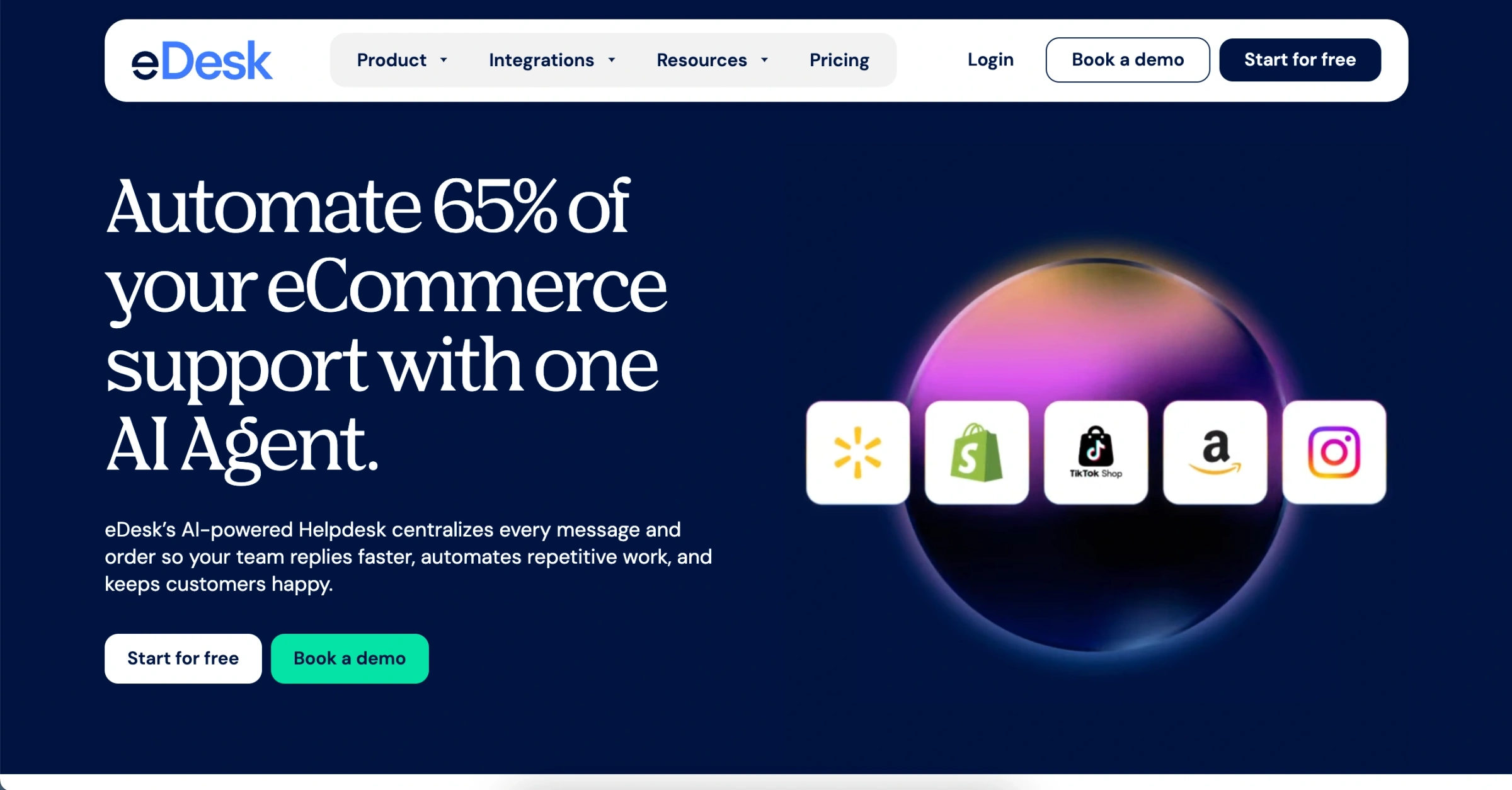
eDesk website homepage hero section
Source: eDesk website

2. eDesk

eDesk is an AI-powered ecommerce customer service software, with a particular strength in multi-marketplace operations. eDesk states it participates in the Amazon and Walmart developer councils and has publicly reported powering millions conversations.

What it does

eDesk's core product is a unified ecommerce help desk that pulls customer messages from marketplaces, webstores, social channels, and email into a single inbox. The platform connects with a various channels including Amazon, eBay, Walmart, Shopify, BigCommerce, WooCommerce, Magento, TikTok Shop, Instagram, WhatsApp, and logistics providers like AfterShip and ShipStation.

On the AI side, eDesk offers two layers. AI-powered inbox tools classify, summarize, and suggest replies for incoming tickets, helping human agents respond faster. The platform also offers an AI Agent and Chatbot that eDesk claims can resolve incoming tickets and online chats without human interaction, automating up to 65% of support. The AI Agent is listed as an add-on with an additional per-resolution charge, separate from the base helpdesk plans. Additional tools include a ecommerce live chat widget, a customer knowledge base builder, automated review request outreach, and pre sales features for converting support inquiries into sales. AI translation is available as a paid add-on at $19 per user per month.

Where it fits

eDesk is strongest for sellers managing ecommerce customer support across multiple marketplaces simultaneously. If you sell on Amazon, eBay, Walmart, and your own Shopify store and need one inbox for all of it, eDesk is built for that scenario.

Limitations

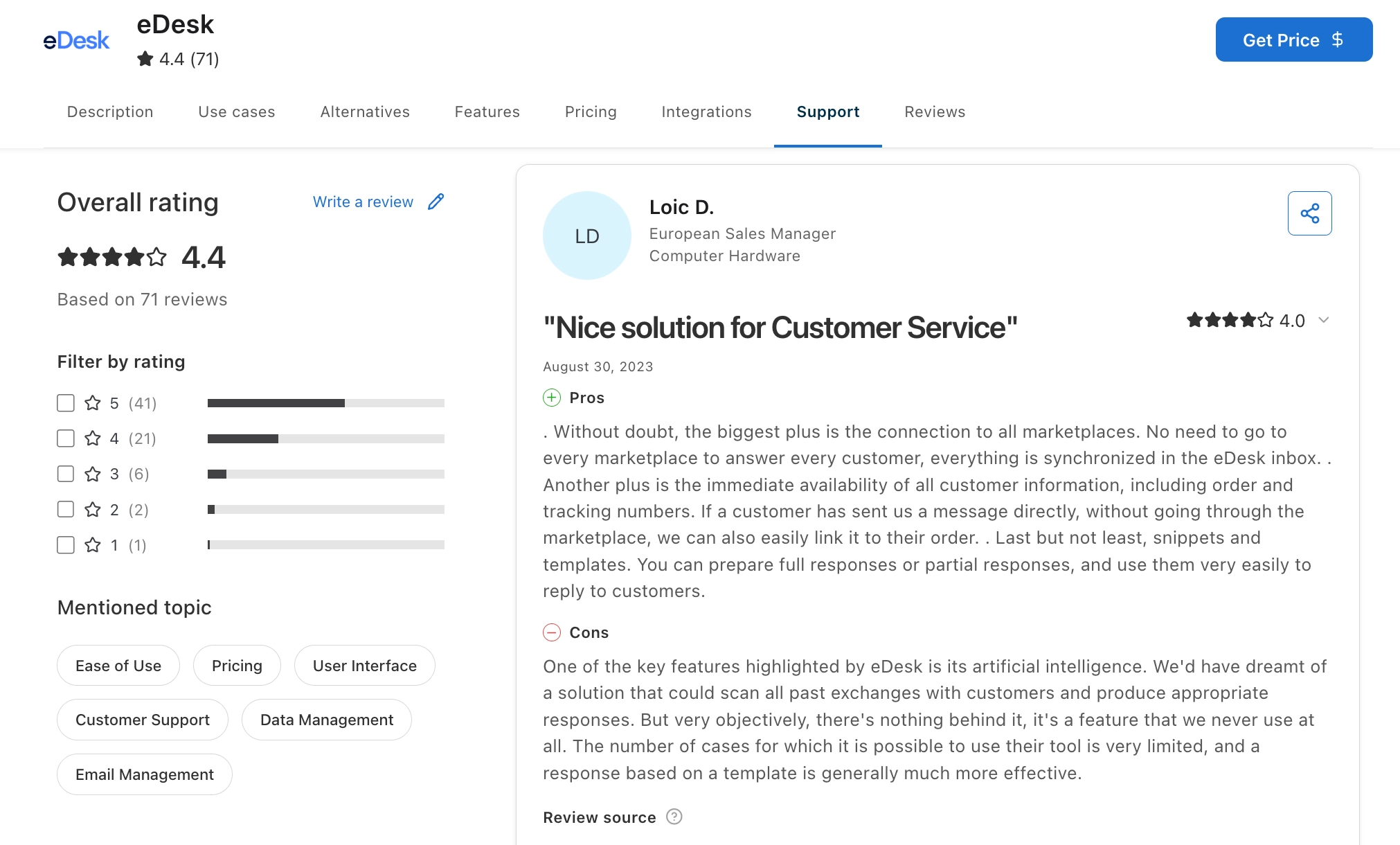
Reviews on Capterra, GetApp, and SelectHub surface two recurring friction points. Some reviewers report that initial setup is complex, particularly for teams unfamiliar with AI help desk software. The complexity goes beyond usage and to pricing as they have a complex pricing structure and several add-ons which can be challenging for brands to get into.

Others note unexpected pricing increases over time, with long-term customers describing repeated price hikes after initial commitments. The AI Agent capability is relatively new compared to eDesk's core helpdesk, so there's less track record to evaluate on autonomous resolution time and quality specifically.

One Capterra review of cons for eDesk states:

"One of the key features highlighted by eDesk is its artificial intelligence. We'd have dreamt of a solution that could scan all past exchanges with customers and produce appropriate responses. But very objectively, there's nothing behind it, it's a feature that we never use at all. The number of cases for which it is possible to use their tool is very limited, and a response based on a template is generally much more effective."

eDesk customer review on Capterra

So while eDesk is a good platform that unifies many channels and has extensive helpdesk features, it's likely that other ecommerce AI tools beat eDesk when it comes to AI capabilities.

Pricing

Plans are listed publicly starting at $39 per store per month (Essential tier). AI Agent, Chatbot, and AI Translations carry additional charges. Enterprise pricing is custom via sales. A 14-day free trial is available.

Best for

Multi-marketplace sellers who need a unified inbox across Amazon, eBay, Walmart, Shopify, and other channels, and want AI-assisted ecommerce support with the option to add autonomous resolution.

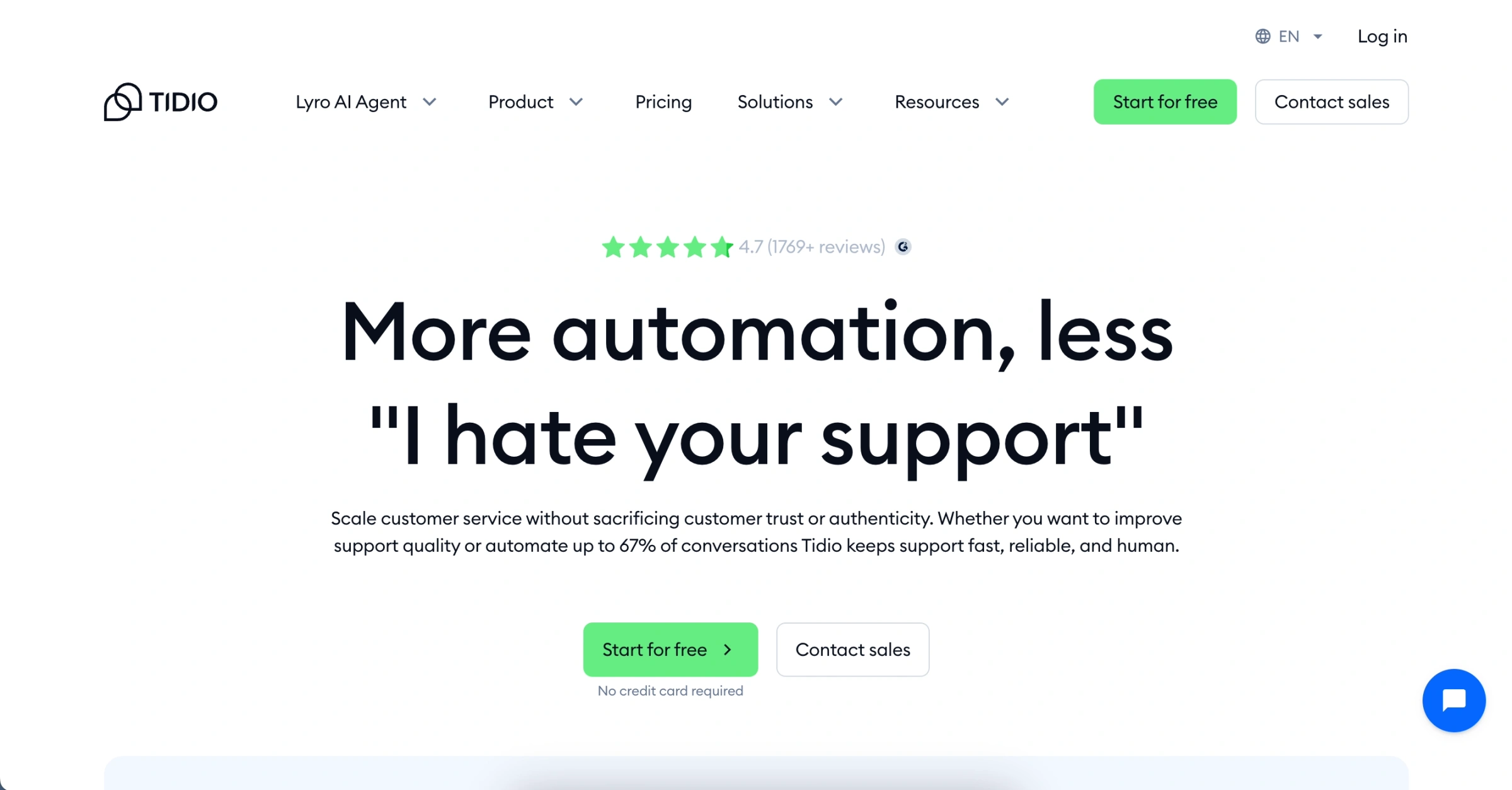
Tidio website homepage hero section
Source: Tidio website

3. Tidio (Lyro AI)

Tidio is a customer communication platform that combines ecommerce live chat, chatbot flows, and an AI agent called Lyro.

What it does

Lyro is Tidio's conversational AI agent, built on Anthropic's Claude model. It learns from your support content via website and FAQ scraping, FAQ uploads, and help-center imports, then uses that knowledge base to answer customer questions. Tidio claims Lyro can automate up to 67% of customer queries.

Lyro is separate from Tidio's Flows product, which handles structured, rule-based automation through a visual drag-and-drop builder. Lyro also has an Actions feature that lets it connect to external systems to perform tasks like checking order status, retrieving shipment details, or updating addresses, though the scope depends on your specific setup and integrations.

The platform integrates with Zendesk and Salesforce. Knowledge from Intercom and Gorgias can be imported through an assisted process with Tidio's support team, rather than a direct integration. Tidio also connects natively with Shopify, WooCommerce, and BigCommerce.

Limitations

Lyro's accuracy depends entirely on the quality of the customer knowledge base you provide. If your help content has gaps, Lyro will too.

Cost is the most frequently cited concern in Tidio's G2 reviews. Users report finding Tidio expensive, with additional frustration around essential automation and analytics features requiring paid upgrades and high costs for core functionality. The separate billing for human conversations, Lyro AI conversations, and Flows automation compounds this, since total cost can increase materially as you add volume across all three quota types. On the free tier, Lyro stops responding after 50 conversations and does not reset - which is barely sufficient for any brand and means that brands will likely get caught in higher pricing tiers almost surely.

Reviewers also flag limited features on the free plan and limited customization options. Some users report performance issues affecting website loading speeds.

Pricing

Tidio offers a free plan that includes 50 one-time Lyro conversations. The Lyro AI Agent add-on starts at $32.50 per month for 50 conversations, with pricing varying by billing term. Customer Service plans are quota-based and scale with billable conversation volume. A 7-day free trial is available. Full pricing details on Tidio's site.

Best for

Small to mid-sized businesses that want an accessible entry point into automated customer service, especially teams already using Tidio for live chat or those with straightforward support workflows and a well-maintained customer knowledge base.

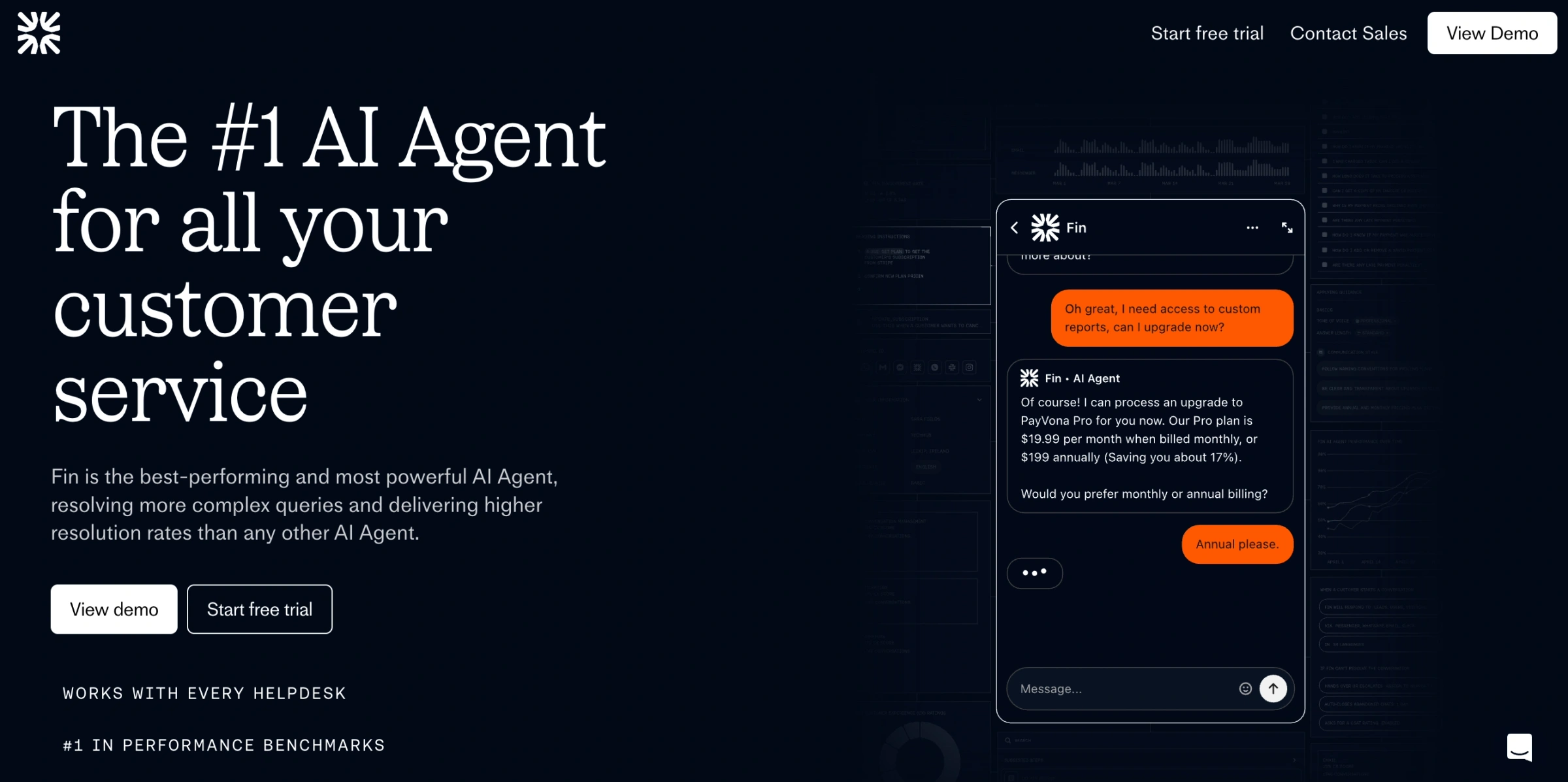
Fin website homepage hero section
Source: Fin website

4. Fin by Intercom

Fin is the Intercom AI agent, available as part of the Intercom Customer Service Suite or as a standalone product that works with other helpdesks including Zendesk and Salesforce.

What it does

Fin answers customer questions using your support content (help center articles, internal docs, PDFs, webpages) across chat, email, SMS, WhatsApp, and social channels. It supports over 45 languages. Intercom reports an average resolution rate of approximately 65-66% across its customer base.

Fin can execute ecommerce actions through Fin Tasks (currently in managed availability, so not every account has access immediately) and Data Connectors. Data Connectors are configured through Intercom's no-code UI, but you typically need usable backend APIs on your end. For Shopify, Intercom provides ready-to-use templates that cover lookup use cases like order status, tracking, and shipping details.

Fin also includes an AI Copilot that assists human agents with reply suggestions and context surfacing. Some limited Copilot usage is included in all plans.

Limitations

G2 reviews surface several recurring concerns. The most frequent is a lack of essential features that hampers workflow efficiency and integration capabilities. Reviewers also report that Fin's AI requires specific phrasing for accurate responses and struggles with nuanced or complex issues. New team members face a steep learning curve.

Pricing is the other consistent pain point. Fin charges $0.99 per resolution on top of seat-based plan costs, and as automation resolves more conversations, the per-resolution charges become the primary cost driver. A team resolving 2,000 conversations per month through Fin adds roughly $1,980 to their base plan. Add-ons like unlimited Copilot ($29/seat/month billed annually, or $35/seat/month on monthly billing) and Proactive Support Plus ($99/month) increase the total further. G2 reviewers specifically flag additional upsells and unexpected bill increases.

Pricing

Fin is priced at $0.99 per resolution. If you use Fin inside Intercom, you also need at least one seat (billed annually: Essential $29/seat/month, Advanced $85/seat/month, Expert $132/seat/month). If you use Fin with another helpdesk (Zendesk, Salesforce), Intercom lists a 50-resolution monthly minimum with no additional seat costs. A 14-day free trial is available, though trials are designed around Intercom's own platform.

Best for

Teams on Intercom who want to add AI resolution without switching platforms, or companies with technical resources to configure Data Connectors for action-based automation.

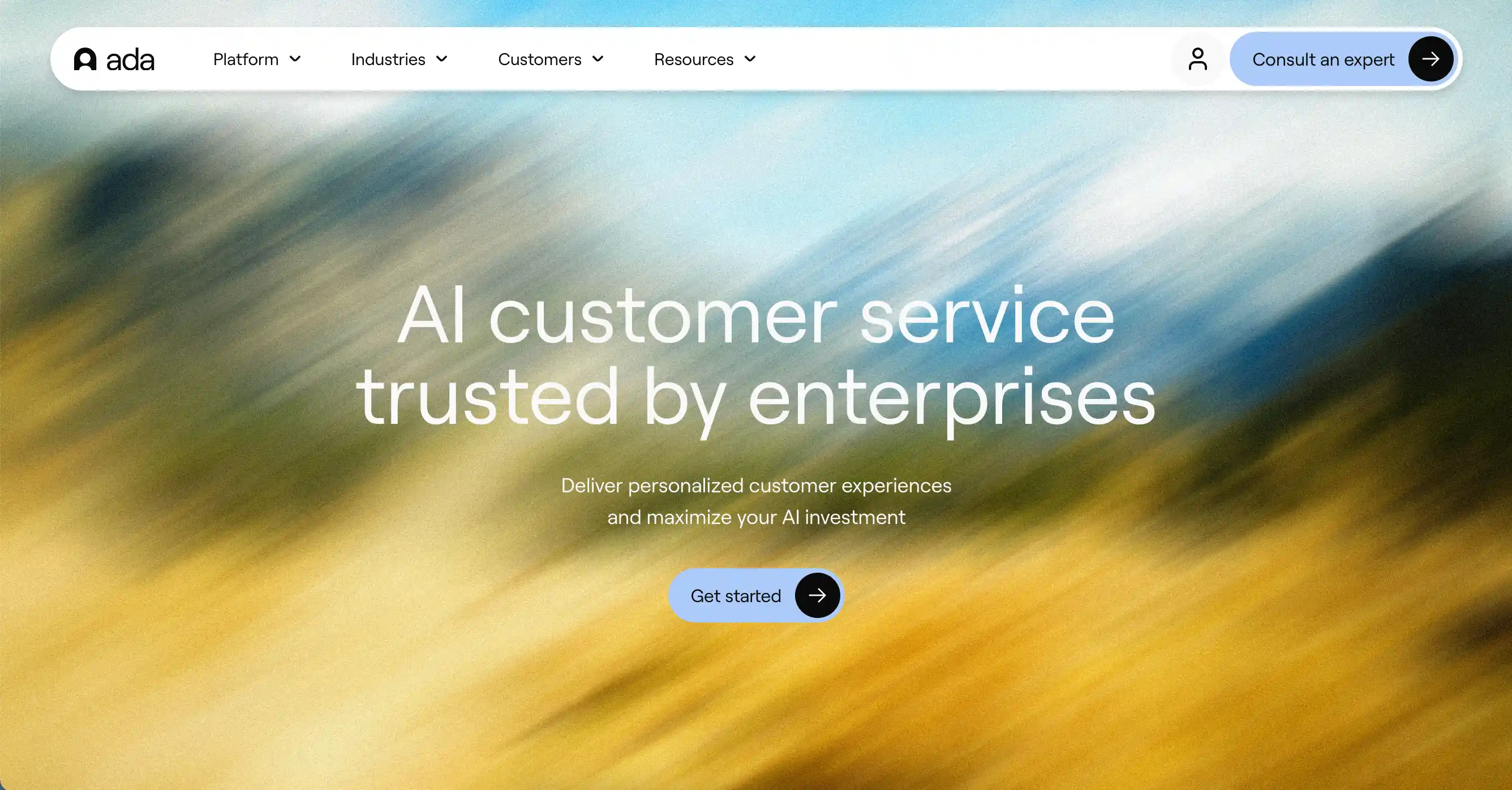
Ada website homepage hero section
Source: Ada website

5. Ada

Ada is an AI-first automated customer service platform. It serves a wide range of industries including financial services, healthcare, gaming, SaaS, and travel alongside retail and DTC brands.

What it does

The platform's core is its proprietary Reasoning Engine, to analyze intent, retrieve knowledge, and generate responses with built-in safeguards. The platform covers messaging, voice, and email from a single system, supports 50+ languages, and offers Playbooks for automating multi-step workflows like refunds, order tracking, order modifications, and account verification.

On the integration side, Ada connects with helpdesks including Zendesk, Salesforce, Freshworks, Gorgias, Gladly, Kustomer, Help Scout, and Dixa, along with contact center platforms like Genesys, Amazon Connect, and NICE CXone. Ada is often deployed alongside existing helpdesk and contact center tools via integrations and handoffs, though it also supports channels directly (messaging, voice, email). Enterprise security certifications include HIPAA, SOC2, and AIUC-1 compliance.

Limitations

G2 reviews highlight several recurring concerns. The most frequent is integration issues, with users reporting that connecting Ada to existing systems can be complex and lead to unresolved bugs. Usability challenges follow closely, particularly around bot training, integration setup, and configuring Proactive Conversations. Reviewers also flag missing integrations and frustration during implementation, along with usage limitations tied to cumbersome training processes and integration challenges with existing systems. Some users note AI limitations in Ada's responses and reporting that affect the natural flow of customer interactions.

Ada's enterprise positioning adds a separate layer of friction for mid-market ecommerce teams. Pricing is sales-led with no publicly listed rates, and implementation generally requires professional services engagement. For ecommerce, DTC, and retail brands running Shopify with Gorgias or Zendesk, Ada's multi-industry architecture may deliver more platform than needed while lacking the deep, out-of-the-box ecommerce logic (subscription management, returns workflows, per-customer reship limits) that purpose-built tools provide natively.

Pricing

Ada does not publish pricing on its website; all plans require a sales conversation. Capterra lists a starting price of $60,000 and indicates a free trial is available.

Best for

Large enterprise brands across multiple industries (fintech, healthcare, travel, retail) that need omnichannel customer support AI automation at scale across messaging, voice, and email, and have the budget and implementation timeline to support a high-touch deployment.

Richpanel website homepage hero section
Source: Richpanel website

6. Richpanel

Richpanel is an AI-powered customer service platform built for ecommerce customer service platform. Richpanel positions itself as a cost-effective Gorgias and Zendesk alternative, with customer self-service as its primary automation mechanism.

What it does

Richpanel's product suite has two core components. The Help Desk is a unified inbox for ecommerce customer support where agents manage conversations across email, live chat, phone, SMS, WhatsApp, Facebook, and Instagram. The Self-Service Portal is an Amazon-like interface embedded in your storefront where customers can independently track orders, edit shipping addresses, initiate returns and exchanges, cancel orders, and browse a branded help center.

On the AI side, Richpanel offers Sidekick. Sidekick drafts reply suggestions, summarizes conversation threads, and provides real-time two-way translation for multilingual support. It learns from your past conversations and FAQs rather than just knowledge base articles. Richpanel also offers a Social Media AI moderator that automatically hides brand-damaging content across paid and organic social posts and responds to comments.

Limitations

The most important distinction for buyers evaluating Richpanel against autonomous AI platforms: Sidekick is an agent-assist tool, not an autonomous AI agent. It drafts suggested replies for human agents to review and send. Richpanel's own Sidekick page states that AI responses are not sent directly to customers, and agents maintain control over every message.

G2 reviews surface several concerns. The most frequently cited is integration issues, with users noting limited compatibility with various essential tools and software. Reviewers also flag chat limitations that affect organization and functionality during high-volume interactions, a lack of features and insufficient documentation for setting up integrations, usability challenges with complicated setups detracting from overall experience, and a difficult setup process compounded by limited documentation.

One Shopify App Store reviewer noted the platform is "way more expensive than you initially think" because you need to pay for the self-service add-on separately to effectively use the live chat and pop-up features. The Help Desk and Self-Service Portal are separately priced components that can be combined, so buyers should review both pricing tiers together to understand the full cost. Native subscription self-service appears limited, with Richpanel's navigation listing "Subscriptions (Coming soon).

Pricing

Richpanel's pricing varies across its own website and Shopify listing, and some figures shift depending on billing term (monthly vs. annual). The Shopify App Store lists the Help Desk Pro plan at $89 per month and Pro Max at $119 per month. The Self-Service Portal has a free tier (up to 50 orders per month) with paid tiers scaling by order volume. Enterprise pricing is available for teams over 50 agents.

Best for

Ecommerce brands that want to reduce ticket volume primarily through customer self-service rather than autonomous AI.

Frequently Asked Questions (FAQs) about Siena Alternatives for Ecommerce Customer Service

What is the best Siena AI alternative for Shopify stores?

For ecommerce, retail, and DTC brands, Yuma AI is the most deeply integrated alternative, with native connections to Gorgias, Zendesk, and 50+ ecommerce tools including Recharge, Loop Returns, AfterShip, and much more. Case studies prove 89% automation at EvryJewels, 70% at Clove, and 91% accuracy at Glossier.

How much does Siena AI cost compared to alternatives?

Siena AI uses conversation-based pricing at approximately $0.90 per conversation, with full pricing requiring a sales call. Among alternatives: Tidio starts free (50 conversations/month), eDesk starts at $49/month, Richpanel's Help Desk Pro starts at $89/month on the Shopify App Store, Fin by Intercom charges $0.99 per resolution plus seat costs starting at $29/month, and Ada uses custom enterprise pricing with Capterra listing a $60,000 starting price. Yuma AI offers custom pricing with a 30-day free trial, charging only for resolved tickets, reducing your cost per ticket.

Which Siena AI alternative has the highest automation rate?

Yuma AI. Based on customer proof, Yuma AI achieves 70% to 89% full automation: EvryJewels at 89%, Clove at 70%, and MFI Medical at 64% on 22,000 monthly tickets. Siena AI claims up to 80% automation with a 4.81/5 CSAT score. Ada reports up to 83% automated resolution at some enterprise customers. Tidio claims up to 70%. Definitions of "automation" vary across vendors, so ask each platform how they measure it and whether unresolved or abandoned conversations count.

What's the fastest Siena AI alternative to deploy?

Tidio can deploy same-day with no-code setup from your existing help center content (but might not perform up to the mark from day one). Yuma AI offers white-glove onboarding where a dedicated account manager handles configuration, with no engineering resources required from the customer. Ada typically requires a longer implementation timeline with professional services, reflecting its enterprise positioning. Richpanel offers white-glove migration support from competing helpdesks.

Do I need engineering resources to set up a Siena AI alternative?

It depends on the platform. Yuma AI provides white-glove onboarding at no extra cost, with a dedicated account manager handling the full setup. Tidio uses a no-code builder that non-technical teams can configure. Richpanel offers guided migration. Fin by Intercom may require custom development for ecommerce workflows like returns, refunds, and subscription changes, since those are not natively supported. Ada typically involves professional services for implementation and custom integrations.

Which Siena AI alternative works best with Gorgias?

Yuma AI has the deepest native Gorgias integration, and the majority of its customer base runs on Gorgias paired with Shopify. Richpanel works with Gorgias as well but functions as an alternative helpdesk rather than an AI layer on top of it. Ada lists Gorgias among its supported integrations. For brands evaluating whether to keep Gorgias or switch, eDesk and Richpanel offer their own built-in helpdesk with AI features included.

Can AI automated customer service platforms take actions, or do they only answer questions?

This varies significantly across platforms. Yuma AI's autonomous agents can execute actions like processing refunds, canceling orders, updating subscriptions, issuing gift cards, and changing shipping addresses directly in Shopify, with operational guardrails (hard caps on refund amounts, per-customer reship limits, order identity validation) controlling what the AI is allowed to do. Fin by Intercom requires custom development to execute ecommerce actions. eDesk and Richpanel assist human agents who then take actions manually. Tidio offers limited Smart Actions for basic tasks like address updates and order status lookups.

How do AI customer service platforms prevent bad responses?

Quality control architecture varies widely. Yuma AI uses a multi-agent system that makes 15 to 20 LLM calls per ticket, with separate models handling intent classification, sentiment analysis, response generation, and quality validation before any message reaches a customer. Operational guardrails enforce hard caps on refunds, discounts, and reshipping. Richpanel's Sidekick takes a different approach: agents review every AI-drafted response before it's sent, keeping humans in the loop at the cost of full automation. Tidio's Lyro generates responses from help center content, which means answer quality depends directly on documentation quality.

Conclusion

Every platform on this list solves a real problem for a specific type of buyer. The question is which problem you're solving and how much risk you're willing to absorb while solving it.

If you're evaluating AI ecommerce customer service platforms, start with three things: how the platform ensures quality and accuracy, whether it natively handles your ecommerce workflows or requires custom development, and what the first 30 days of implementation actually look like.

We built Yuma AI exclusively for ecommerce, retail, and DTC brands. That focus shows up in the details: native handling of returns, subscriptions, WISMO, and refunds without custom development; accuracy proven across complex global brand operations like Glossier and CABAIA; a dedicated account manager who stays with you after launch and proactively optimizes your setup; and a platform that's highly customizable without requiring engineering resources to configure or integrate.

If that sounds like your team, we'd love to show you how it works - book a demo.

#ai
#automation
#customerservice
#customersupport
#DTC
#e-commerce
#future
#shopify
Share this post
#ai
#automation
#customerservice
#customersupport
#DTC
#e-commerce
#future
#shopify
Share this post

Explore More Insights on AI & E-Commerce

How Javvy Coffee achieved 70% automation and slashed response time from 24 Hours to 12 Minutes, with Yuma AI

How Javvy Coffee achieved 70% automation and slashed response time from 24 Hours to 12 Minutes, with Yuma AI

Learn how the global consumer subscription brand Javvy Coffee automated 7o% of their CX and cut FRT by 99% with Yuma AI

How UnBonMaillot automated 50% of CX and achieved 4x cost efficiency with Yuma AI

How UnBonMaillot automated 50% of CX and achieved 4x cost efficiency with Yuma AI

How FINN, Europe’s leading car subscription platform, automated 45% of B2B CX tickets and cut resolution times by 90% with Yuma AI

How FINN, Europe’s leading car subscription platform, automated 45% of B2B CX tickets and cut resolution times by 90% with Yuma AI

FINN used Yuma AI to automate 45% of support tickets and cut average resolution times by 90%, freeing agents for high-value sales work and reinforcing the brand’s tech-first, revenue-driven culture.

The Koin Club Transforms Customer Support with Yuma AI: 40% Automation & SLA Boost to 57%

The Koin Club Transforms Customer Support with Yuma AI: 40% Automation & SLA Boost to 57%

"The Koin Club Transforms Customer Support with Yuma AI: 40% Automation & SLA Boost by 50% all while reducing 83% of human effort for their customer support"

Omnie and Yuma AI: Reshaping E-Commerce Customer Service together

Omnie and Yuma AI: Reshaping E-Commerce Customer Service together

Omnie has automated 50% of customer support for several of its e-commerce clients after partnering with Yuma AI. They also succeeded in reducing the average FRT from 7 hours to 1 hour. Omnie is currently serving 12 clients with Yuma's AI (and growing).

MyVariations Slashes Response Time by 70% and Automates 62% of Customer Support Tickets with Yuma AI

MyVariations Slashes Response Time by 70% and Automates 62% of Customer Support Tickets with Yuma AI

"Thanks to the Yuma team, we have automated more than 62% of our total tickets in just a few months while keeping our Trust Pilot score of 4.8/5"

How MFI Medical Cut First Response Time by 87% and Automated 64% of Customer Inquiries with Yuma AI

How MFI Medical Cut First Response Time by 87% and Automated 64% of Customer Inquiries with Yuma AI

Yuma has enabled MFI Medical to save $30,000 annually, drastically reduce response times (FRT), and boost their Google rating from 3.5 to 4.4, reflecting improved customer satisfaction and operational efficiency.

How Petlibro Achieved 79% Automation and Saves 20% Annually with Yuma AI

How Petlibro Achieved 79% Automation and Saves 20% Annually with Yuma AI

Petlibro leverages Yuma AI for 79% automation, reducing costs by 20% and speeding up resolutions by 30%. Enhanced support includes 24/7 coverage and seamless integration, empowering growth.

How CABAIA Achieved 74% Cost Reduction with Yuma AI

How CABAIA Achieved 74% Cost Reduction with Yuma AI

CABAIA enhances customer experience with Yuma AI, achieving significant cost reductions and boosting response efficiency. This strategic implementation allows 24/7 customer interaction with seamless integration, empowering their business growth.

A Glossier Touch: Elevating Customer Experience with Yuma AI

A Glossier Touch: Elevating Customer Experience with Yuma AI

Learn how a massive global brand like Glossier slashed 87% on overall response time and saved 16 hours in per ticket resolution, all with high accuracy across the board.

How Clove Achieved 3x ROI, 70% AI Automation, and 25% Cost Savings in Just 3 Months with Yuma AI

How Clove Achieved 3x ROI, 70% AI Automation, and 25% Cost Savings in Just 3 Months with Yuma AI

Explore how Clove revolutionized customer support with AI, achieving 70% automation, slashing response times to 3 minutes, and realizing a 3x ROI, through their successful partnership with Yuma AI.

How EvryJewels Achieved 89% Automation, slashed cost by 63% and process over 150k tickets with Yuma

How EvryJewels Achieved 89% Automation, slashed cost by 63% and process over 150k tickets with Yuma

Learn how EvryJewels scaled customer support with Yuma AI, slashing costs, automating 89% of tickets, and cutting response times by 87.5%.