Conversational AI for Customer Service: What It Actually Means in 2026
Conversational AI has moved past answering questions. A product-led guide to what it actually does for ecommerce support teams in 2026: the difference between chatbots, conversational AI, and AI agents that resolve tickets end-to-end, plus the evaluation criteria that separate tools that resolve from tools that just demo well.
1 / 8What is conversational AI for customer service?
Key takeaways
In 2026 the best conversational AI resolves tickets end-to-end by taking actions like refunds, cancellations and return labels.
Rule-based chatbots, conversational AI and AI agents differ mainly in whether the tool can act or only answer.
PwC's 2025 Customer Experience Survey found 52% of consumers stopped buying from a brand because of a bad experience.
Hackett found early Gen AI deployments gave a 13% lift in customer experience and 11% in service quality, but only 7% cost reduction.
Start with your highest-volume ticket type, usually WISMO, measure resolution rate and CSAT, then expand.
Conversational AI for customer service is AI that understands what customers ask in their own words and responds in natural language across email, chat, social DMs, SMS and phone calls. But that definition undersells what the technology actually does now.
Some people still picture a chat popup that answers FAQs, but in 2026, the best conversational AI resolves tickets end-to-end by taking actions. They can now process refunds, pull tracking data from Shopify, cancel orders, and generate return labels for ecommerce brands.
Simply put? That means they can now close tickets without a human ever touching them, and this post will explain what that looks like and how you can leverage conversational AI for your business.
What is conversational AI for customer service?
At its core, conversational AI uses natural language processing and machine learning to understand customer intent and generate responses. Unlike rule-based customer service automation, it handles the infinite ways people phrase the same question. A customer typing "where's my stuff?" is asking the same thing as one who writes "I haven't received my order yet," and conversational AI can recognize all of these questions as the same intent and handle them the same way.
For ecommerce brands, this matters because customer interactions don't follow scripts, and conversational AI can handle nuance and different phrasing without needing a separate rule for each variation.
Yuma runs on one written Handbook, managed in plain language, and looks up order data, product catalogs and shipping details as it works. With Ask Yuma, merchants describe how they do support, upload an existing SOP, or point at real tickets, and Ask Yuma writes the Handbook pages. That means a CX lead can go from a Google Doc of return policies to a tested playbook without writing a single rule or waiting on engineering.
From chatbots to agents: What changed?
There are three distinct tiers of automation in customer service, and the gap between them is significant. Knowing which one you're looking at saves time in every demo.
Rule-based chatbots and canned responses
Rule-based chatbots for customer service run on scripted decision trees, helpdesk macros, and keyword triggers. For example, a customer clicks "Track my order" and gets a canned reply. They work well enough for simple deflection like store hours, password resets, and basic policy lookups.
The ceiling shows up fast, however. The moment a customer goes off-script, asks a follow-up the tree didn't anticipate, or combines two questions in one message, the bot either loops or escalates. If you've tried rule-based automation before and run into a wall, this could be where it broke.
Conversational AI
Conversational AI understands intent, holds context across a conversation, and generates natural-sounding responses. It can handle phrasing variations ("where's my stuff" maps to the same intent as "order status inquiry"), and it can maintain a multi-turn thread without losing track.
This is a meaningful step up from scripted bots, but it still stops short of taking actions. Conversational AI at this tier can tell a customer the return policy and direct them to a return landing page, but it can't actually process the return.
AI agents: The shift from assist to act
AI agents do everything conversational AI can, plus they also take autonomous actions. They process refunds, cancel orders, pull tracking data from Shopify, generate return labels, and update subscriptions in Recharge, resolving tickets end-to-end without a human touching them.
According to PwC's 2025 Customer Experience Survey, 52% of consumers stopped buying from a brand because of a bad experience. That stat explains why the industry is moving toward this tier. If more than half of customers leave over a bad experience, tools that only suggest replies aren't enough.
Yuma operates at this level. Its Handbook has a playbook for each customer situation, with its own steps, limits and tests, and Yuma takes real actions inside Shopify, Gorgias, Zendesk, and other connected platforms. This is the core distinction between generative AI vs chatbots: one takes actions, the other suggests responses.
How conversational AI works in customer service
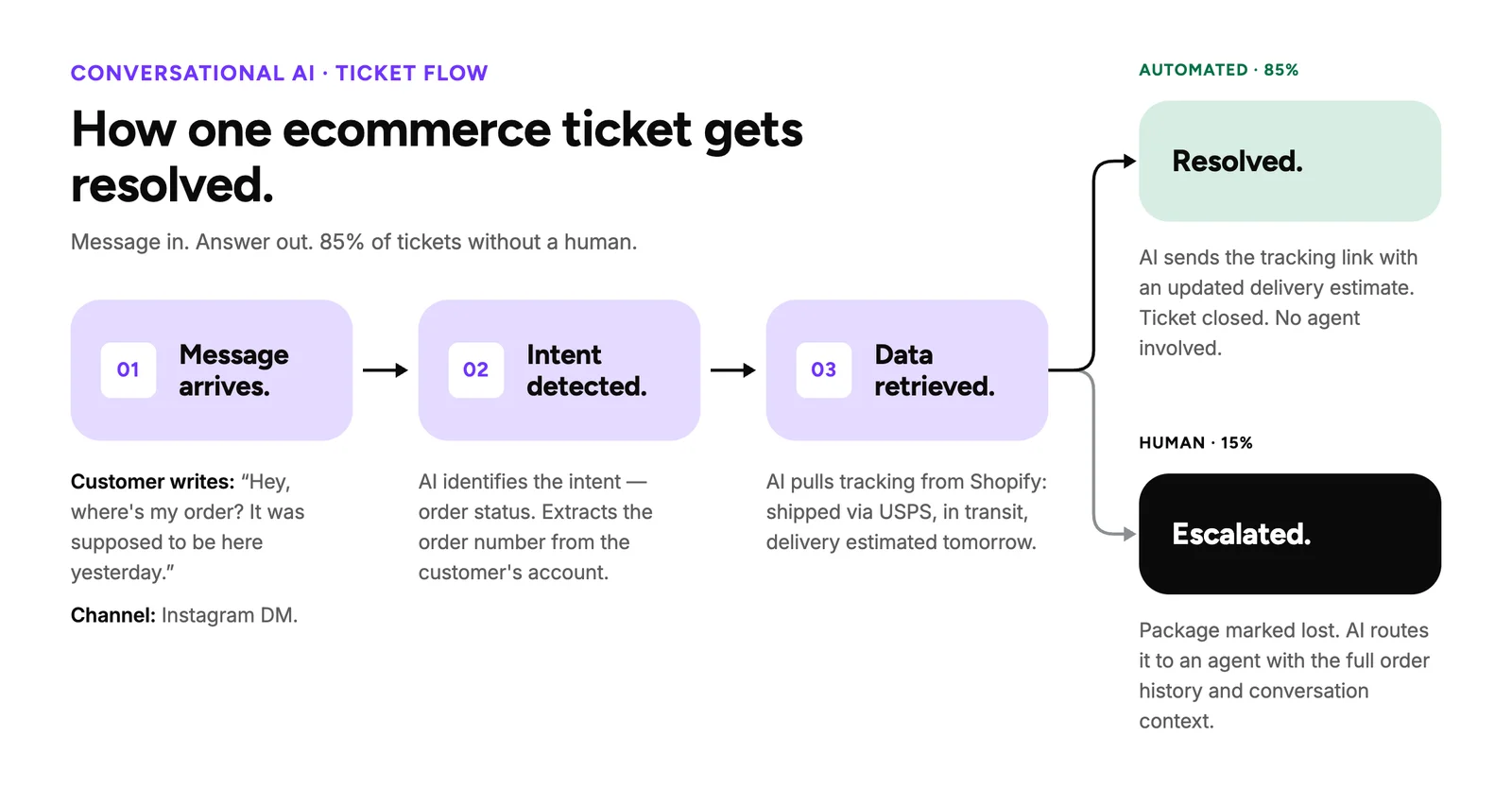
A customer sends an Instagram DM: "Hey, where's my order? It was supposed to be here yesterday."
The AI identifies the intent (order status inquiry) and extracts the order number from the customer's account. It pulls tracking data from Shopify, and it sends a response with the tracking link and closes the ticket, with no humans involved.
The Hackett Group's 2026 GBS Key Issues Study found that early Gen AI deployments are delivering a 13% improvement in customer experience and 11% gains in service quality, while cost reduction came in at just 7%. The takeaway is that AI's primary value in service operations is improving the quality of the experience, not just cutting expenses.
When the AI can't resolve an issue (such as if a package is marked as lost or there's a damaged item dispute), it routes the ticket to a human agent with the full order history and conversation context attached. The agent picks up mid-thread with everything they need.
Yuma handles this through playbooks in its Handbook, one per customer situation, each with its own procedures and tests. A WISMO playbook follows different steps than a returns playbook, and the tests rerun whenever a policy changes. This is why accuracy stays high as you add more use cases, and why the approach scales to generative AI for customer support across every ticket category. The result is real-time humanlike support that holds up at volume.
See Yuma in action
See what AI could automate in your queue
A free audit of your real ticket history: your automation potential and where to start.
These are the ticket types that make up the bulk of ecommerce support volume. Each one plays out across email, live chat, Instagram, Facebook, WhatsApp, and SMS, and with Yuma Voice, on the phone line too.
WISMO and order status
When a customer asks where their order is, AI pulls tracking from Shopify, sends the tracking link with an estimated delivery date, and closes the ticket. WISMO questions can easily be the single highest-volume ticket category for ecommerce brands. They can also come through every channel, so streamlining responses with AI agents can be a significant time-saver for businesses and free up human agents to respond to more critical issues.
Returns and exchanges
When a customer wants to return or exchange an item, AI checks whether it falls within the return window, processes the return if it qualifies, generates a return label, and confirms next steps. If the item is outside policy, it explains why and offers alternatives. These requests land heavily in email and live chat, where customers tend to attach photos and reference order details, making them well-suited for AI that can pull context from the order history automatically.
Pre-sales product questions
When a shopper asks about sizing, materials, or compatibility before buying, AI answers from the product catalog and knowledge base and can recommend alternatives if something is out of stock. Pre-sales questions are especially high-value on live chat and Instagram or WhatsApp DMs, where a fast, accurate answer can be the difference between a conversion and an abandoned session.
Subscription management
When a subscriber wants to pause, skip, cancel, or resume, AI connects directly to Recharge, Skio, or Loop and processes the change. These requests are straightforward and repetitive, which makes them strong automation candidates. They come in primarily through email and live chat, with SMS growing as a channel for quick actions like skipping a shipment.
Social media support
When a customer comments on an Instagram or Facebook post asking about an order or product, AI classifies the comment by intent and sentiment, then decides whether to reply publicly, send a DM, or hide spam. Speed matters more here than on any other channel because public comments are visible to every potential customer scrolling past, and a slow or missing response shapes perception for more than just the person who asked.
Across all five categories, the pattern is the same. The AI identifies intent, pulls the relevant data, takes the action, and closes the ticket. Scaling this across an entire operation is what ecommerce customer service with generative AI looks like in practice.
The ecommerce tech stack for conversational AI
Conversational AI only works in ecommerce when it's connected to the right stack. These are some of the key platforms you'll need to connect for your conversational AI to handle tickets end-to-end:
Commerce platform (Shopify, BigCommerce) is where order data, product catalog, and customer records live. Without this connection, the AI can't look up an order or process a refund.
Helpdesk (Gorgias, Zendesk, Kustomer) is where tickets are managed. The AI works inside the helpdesk. Your agents see AI-handled tickets in the same queue as human-handled ones.
Subscription platform (Recharge, Skio, Loop) gives the AI direct access to pause, skip, cancel, and resume subscriptions. Without it, every subscription ticket requires a human.
AI layer (Yuma) sits on top of all three. Reads from the commerce and subscription platforms, acts inside the helpdesk, sends responses in the customer's channel. It connects to what you already use.
What to look for in a conversational AI platform
Forrester predicts service quality will dip in 2026 as companies rush to scale AI without addressing operational gaps. The wrong tool doesn't just fail to help. It makes service worse. These criteria separate AI customer service software that resolves from software that just demos well.
Can it take actions? If the AI can't process a refund, cancel an order, or generate a return label, it's still drafting replies for a human to send.
Does it work with your stack? The commerce platform, helpdesk, and subscription tools covered above need to connect without forcing a platform migration. Ask whether you can integrate AI into your CX infrastructure without re-platforming.
What happens on escalation? Does the human agent get full conversation history and order context, or start from scratch?
Brand voice controls. Can you configure tone per channel and per store?
Pricing model. Per-seat, per-resolution, or performance-based? A per-resolution model means you only pay for tickets the AI fully resolves.
Security. Look for SOC 2 Type II certification specifically.
Start evaluating conversational AI for your team
Conversational AI for customer service in 2026 means AI agents that resolve tickets by taking actions. The act-vs-assist distinction is the most useful filter when evaluating tools.
Start with your highest-volume ticket type. For most ecommerce brands, that's WISMO. Automate it. Measure the results: resolution rate, first response time, CSAT, cost per ticket. Then expand to returns, pre-sales, subscriptions. That's how you validate whether a tool actually resolves or just answers. Tools like Yuma's Chat AI, for example, can have full conversations that address customer needs and can resolve tickets entirely, and you only pay when Yuma fully resolves a ticket.
See Yuma in action
The difference between conversational AI that assists and conversational AI that resolves is whether it can take actions inside your commerce stack. Yuma does (refunds, cancellations, tracking, returns) across Gorgias, Zendesk, and Shopify.
Frequently asked questions about conversational AI for customer service
How much does conversational AI for customer service cost?
Pricing varies by vendor and model. Some platforms charge per seat, others per resolution, and some use performance-based pricing where you only pay for tickets the AI fully resolves. Per-resolution pricing tends to align incentives better for ecommerce brands because it ties cost directly to outcomes. Cost per resolution typically ranges from under a dollar to several dollars depending on ticket complexity and volume.
How long does it take to implement conversational AI for customer service?
Implementation timelines range from hours to months. Self-serve tools can be configured in a day but often require weeks of tuning. Platforms with white-glove onboarding handle setup for you. With Yuma, most brands go live within a week, with no implementation fee. Ask Yuma drafts your Handbook from the macros, SOPs and tickets you already have, your Yuma team connects your helpdesk and store, and each playbook goes live gradually once its tests pass. You don't need engineers at any point. The biggest variable is how well-documented your processes and policies are.
Can conversational AI handle multiple languages for global ecommerce brands?
Yes. Modern platforms auto-detect the customer's language and respond in kind. Yuma handles regional dialect differences, such as formal vs. informal address in French, German, and regional variations in Spanish and Portuguese. This is set in brand pages, which can be scoped per language, so dialect-awareness carries across every channel. On phone calls, Yuma Voice also works in multiple languages and follows a caller who switches language mid-call.
What is the difference between conversational AI and generative AI for customer service?
Conversational AI is a broad category, meaning any AI that understands natural language and generates responses. Generative AI, powered by large language models, is the underlying technology that makes modern conversational AI possible. In practice, the most capable tools combine both, using generative AI for language understanding, plus structured processes and guardrails for taking actions safely.
Is conversational AI secure enough to handle customer payment and order data?
It depends on the vendor. Look for SOC 2 Type II certification. Beyond that, ask how the AI accesses order data, what hard limits exist on destructive actions like refunds, and whether payment details are ever stored or passed through the AI. Yuma is SOC 2 Type II certified and enforces system-level caps on refund amounts and cancellation limits.
Can conversational AI work alongside human support agents?
Yes, and the best implementations are built for this. AI handles high-volume, repeatable tickets (WISMO, returns within policy, subscription changes) while human agents focus on conversations needing judgment or empathy. The key is clean escalation: when the AI can't resolve, it hands off with the full conversation history and order context so the agent picks up mid-thread.