
Intercom is now Fin, and Fin is now owned by Salesforce. The acquisition completed on September 10, 2026, and while the product still works the way it did prior to the acquisition, the roadmap doesn't belong to the same team anymore.
For SaaS and product-led companies, that might be fine. Salesforce knows that world. But if you run ecommerce support, the acquisition now brings up questions about fit. Customers may be asking: was a platform built for SaaS messaging ever the right fit for teams whose tickets are order tracking, returns, and subscription changes?
Fin has added Shopify-specific ecommerce capabilities, but for teams that need depth across the full commerce stack, there are now alternatives built specifically for that complexity.
This list covers seven of them, organized to help you find exactly what you're looking for.
What happened to Intercom?
Intercom went through pretty significant change recently, so if you stepped away from your Intercom contract in April and came back in October, it's possible you may not quite recognize the new company.
- May 12, 2026: Intercom rebranded the company as Fin, keeping "Intercom" as the helpdesk product name. The rename made the AI agent the corporate identity.
- June 15, 2026: Salesforce signed a definitive agreement to acquire Fin for approximately $3.6 billion.
- September 10, 2026: The acquisition was completed. Fin now operates as part of Salesforce AI Labs, bringing its 30,000+ customer base and technical team under Salesforce's umbrella. Marc Benioff said Fin's technology will make "Agentforce even more powerful for customer service."
Pricing hasn't yet changed, and it's still $0.99 per outcome, with seats at $29, $85, and $132. But we don't know if product development or roadmaps may change long-term.
For teams with an active Intercom contract, nothing breaks tomorrow. For teams approaching a renewal or mid-evaluation, the question is whether to bet on where Fin is heading under Salesforce or move to a platform with an independent roadmap.
7 Intercom alternatives worth evaluating in 2026
The alternatives below split into three categories based on what you're looking for.
- Ecommerce-specific tools are for teams whose tickets are WISMO, returns, and subscriptions.
- Full helpdesk replacements are for teams that want to switch platforms entirely.
- Budget and small-team options are for teams that need core functionality at a lower price point.
Here are the top seven Intercom alternatives and how they fit into these categories.
| Tool | Category | Best for | Why it's great |
|---|---|---|---|
| Yuma AI | Ecommerce-specific | Shopify brands on Gorgias/Zendesk | Autonomous actions inside Shopify, Recharge, 170+ tools |
| Gorgias AI | Ecommerce-specific | Shopify brands wanting helpdesk + AI | Shopify-native helpdesk with built-in AI Agent |
| Siena AI | Ecommerce-specific | DTC brands prioritizing brand voice | CoRE engine for empathic, brand-consistent AI |
| Zendesk | Full helpdesk replacement | Enterprise teams wanting a full suite | Enterprise scale, broad integration ecosystem |
| Help Scout | Full helpdesk replacement | Email-first mid-market teams | Free for 5 users, clean email-first UX |
| Freshdesk | Lower entry price | Mid-market teams with a lower starting budget | Freddy AI for auto-triage and reply suggestions |
| Tidio | Small team / SMB | Small Shopify stores testing AI | Lyro AI for generative automation |
Ecommerce-specific alternatives
Fin has added ecommerce capabilities, including Shopify order actions and in-conversation checkout, but its ecommerce support is Shopify-specific and the platform still serves SaaS, product-led, and enterprise teams alongside retail.
These alternatives were built for ecommerce from the ground up, with deeper integrations across the ecommerce customer service software stack and workflows scoped to the ticket types ecommerce teams actually handle.
Yuma AI
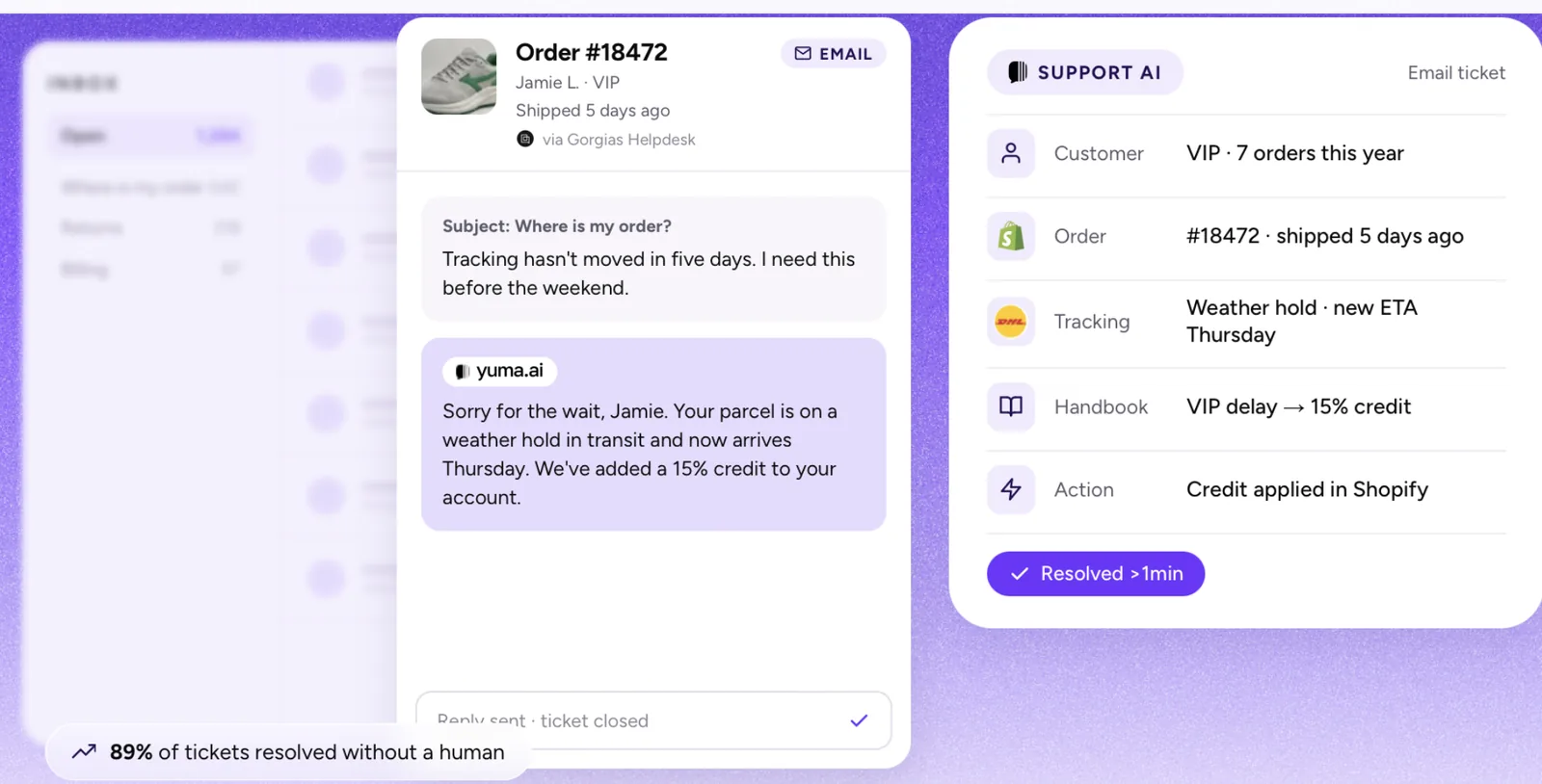
Yuma is one of the best AI customer service platforms, and it serves ecommerce brands exclusively. It installs inside your existing helpdesk (Gorgias, Zendesk, or Kustomer) rather than replacing it, so your team keeps the same workspace and the same workflows.
That overlay model is a marked difference for Fin, because instead of switching platforms, you just add ecommerce-specific AI on top of the one you already have.
Fin now has native Shopify actions, but Yuma's ecommerce coverage goes deeper across the full commerce stack. Recharge for subscriptions, Loop for returns, ShipBob for fulfillment, and 170+ other commerce tools. Each ticket type gets its own Playbook, a specialist workflow with its own steps and guardrails, rather than one generic configuration handling everything.
Yuma also recently launched a Voice AI Agent for teams that handle phone support alongside chat and email, and Yuma's account team builds everything to spec during onboarding, rather than handing you a self-serve setup wizard.
Pros
- Overlay model keeps your existing helpdesk intact
- Specialist Playbooks scoped per ticket type
- 170+ commerce integrations beyond Shopify
- White-glove onboarding
- Voice AI Agent for phone support
Cons
- Ecommerce only, so it doesn't fit SaaS or product-led teams
- Not a helpdesk, so you still need Gorgias, Zendesk, or Kustomer underneath
Pricing: Performance-based. Brands pay only for tickets the AI fully resolves.
Want to see how Yuma measures up against competitors? Check out the Yuma AI comparison page.
Gorgias AI
Gorgias is a helpdesk first, with AI agents second. The platform was built as a Shopify-native helpdesk, and the AI customer service software is a separate feature layered on top of the ticketing system.
For ecommerce teams leaving Intercom who want both helpdesk and AI in a single tool, Gorgias is a natural landing spot. You get Shopify-native ticket management and an AI layer in one subscription.
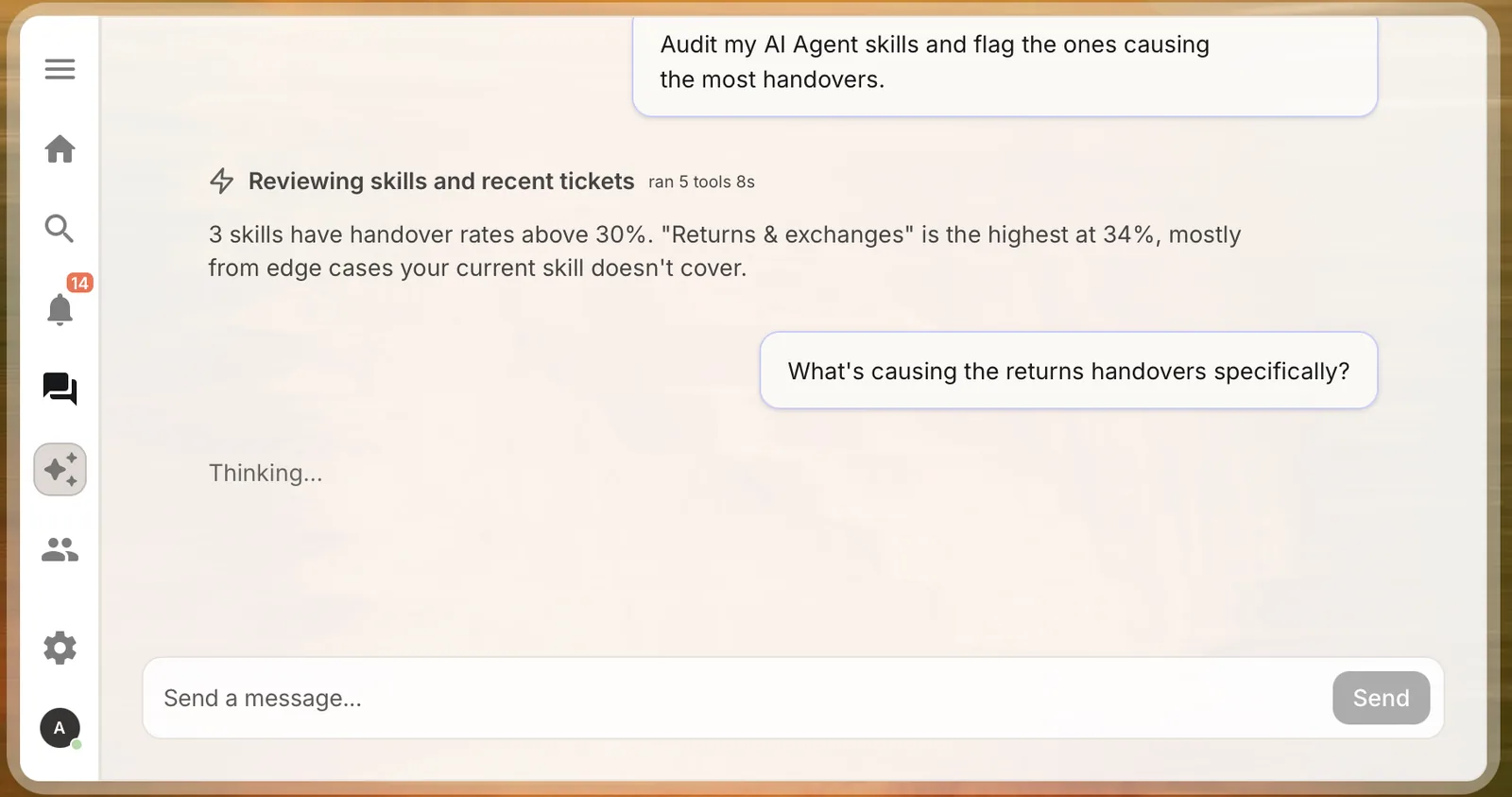
The trade-off here is that the AI operates within the constraints of a platform that wasn't originally designed for autonomous resolution. For teams that want to go deep on AI-driven automation, other options may be a better fit.
Pros
- Shopify-native helpdesk with built-in AI
- Single platform for ticketing and automation
- Strong Shopify data integration
Cons
- AI Agent is an add-on with separate pricing
- Less flexibility for brands on some non-Shopify platforms
Pricing: From $40/month plus interaction fees, when choosing plans with AI agents.
Siena AI
Siena focuses on "empathic AI" for consumer brands, with an emphasis on brand voice consistency across channels. AI Personas are built on your tone, voice, and customer language, which makes it a fit for ecommerce brands that treat customer communication as a brand touchpoint rather than a cost center.
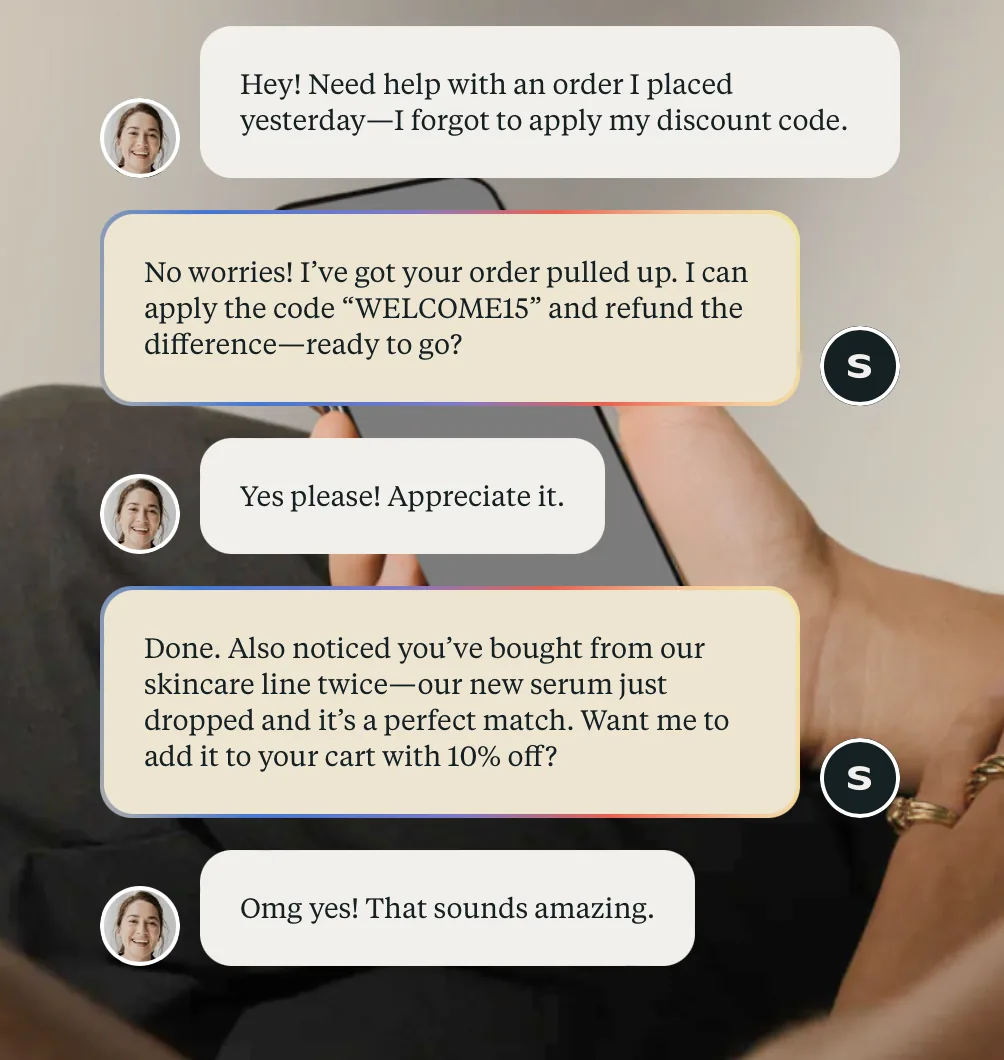
Siena integrates with helpdesks like Gorgias and Zendesk, but it operates as its own separate layer rather than working inside the helpdesk interface the way an overlay does. That adds another surface for your team to manage.
If you're comparing Siena with Yuma and Gorgias, the difference comes down to how each tool handles high-stakes actions like refunds and returns. Siena and Gorgias both lean on conversational reasoning to generate responses. Yuma uses structural safeguards (deterministic workflows, hard operational limits per ticket type) to control what the AI can and can't do in those scenarios.
Pros
- Strong brand voice controls via AI Personas
- Purpose-built for ecommerce
- Minimal setup time with dedicated onboarding
- Dedicated agents for customer service, shopping, and social media
Cons
- Operates as a separate layer alongside your helpdesk, not inside it
- Higher base price than many alternatives
- Smaller integration ecosystem than Yuma
Pricing: $750/month plus $0.90 per automated ticket.
Want to learn more? See how Yuma compares to Siena.