Sierra is an established customer service AI platform, with a growing base of large-scale customers. Its agents handle conversations across chat, email, and voice, and the platform has gained traction with large consumer and retail brands through an outcome-based pricing model tied to business results.
But the teams searching for Sierra alternatives tend to share one of two motivations:
- The cost exceeds their budget.
- They need a tool built for a specific vertical rather than a cross-industry enterprise platform.
This list organizes seven alternatives by what's actually driving your search, so you can shortlist based on your stack, your volume, and what you can spend.
Where Sierra fits and when teams may consider alternatives instead
Sierra's platform deploys AI agents that resolve customer service interactions across chat, email, and voice, using outcome-based pricing where customers pay based on business results the AI achieves.
Here are a few things to keep in mind when deciding if Sierra AI is right for you:
- Cost. Sierra's annual contracts reportedly start around $150,000, with first-year budgets often reaching $200,000 to $350,000 or more. For mid-market ecommerce brands handling 3,000 to 10,000 tickets per month, that pricing can exceed their entire CX budget.
- Pricing transparency. Sierra doesn't publish pricing or offer a free trial, so there's no way to evaluate cost before a sales conversation. For mid-market teams that want to test a platform against real ticket data before committing to an annual contract, that process adds weeks before a single ticket is automated. Other platforms in the category publish starting rates and offer trial periods that let teams validate results before signing.
- Vertical fit. Sierra is a cross-industry platform. Ecommerce workflows like processing Shopify refunds, managing Recharge subscriptions, or generating return labels require configuration rather than arriving ready to use. Teams that need those workflows on day one tend to look at purpose-built alternatives.
Best Sierra AI alternatives by category
With 52% of organizations now deploying agents in production and customer service ranking as one of the top five areas where early adopters see the highest returns, choosing the right AI customer support tool is critical.
The alternatives below are grouped into three categories based on the reasons teams typically move away from Sierra:
- Ecommerce-specific alternatives for teams whose ticket volume is driven by WISMO, returns, and subscriptions. Sierra serves ecommerce brands, but as a cross-industry platform, workflows like Shopify refund processing and return label generation need to be configured during implementation. Purpose-built tools arrive with those workflows ready to deploy.
- Enterprise peers for teams that need Sierra-level scale and autonomy but want different pricing, a different implementation model, or stronger coverage in a specific vertical like tech or fintech.
- Helpdesk-native alternatives for teams that want AI resolution added to their existing Gorgias, Zendesk, or Intercom setup without introducing a separate platform.
Here's a quick overview of the best Sierra competitors by category:
| Tool | Category | Best for | Pricing model |
|---|---|---|---|
| Yuma AI | Ecommerce-specific | Shopify + Gorgias/Zendesk brands | Outcome-based, from ~$1.20/resolution |
| Decagon | Enterprise peer | Tech and fintech with engineering resources | Custom, $50K+ annual floor |
| Ada | Enterprise peer | High-volume, cross-industry | Custom enterprise contracts |
| Fin (Intercom) | Helpdesk-native | SaaS and product-led teams | $0.99/resolution |
| Gorgias AI | Ecommerce-specific | Shopify brands wanting helpdesk + AI in one | From $40/month + interaction fees |
| Siena AI | Ecommerce-specific | DTC brands prioritizing brand voice | $750/month + $0.90/conversation |
| Zendesk AI | Helpdesk-native | Enterprise teams already on Zendesk | From $50/agent/month + add-ons |
Ecommerce-specific alternatives
These platforms were built for ecommerce from the ground up. They connect natively to Shopify, integrate with subscription and returns tools, and arrive with order management workflows ready to deploy rather than requiring custom configuration.
Yuma AI
Yuma was built exclusively for ecommerce. It deploys specialist support AI agents called Auto-Pilots that resolve tickets end-to-end inside your existing helpdesk, processing refunds, pulling tracking data, canceling orders, and managing subscriptions.
Each ticket type gets its own agent with its own process and guardrails, rather than one general AI handling everything. Yuma is backed by Y Combinator and serves brands including Glossier, Clove, and EvryJewels.
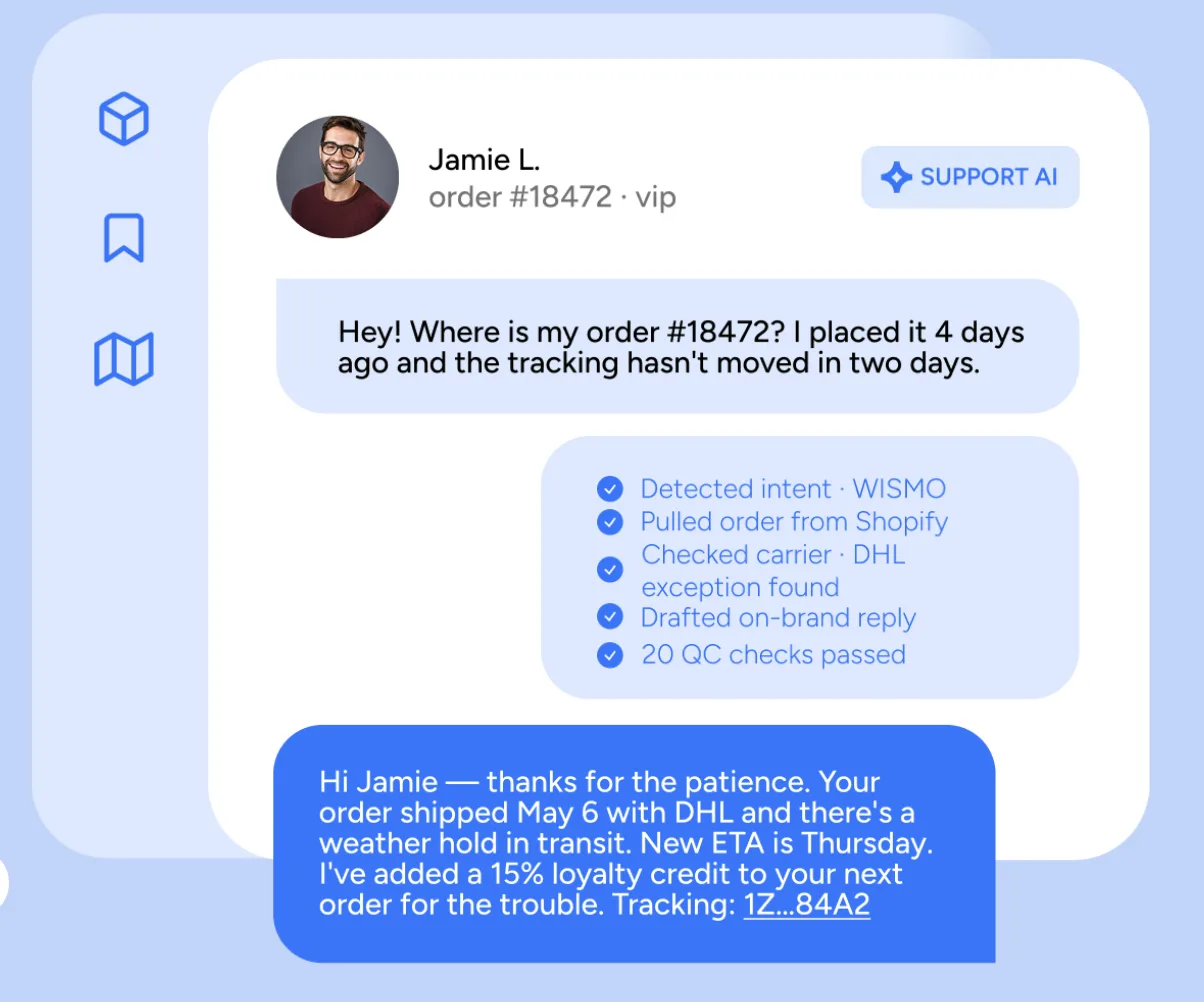
Two capabilities extend Yuma's reach beyond what API-connected tools can do:
- Browser Actions lets Yuma interact with web-only platforms that have no API, such as carrier claim portals and supplier systems.
- Event-Driven Automation handles workflows that span multiple steps and parties, pausing mid-ticket to wait for a third-party response and resuming automatically when it arrives.
Pros:
- End-to-end ticket resolution with real actions inside connected platforms
- Works inside Gorgias, Zendesk, Kustomer, and Gladly without re-platforming
- Browser Actions and Event-Driven Automation handle web-only systems and multi-party workflows that other tools escalate
- White-glove onboarding with the 30/30 promise: 30% automation in 30 days
- SOC 2 Type II certified
Cons:
- Ecommerce only, so SaaS companies and brands without a supported commerce platform won't get full value
- No voice or phone channel
- Setup requires onboarding with Yuma's team rather than instant self-serve
Pricing:
Outcome-based, starting at approximately $1.20 per resolution. Escalated tickets aren't billed. First 30 days free. No six-figure minimums. Compared to Sierra, this can be a significant cost decrease.
Want to see how Yuma measures up? Compare Yuma AI to other leading tools today.
Gorgias AI
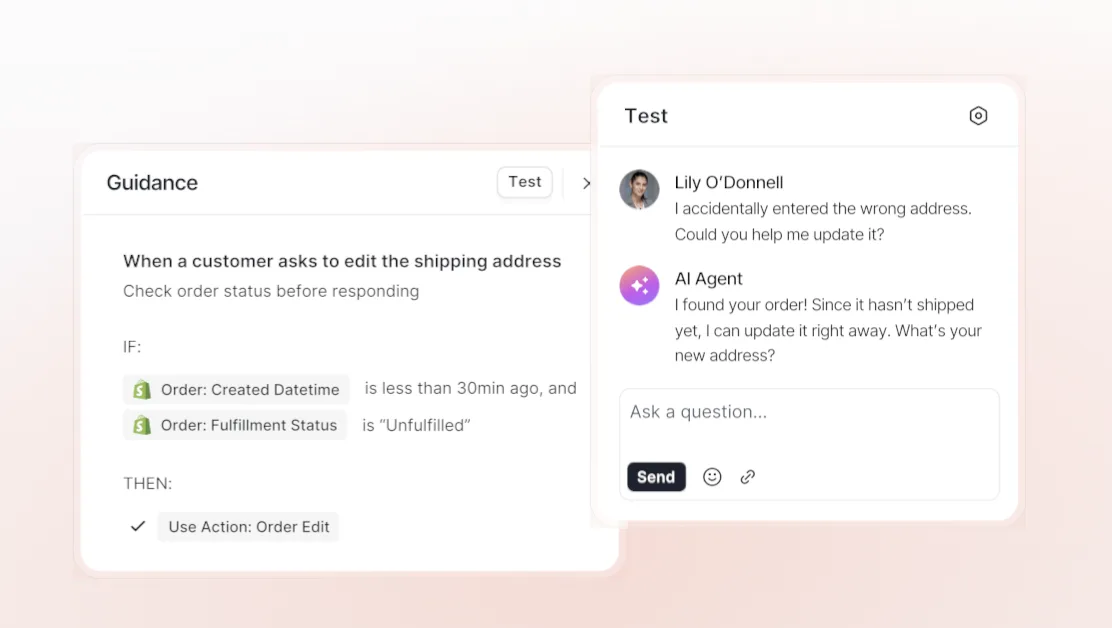
Gorgias is an ecommerce helpdesk with a built-in AI Agent that handles pre-purchase and post-purchase conversations. The Shopping Assistant engages shoppers with product recommendations, while the Support Agent resolves post-purchase tickets including order tracking, refund processing, and return initiation.
Pros:
- Helpdesk and AI share a single platform, so agents and AI work from the same context
- Deep Shopify integration that's good for ecommerce brands
- AI trained on millions of ecommerce scenarios through an OpenAI partnership
Cons:
- AI pricing is separate from helpdesk plan costs, with $1.50 interaction fees if volume exceeds the plan limit
- Interactions are billed as automated once 72 hours pass without human handover, so there can be a reporting delay
Pricing:
Starter plan with AI Agent at $40 per month plus interaction fees. Helpdesk features are a separate $10 monthly fee. Teams automating support with AI tools for Gorgias have several options depending on whether they want AI built into the helpdesk or layered on top.
Siena AI
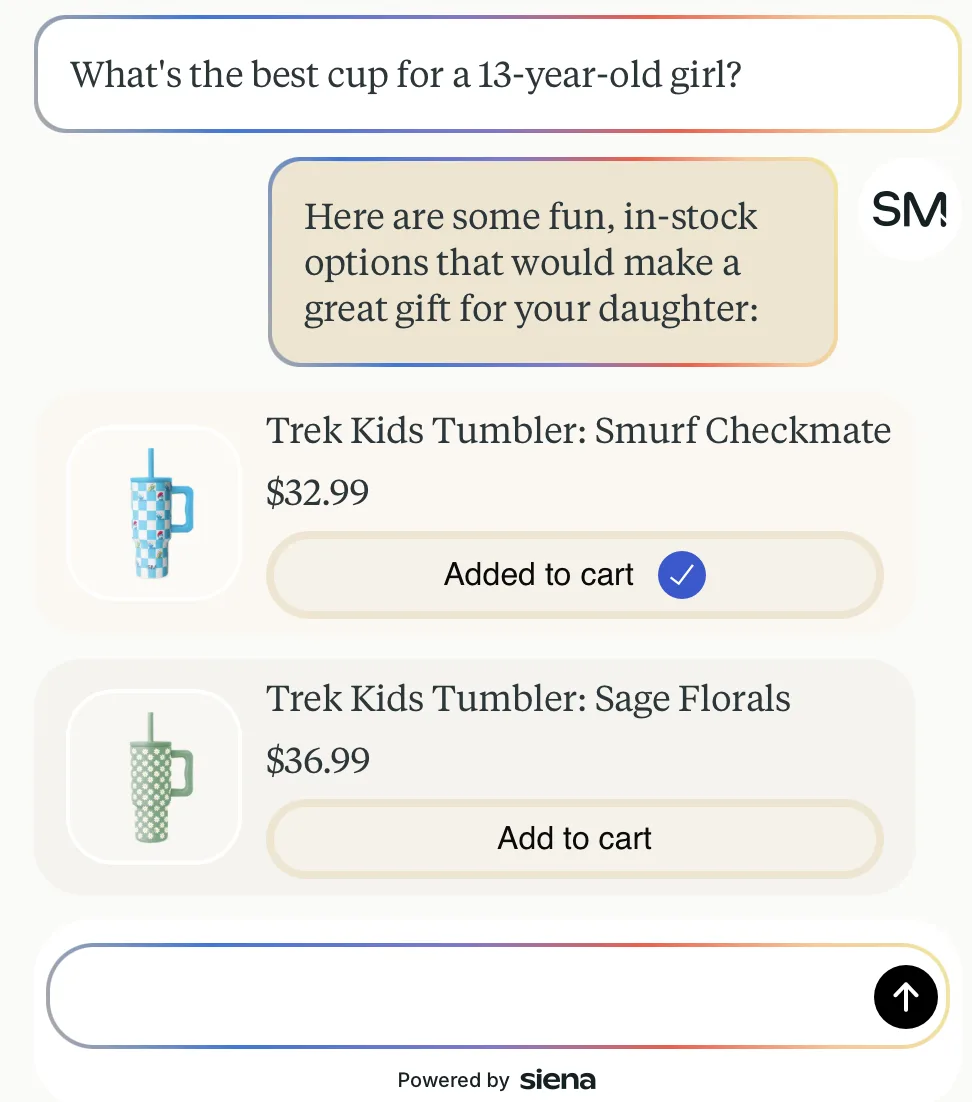
Siena AI is an autonomous customer service platform built for DTC ecommerce. It uses a Cognitive Reasoning-Based Engine (CORE) and AI personas to handle conversations with brand-specific empathy across email, chat, WhatsApp, Instagram DMs, and SMS.
Siena connects to Shopify, Zendesk, and Kustomer, and takes real actions including processing returns, editing orders, and managing subscriptions. Compared to Yuma, however, Siena averages lower success in full automation.
Pros:
- Has historically stayed true to customers' brand voices
- Handles both routine and moderately complex ecommerce tickets
- Solid history of providing good customer support
Cons:
- G2 reviews flag a routing issue where AI sometimes fails to escalate or prematurely closes a ticket
- Requires a separate helpdesk
Pricing:
$750/month platform fee plus $0.90 per automated ticket. Support and implementation are included.
Enterprise peers
These platforms operate at a similar scale and price point to Sierra. They're built for large organizations with dedicated engineering resources and six-figure automation budgets, and they serve multiple industries rather than specializing in ecommerce.
Decagon
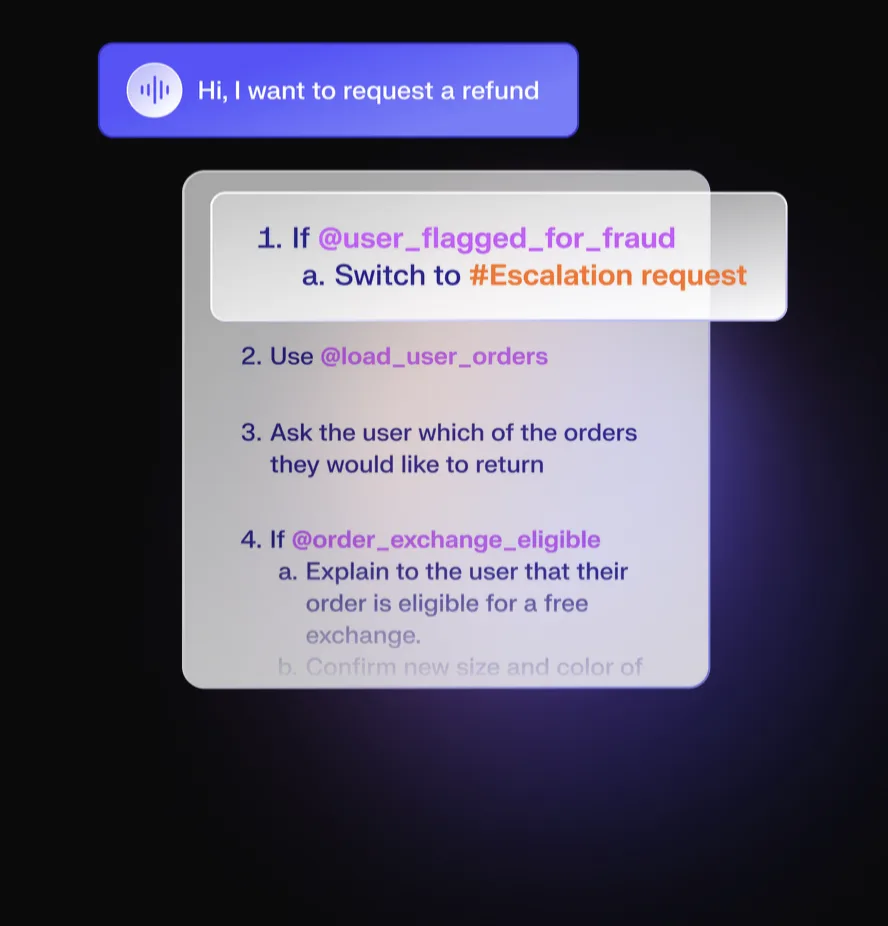
Decagon is the closest architectural peer to Sierra. It uses Agent Operating Procedures (AOPs) for workflow definition and has raised funding at a $4.5 billion valuation. The platform is strong in tech and fintech, serving customers like Notion and Duolingo.
Pros:
- Autonomous, LLM-native resolution across chat, email, and messaging
- AOP framework gives engineering teams granular control over agent behavior
- Strong in tech and fintech verticals
Cons:
- Reported annual floor around $50,000
- Implementation requires engineering resources to define AOPs and configure integrations, which can take around six weeks
- For ecommerce teams without dedicated engineering support, timelines can extend significantly
Pricing:
Custom enterprise contracts. Reported $50K+ annual floor.
Ada
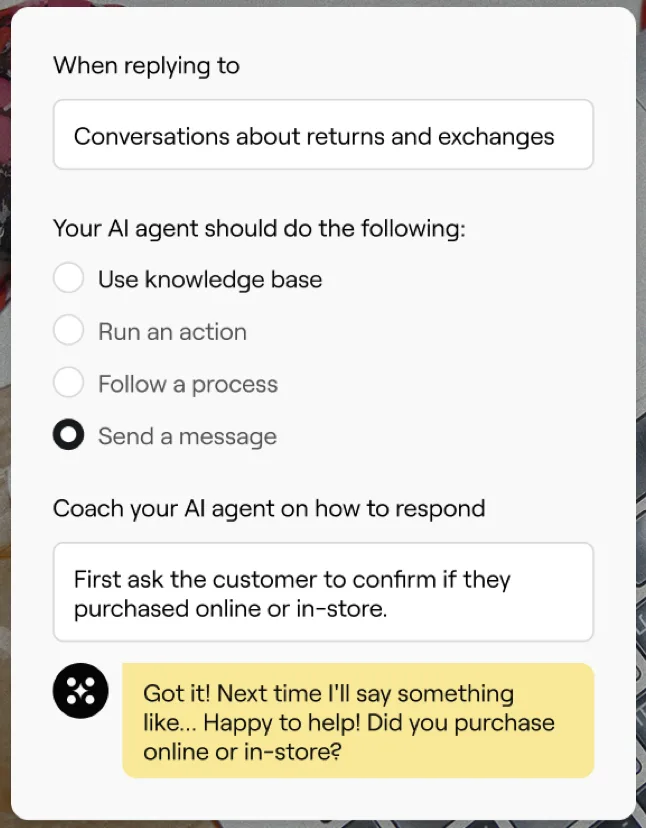
Ada is an AI-native customer service platform with a no-code builder for designing AI conversation flows. SOP-driven playbooks structure how the AI resolves issues across chat, email, voice, SMS, and social.
Ada supports 60 languages, making it well-suited for enterprise buyers with global reach.
Pros:
- No-code builder accessible to non-technical teams
- Strong multi-channel and multilingual coverage
- AI-native architecture
Cons:
- No public pricing; custom enterprise contracts only
- No native Shopify integration at time of publishing, so ecommerce workflows require custom configuration via playbooks
- Multiple G2 reviewers cite that integrations are complex to set up in their workflows
Pricing:
No public pricing page, requiring a sales-led process.
Helpdesk-native alternatives
These tools either include a helpdesk or layer AI directly into one you already use. They're a fit for teams that want to add resolution capability without introducing a standalone AI platform on top of their existing stack.
Fin (Intercom)
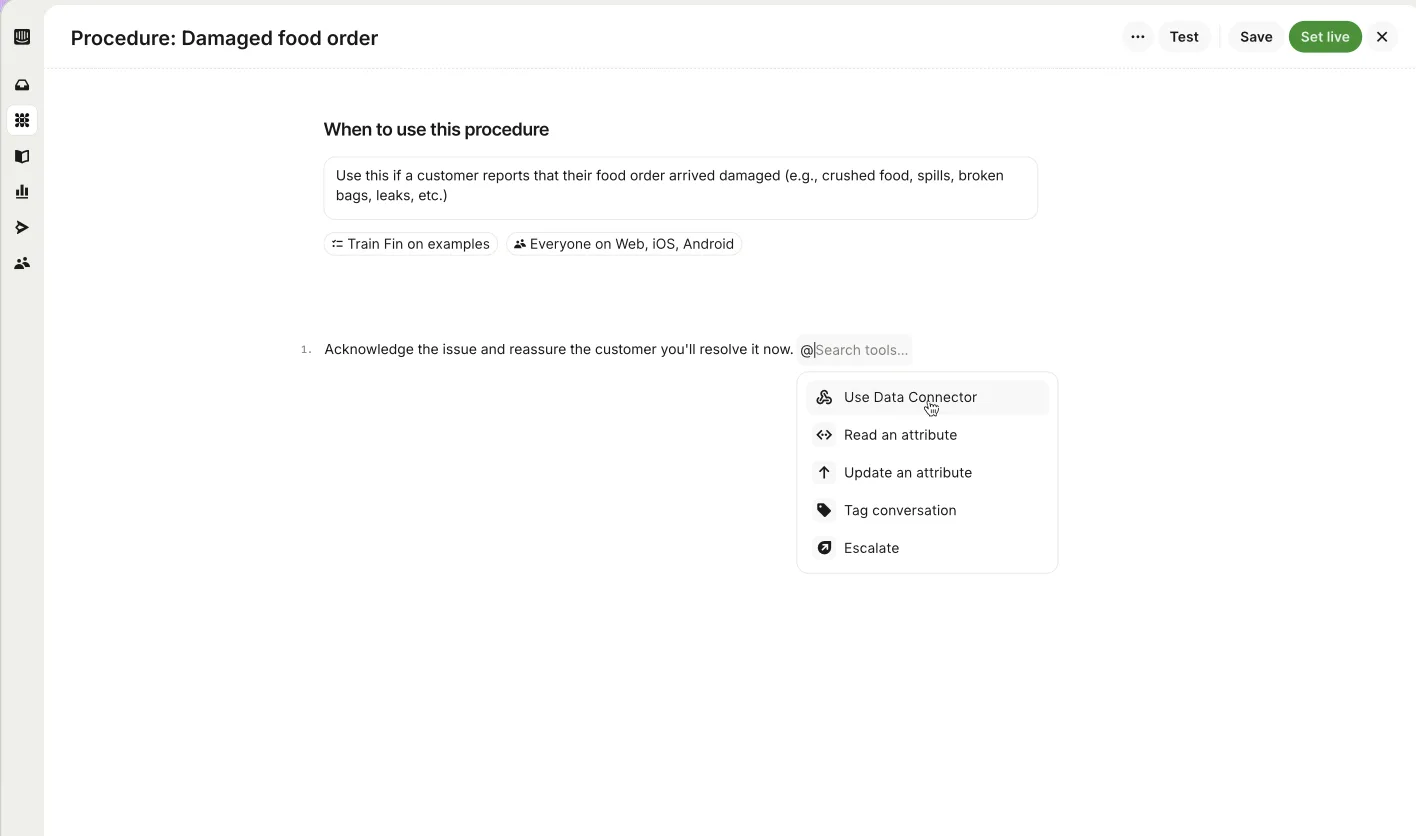
Fin's AI Agent resolves conversations across chat, email, voice, SMS, and social, running on a proprietary model called Apex.
Like Yuma, Fin operates as a true AI agent rather than a scripted tree, which is where the generative AI vs chatbots distinction becomes practical.
Pros:
- Fast setup and implementation period
- Cost-effective resolution-based pricing
- Strong for SaaS and product-led support
- Works standalone or inside Fin
Cons:
- G2 reviewers flag that Fin requires customers to use specific phrasing to get accurate responses, which could contribute to lower resolution rates with nuanced issues
- The pending Salesforce acquisition can introduce uncertainty about the company's overall stability.
Pricing:
Standalone with any helpdesk at $0.99 per outcome, 50-outcome monthly minimum, no seat fees. With Intercom at $19/seat/month plus $0.99 per outcome. Additional add-ons available.
Zendesk AI
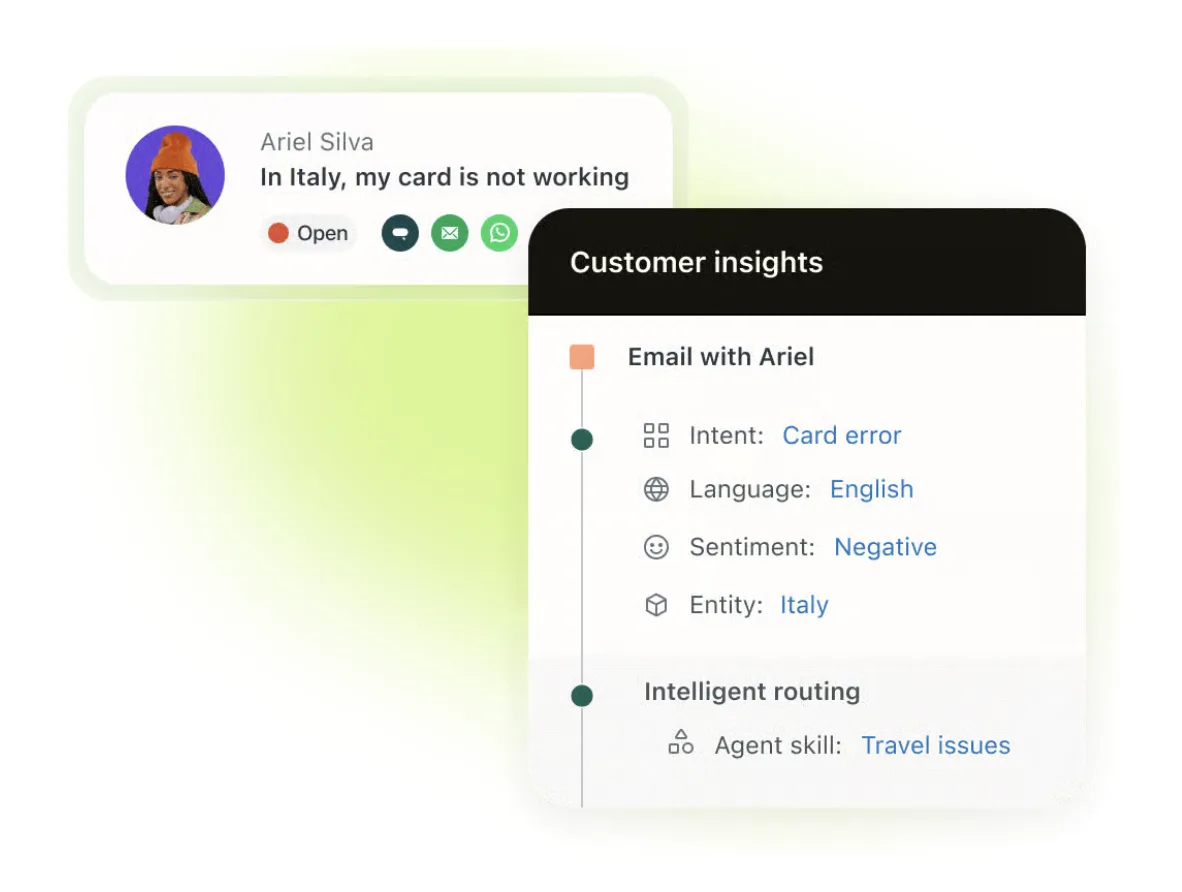
Zendesk is an enterprise customer service platform with AI features layered across its Suite plans. AI Agents handle autonomous resolution, intelligent triage auto-classifies and routes tickets, and an agent workspace gives reps full customer history.
Pros:
- Enterprise-grade with a large integration ecosystem
- Strong reporting and analytics
- Works across industries and scales to large teams
Cons:
- AI Agent features require higher-tier Suite plans, and Copilot is an extra add-on
- Ecommerce-specific workflows like Shopify order actions require third-party marketplace apps rather than native integrations
- Multiple customer reviews described a steep learning curve when it came to features like workflow setup and automation.
Pricing:
AI Agents included from Suite Team at $50/agent/month billed yearly. Copilot is a separate add-on.
How to choose a Sierra alternative
BCG's customer service agentic AI report found that only 28% of companies have unlocked measurable business value from generative AI in customer service, while 72% are struggling due to poor technology integration and lack of focused strategy.
That means that investing in AI isn't the hard part, but choosing the right customer service automation software that actually fits into your current process and tech stacks can be challenging:
Three questions help narrow the field:
What's your vertical?
Cross-industry platforms like Sierra, Ada, and Decagon require configuration for different verticals, including ecommerce. Purpose-built platforms like Yuma, Gorgias AI, and Siena come with order management, return processing, and subscription handling ready to deploy. If your ticket volume is driven by WISMO, returns, and sizing questions, a purpose-built tool saves weeks of configuration.
What's your budget?
Enterprise peers like Decagon and Ada have similar six-figure annual floors. Helpdesk-native options like Fin and Zendesk AI, and ecommerce-specific tools like Yuma start lower and tie cost more directly to output. If your annual CX budget is under $100,000, the enterprise tier of alternatives will likely exceed it.
How do you want to pay?
Outcome-based and per-resolution pricing both align cost with results, but the details about what you're actually paying for can differ. Ask each vendor exactly what counts as "resolved" and whether escalated tickets are billed. A platform that counts a conversation as resolved when the customer stops replying produces a different bill than one that counts it only when an action was completed and the ticket was closed.
The right Sierra AI alternative depends on your stack and scale
BCG and MIT Sloan Management Review found that 35% of companies are already using agentic AI, with another 44% planning near-term deployment. The adoption curve is steep, but few organizations have restructured their workflows to keep pace.
Choosing the right AI customer service software that fits your stack now, rather than requiring a six-month implementation before a single ticket is automated, is how teams close that gap. Here's the shortlist by buyer profile:
- Ecommerce brands on Shopify with Gorgias or Zendesk → Yuma
- Shopify brands wanting helpdesk and AI in one platform → Gorgias AI
- DTC brands where brand voice is the primary criterion → Siena
- Enterprise teams with engineering resources and $50K+ budget → Decagon
- SaaS and product-led companies → Fin
- Teams already standardized on Zendesk → Zendesk AI
- Cross-industry enterprise with high volume → Ada
Frequently asked questions about Sierra AI alternatives
How much does Sierra AI cost?
Sierra doesn't publish pricing. The platform uses outcome-based pricing where customers pay based on business results achieved by the AI agents. Third-party analyses place starting annual contracts around $150,000, with first-year budgets often in the $200,000 to $350,000 range depending on volume and scope. These figures are directional estimates, not vendor-confirmed.
What is the difference between Sierra and ecommerce-specific tools like Yuma?
Sierra is a cross-industry enterprise platform, while Yuma is built exclusively for ecommerce. The practical difference between Yuma vs Sierra is that Yuma arrives with 75+ Shopify actions, return processing, subscription management, and WISMO handling ready to deploy, while Sierra requires configuration to support those workflows.
Can Sierra handle Shopify order actions natively?
Sierra can connect to Shopify, but the integration is configured during implementation rather than arriving as a native, pre-built connection. Ecommerce-specific platforms like Yuma have deeper native Shopify integrations with pre-built actions for orders, refunds, cancellations, and subscriptions.
Is Sierra's outcome-based pricing the same as per-resolution pricing?
Outcome-based pricing isn't necessarily the same as per-resolution processing. They're close, but not identical. Per-resolution pricing charges a fixed rate for each conversation the AI closes, with a clear definition of what counts as resolved. Outcome-based pricing ties cost to broader business results, which can include resolution but may also factor in other metrics.
The key question for either model is how the vendor defines a billable event and whether escalated tickets are charged.


