Why this matters now
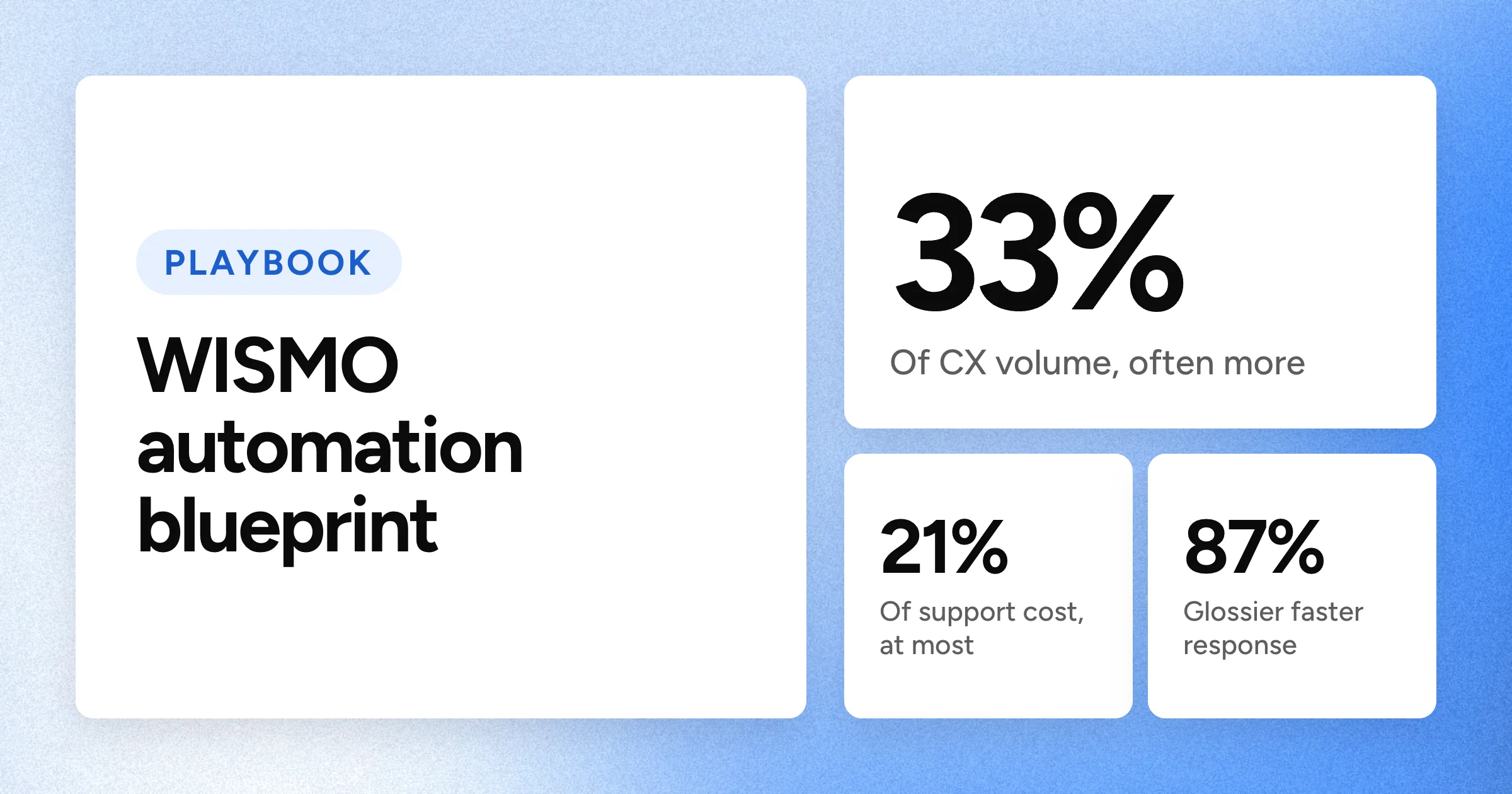
Most brands don’t struggle with WISMO because they lack tracking. They struggle because their WISMO logic doesn’t scale when ticket volume spikes. That’s where CSAT drops, refund leakage starts, and trust quietly erodes. WISMO tickets drive over 33% of volume and up to 21% of cost (data sourced from Yuma platform). This blueprint shows how leading brands structure WISMO so it behaves like a senior human CX agent, protecting brand trust while freeing human bandwidth for higher-value CX work. Here’s how to automate them without risk or diminishing brand trust. It draws on how leading brands run WISMO in production, including Yuma customer Glossier.
Why WISMO is the first domino
Most CX teams unknowingly face the invisible cost of “good enough” WISMO SOPs. In ecommerce, support feels messy, but volume is predictable. Three intents dominate: where is my order? (WISMO), post-delivery issues (damage, leakage, shade mismatches, missing items), and influencer and partnership requests.
Across leading brands, including Glossier, WISMO usually drive most of the volume and a large share of cost. In our benchmark data, it often accounts for over 33% of CX volume and up to 21% of support cost.
Most leaders treat WISMO as noise. In reality, it is a loyalty test. After checkout, customers sit in an information gap. Silence, conflicting ETAs and surprise split shipments turn a routine purchase into a worry. That worry becomes more tickets, lower CSAT and unnecessary refunds.
The upside: WISMO is structured and runs on a core set of signals, so it’s one of the safest workflows to automate.
What a well executed WISMO automation does
A well designed WISMO automation
- Replies instantly to routine “where is my order?” questions.
- Translates carrier jargon into clear, honest updates.
- Knows when to stop and hand off to a human.
- Prevents many tickets entirely through proactive notifications and a clear branded tracking page.
The goal is not to “deflect tickets at all costs”. It is to behave like a careful senior agent at scale: protecting trust while freeing time for higher-stakes work such as post-delivery issues and creator relationships. To see this approach in action, explore how leading brands automate WISMO updates end-to-end.
Step by step: a safe WISMO flow
This is the decision logic your AI or rules-engine should follow, step by step.
Think of WISMO as a short decision tree. Each step reduces risk before a message reaches the customer, and the pattern is tool agnostic and mirrors how leading brands run WISMO in production. For the full picture on building AI ecommerce support, our complete guide to gen AI customer service covers the broader strategy.
To apply it, you need access to order, payment and risk data, carrier tracking events and simple tags for refunded or PR shipments. If you’re not using AI yet, you can still use this as a manual playbook with macros and routing rules.
Step 0: Strip out lookalikes
Before touching tracking data, separate true WISMO from other intents like:
PR and creator packages: If the ticket is about a PR box, seeding or influencer shipment, send it to your creator/PR workflow. These can be managed separately.
Post-delivery issues: If the order arrived but something is missing, broken or wrong, treat it as a post-delivery ticket. That needs its own policies for evidence, replacements and refunds.
Now, only genuine “where is my order?” questions can enter the WISMO flow.
Step 1: Find the right order
A surprising amount of frustration starts with the wrong order on screen or no order found.
Search by email first
Customers often mistype order IDs or paste old ones, but their email address is usually stable.
Validate order IDs
If your IDs follow a clear pattern and the message does not match it, ignore the ID and rely on email and other context.
Handle multiple orders
When several recent orders match, default to the most recent unless the message clearly points to another one (product name, date, explicit ID).
If no order can be found after checking subject, body and identifiers, stop automation and hand off. Either you have one specific order loaded, or you hand the case to a human agent.
Step 2: Screen for risk and exceptions
Next, ask: “Is this an order that should follow the rest of the automation flow?”
- If the order carries fraud or payment risk tags from your risk tools, send it straight to a specialist or manager queue.
- If the order has been fully refunded, voided or canceled, move out of WISMO. The customer needs a simple explanation of what happened to their money, not a tracking update.
Principle: if finance or risk systems mark an order as sensitive, automation can’t overrule that judgment.
Step 3: Split domestic and international
The same “where is my order?” behaves differently across routes.
International shipments usually have longer “normal” transit windows, more hand-offs and more ambiguous exception codes. Domestic core markets, like US or UK shipping from local warehouses, are more predictable.
At minimum, build two branches:
- One for domestic orders and
- One for international or cross-border orders.
Most logic stays the same, but thresholds for “late” differ, such as days since shipment or days since last scan.
Step 4: Map tracking-states to human like answers
Once you know the order and route, translate those conditions into a small set of customer outcomes.
Not yet shipped: If the order is unfulfilled or still in the warehouse, say so plainly. Share typical handling time. If the order is canceled or refunded, stop treating it as WISMO and explain the cancellation instead.
In transit and on time: If the parcel was shipped recently and tracking has moved within a reasonable window for that route (for example, under seven business days since shipment and under five days since the last scan for domestic orders), treat it as normal. Restate the status in everyday language, offer a realistic delivery window and link to tracking.
Likely delayed or lost: If the parcel is beyond your transit window or tracking has been stagnant for several days (for example, beyond those shipment and movement thresholds), acknowledge the delay. Do not just repeat carrier wording. Explain what happens next: investigation, replacement, refund or a mix, aligned with your policy. Decide in advance when parcel is “late”.
Marked delivered but not received: If tracking says “delivered” but the customer has no parcel, start with simple checks (neighbors, reception, safe places). If still missing, outline the next steps, what information you need and typical timelines for claims. The tone should be investigative and collaborative, not defensive.
Returned, waiting at pickup, or unknown exceptions: If tracking shows “returned to sender”, explain common reasons and whether you will reship or refund. If a parcel is at a pickup point, share the address, what to bring and any deadline.
Step 5: Guardrails and learning
Two habits keep WISMO automation safe. Enforce the order of operations. Always: find the order, check risk, identify routes, classify state, then reply. Skipping steps is where most automation mistakes happen. Define clear hand-off rules. Do not automate when fraud or payment risk is present, when orders are canceled or refunded, when tracking status is conflicting or unknown, or when carrier messages say “requires intervention”, etc.
Keep a simple audit trail and review a small weekly sample gives CX leaders what they need to tune thresholds. Use fall-back logics and guardrails for AI.
When WISMO works like this, brands typically see two effects: fewer inbound tickets without a CSAT penalty, and more agent capacity for complex cases and workflows.
What success looks like
A good WISMO automation is not “less tickets” at any cost. It is fewer queries, better CSAT, and tighter refund control. Here’s what to measure, and how to translate it into ROI.
For example, Glossier’s primary requirement was to automate WISMO (where is my package?) tickets without missing critical details like customs delays or lost packages. With Yuma, Glossier cut its response time by 87% and saved 16 hours per ticket.
The 5 metrics that prove it works
1) WISMO query rate
How many WISMO tickets you get for every 100 orders shipped. This is the cleanest “did we prevent contacts?” metric and it normalizes for growth and seasonality.
2) WISMO containment rate
Percent of WISMO tickets fully resolved without a human reply. Track it by route and by tracking-state. A high overall rate can hide failure in one state (for example “delivered not received”).
3) First-response-time FRT (WISMO)
WISMO is anxiety. Speed matters most here. You want instant first replies for routine states, and fast human takeover for exceptional cases.
4) Refund and reship leakage
Two parts:
- Unnecessary refunds: refunds issued while the parcel is still on-time and moving.
- Duplicate resolutions: refund + reship, or multiple reships, triggered by unclear status.
5) WISMO CSAT and recontact rate
CSAT alone can lie. Pair it with recontact within 7 days on the same order. If customers come back, the update was not clear or did not set expectations.
What to expect if it’s working
- WISMO contact rate trends down over 4 to 8 weeks (after you tune thresholds and templates).
- Containment is high on “in transit and on time”, lower on the risky states by design.
- CSAT holds steady and improves over time.
- Refund/reship leakage becomes more consistent and policy-aligned instead of spiky during peaks.
What comes next?
WISMO automation is one piece of a larger shift. If you're thinking about where AI customer support is headed over the next decade, the trajectory is worth understanding before you build.
You either do everything yourself or you get a platform to do it. There’s a third way: you can get a free 30-day trial of Yuma's Support AI (no strings attached). Everything you’ve just read is taken directly from the logic used inside Yuma’s production WISMO flows for global brands.
If you're curious how this behaves in practice, under real ticket volume, edge cases and messy customer language, you can explore it hands-on.
We offer a 30-day free trial where you can:
- Test your existing WISMO logic against real scenarios
- See where risk or leakage appears
- Decide if this approach fits your brand
No lock-in, no pressure. Just visibility. When you're ready to evaluate the full offering, see Yuma's pricing to find the plan that fits your team. Yuma comes with a solid Account Management team that provides on-going white-glove support for each and every brand. For broader implementation guardrails beyond WISMO, see our guide on implementation mistakes that kill AI customer service.